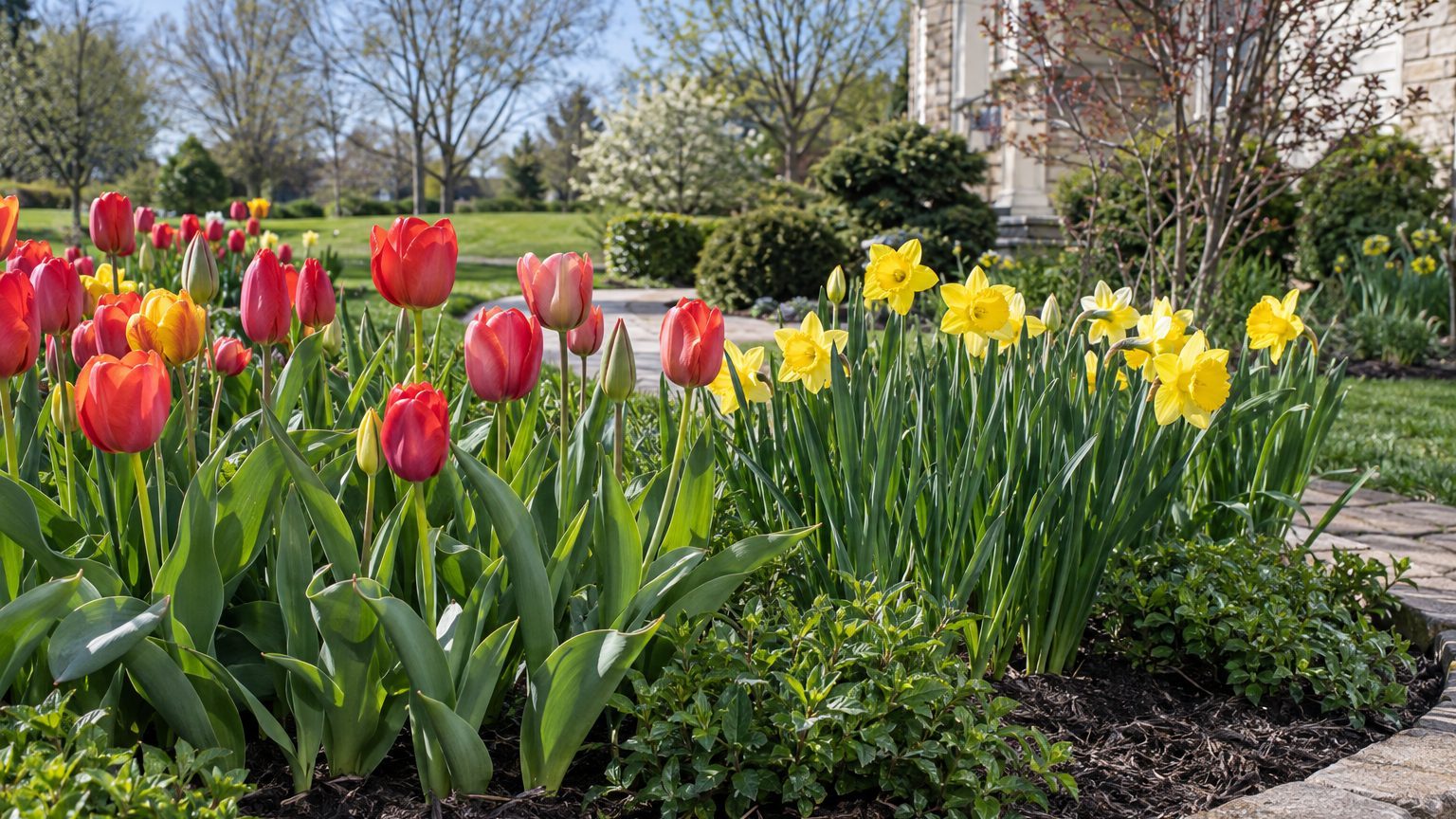
Daffodils nodding along a fence in spring, or tulips that put on one show and never return: both are decided by what goes into the ground the autumn before. Spring bulbs are planted in fall, wait out the winter and flower as the soil warms, but how well they do changes a great deal between Alaska and Florida.
The Spring Bulb Year by Season
A spring bulb spends most of its year out of sight, and each season asks one thing of you.
- In early fall, garden centers stock bulbs at their fullest selection, so buy then. A bulb still in the bag does better planted late than stored over the winter.
- Once the soil has cooled below about 60°F, plant. Roots have time to form before the ground freezes, and the bulbs stay too cool to sprout before winter.
- Through winter, the bulb rests underground and settles its roots. Most spring-flowering bulbs need about 12 to 16 weeks of cold to flower, so the cold is what sets the bloom.
- In early spring, shoots rise as the soil warms and the flowers open, running on the energy stored in the bulb.
- After the bloom, remove only the faded flowers and leave the leaves in place until they turn brown, because they are feeding the bulb for next year.
- In summer, the foliage is gone and the bulb sleeps again below ground, so mark the spot to keep a spade away from it.
The state selector right under this section takes you to the page for your own state.
From the almanac
Bulbs in your state
The dates on this page depend on where you live. Your state's page carries its frost dates, its USDA zones and the year laid out month by month.
Northeast
Southeast
- Alabama
- Arkansas
- Delaware
- Florida
- Georgia
- Kentucky
- Louisiana
- Maryland
- Mississippi
- North Carolina
- South Carolina
- Tennessee
- Virginia
- West Virginia
Midwest
Southwest
West
Pacific Northwest
Canada
Types of Spring Bulbs and How to Tell Them Apart
Tulips come in several families. Darwin hybrids and Emperor tulips are bred to return for several years, while the botanical (species) tulips are less showy than the big hybrids but very hardy and good for naturalizing.
Narcissus, the daffodils, have trumpet-shaped flowers in yellow or white, and they are the more reliable perennial bulb. Hybrid tulips are often short-lived.
| Bulb type | When it blooms | What it needs |
|---|---|---|
| Tulips | During the spring succession | Winter chill, and a refrigerator stint where winters are mild. Hybrids often fade after a few years |
| Daffodils | During the spring succession | Little fuss. They last longer than tulips and never have to be dug |
| Snowdrops and winter aconites | At the start of the season | Cold winters. Snowdrops are hardy |
| Alliums (ornamental onions) | At the end of the season | Winter chill, and planting a few weeks before a hard frost works |
Crocus, grape hyacinths, Siberian squill (scilla) and bluebells are small bulbs that suit the dappled ground under trees and shrubs, as in Illinois yards. Hyacinths, like tulips, are chilled in the refrigerator before planting where winters are too mild. Squirrels and voles go after crocus, which is worth knowing before you plant a lawn full of them.
Best Spring Bulbs by Region and Hardiness Zone
Winter cold, soil type and hungry wildlife shape what lasts from one region to the next.
- Upper Midwest and northern plains: In Wisconsin, daffodils tend to outlive tulips in the wet, heavy clay, and hybrid tulips may return only a few years. Minnesota and the Dakotas share the cold, and in South Dakota alliums can go in a few weeks before a hard frost.
- New England and New York: In New Hampshire, most species and hybrids are hardy to zone 3. Daffodils planted among tastier plants can train deer to stay away from them.
- Mid-Atlantic, Kentucky and Tennessee: In Maryland, daffodils, hyacinth, allium, fritillaria and scilla are the ones deer and squirrels pass over. Daffodils naturalize and never need digging.
- Deep South: In South Carolina, tulips are treated as annuals and discarded after bloom, while jonquil, tazetta and poeticus daffodils grow reliably. In Georgia, tulips usually decline after the first year.
- Texas: Mild winters mean tulips, crocus, some narcissus and Dutch hyacinth need six to 10 weeks of chilling before planting.
- Rocky Mountain states: In Wyoming, species tulips, snow iris and crocus cope with the dry conditions. Daffodils are a good pick because deer leave them alone.
- Pacific Northwest: In Washington, Darwin hybrids and Emperor tulips return for several years, but deer will eat tulips and avoid daffodils.
- Florida: Winters are too warm to give tulips the resting period they need, so they are not worth the effort there.
Alaska, the Desert Southwest and the Great Lakes follow the same logic, and your state page narrows it further.
Common Spring Bulb Problems and What Causes Them
Leaves but No Flowers

A bulb that was planted too late, or never got enough cold, comes up green and skips the bloom. In Texas, bulbs planted in January or February do not have time to grow a strong root system before spring. Plant in fall, and where winters are mild, chill tulips and hyacinths first.
Tulips That Do Not Return

Most hybrid tulips fade after the first year, especially where winters are mild. According to Texas A&M AgriLife Extension, the cause is too few chilling hours, more so the further south you go. Wet clay and water-hungry annuals planted right on top shorten the bulbs’ life. Replant fresh bulbs each fall, or choose daffodils.
Missing or Chewed Bulbs
Empty holes where bulbs went in, or flowers nipped off at the stem, point to voles, squirrels, rabbits or deer. Tulips and crocus are their favorites. Daffodils get left alone, and their sap contains needle-sharp crystals that burn the mouth.
Rotting Bulbs
Shoots that wilt soon after they emerge, in a spot where water stands in spring, suggest root rot. The advice is to pull such plants up and throw them away. Replant in full sun on ground that drains.
Spring Bulb Guides by State
Two pages cover the timing that depends on where you live, and the state selector under the first section leads to both.
- When to Plant Tulips and Daffodils in your state, for the planting window to aim for in fall.
- When Do Tulips and Daffodils Bloom in your state, for the months the flowers open, so you can plan the spring show.
Common Questions
Can You Plant Spring Bulbs Late?
Yes. A bulb still in the bag is better planted late than stored, and it can go in as long as the ground can be dug. In Tennessee, planting runs into early winter, and the bulbs still collect the chilling they need for bloom.
Which Bulbs Grow Under Trees?
In Illinois, grape hyacinths, crocus, winter aconites, snowdrops, Siberian squill, leucojums, bluebells and early maturing daffodils perform well under trees and shrubs. They flower before the canopy fills in and shades them.
Do Bulbs for Pots Need Chilling Too?
Hardy bulbs need a chilling spell to behave as if they went through a winter, and this goes for forcing them indoors. Tender bulbs skip that step and can be started at any time.
Every page in this guide
Care
Choosing
Diseases
- Spring Bulb Diseases: Gray Mold, Basal Rot and Blue Mold
- Blue Mold on Spring Bulbs: Signs, Treatment and Prevention
- Bulb Rot on Spring Bulbs: Signs, Treatment and Prevention
- Fusarium Basal Rot on Spring Bulbs: Signs, Treatment and Prevention
- Gray Mold on Spring Bulbs: Signs, Treatment and Prevention
- Leaf Spot on Spring Bulbs: Signs, Treatment and Prevention
- Root Rot on Spring Bulbs: Signs, Treatment and Prevention
- Tulip Breaking Virus on Spring Bulbs: Signs, Treatment and Prevention
- Tulip Fire on Spring Bulbs: Signs, Treatment and Prevention
- White Rot on Spring Bulbs: Signs, Treatment and Prevention
Growing
Guides
- Alliums: When to Plant, Bloom Time and Care
- Crocus: When to Plant, Bloom Time and Naturalizing
- Daffodils: When to Plant, Bloom Time and Care
- Deer- and Squirrel-Proof Bulbs, and How to Protect Them
- Hyacinths and Grape Hyacinths: Planting and Care
- Planting Spring Bulbs in Pots and Containers
- How to Naturalize Daffodils and Other Spring Bulbs
- How to Pre-Chill Tulip Bulbs for Mild Winters
- Tulips: Types, Planting Time, Bloom and Care
Pests
- Spring Bulb Pests: Voles, Squirrels, Deer and Bulb Mites
- Aphids on Spring Bulbs: How to Spot Them and Get Rid of Them
- Bulb Mites on Spring Bulbs: How to Spot Them and Get Rid of Them
- Chipmunks on Spring Bulbs: How to Spot Them and Get Rid of Them
- Deer on Spring Bulbs: How to Spot Them and Get Rid of Them
- Gophers on Spring Bulbs: How to Spot Them and Get Rid of Them
- Narcissus Bulb Flies: How to Spot Them and Get Rid of Them
- Bulb and Stem Nematodes: How to Spot Them and Get Rid of Them
- Rabbits on Spring Bulbs: How to Spot Them and Get Rid of Them
- Squirrels on Spring Bulbs: How to Spot Them and Get Rid of Them
- Thrips on Spring Bulbs: How to Spot Them and Get Rid of Them
- Voles on Spring Bulbs: How to Spot Them and Get Rid of Them
Problems
- Why Tulips and Daffodils Do Not Bloom, and How to Fix It
- Bulbs Coming Up Too Early: Causes and How to Fix It
- Daffodils Not Blooming: Causes and How to Fix It
- Floppy Tulip Stems: Causes and How to Fix It
- Bulbs Rotting in the Ground: Causes and How to Fix It
- Bulbs Sprouting in Fall: Causes and How to Fix It
- Tulips Not Blooming: Causes and How to Fix It
- Tulips Not Coming Back: Causes and How to Fix It
Varieties
- Types of Spring Bulbs Compared: Tulips, Daffodils and More
- Drumstick Allium: Bloom Time, Height, Zones and Care
- Grape Hyacinth: Bloom Time, Height, Zones and Care
- Lady Jane Tulip: Bloom Time, Height, Zones and Care
- Paperwhite Narcissus: Bloom Time, Height, Zones and Care
- Pheasant's Eye Daffodil: Bloom Time, Height, Zones and Care
- Siberian Squill: Bloom Time, Height, Zones and Care
- Snow Crocus: Bloom Time, Height, Zones and Care
- Snowdrop: Bloom Time, Height, Zones and Care
- Star of Persia Allium: Bloom Time, Height, Zones and Care
- Tete-a-Tete Daffodil: Bloom Time, Height, Zones and Care
- Triumph Tulip: Bloom Time, Height, Zones and Care