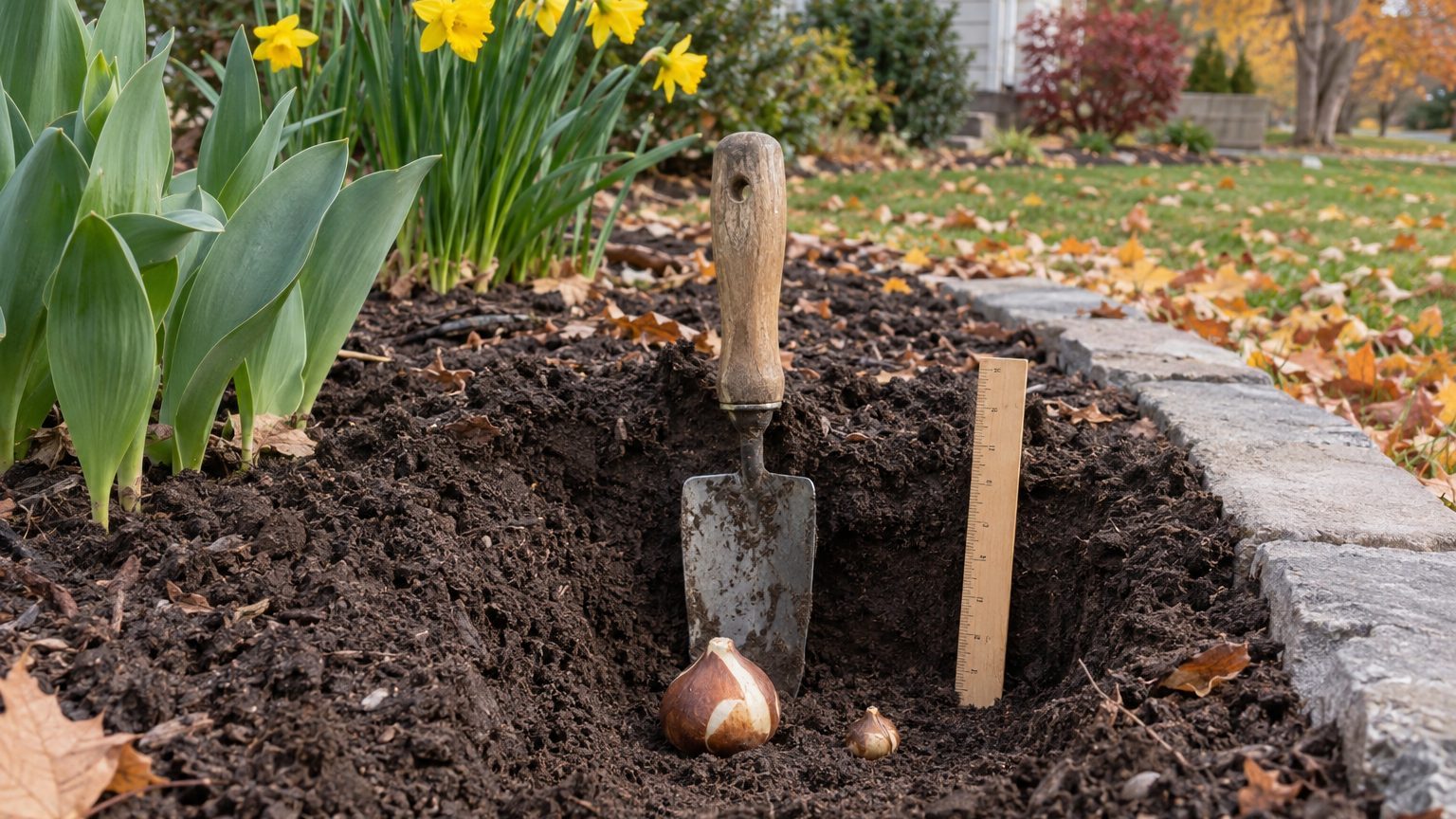
Spring bulbs go into the ground when fall soil has cooled, and the hole you dig matters as much as the bulb you drop in it. At the right depth, a tulip or daffodil bulb stays beneath the reach of freeze-and-thaw swings and still pushes a stem up through the soil in spring. Tulips and daffodils each have a right planting depth and spacing, and getting both right sets up a strong spring display in the yard.
How Deep Should You Plant Spring Bulbs?
Across the country, a bulb goes in about three times deeper than it is tall, and big bulbs therefore sit deeper than small ones. Tulips, daffodils and hyacinths are the big group. Crocus, snowdrops and grape hyacinths are the small group.
Where you garden nudges the exact number a little, since extension services in different states round the rule in slightly different ways. Soil and winter cold are the reasons local advice differs from place to place.
Planting months depend on where your yard is, so look up your own state’s timing before you plant.
From the almanac
Bulbs in your state
The dates on this page depend on where you live. Your state's page carries its frost dates, its USDA zones and the year laid out month by month.
Northeast
Southeast
- Alabama
- Arkansas
- Delaware
- Florida
- Georgia
- Kentucky
- Louisiana
- Maryland
- Mississippi
- North Carolina
- South Carolina
- Tennessee
- Virginia
- West Virginia
Midwest
Southwest
West
Pacific Northwest
Canada
How to Space and Plant Bulbs

The depth rule comes down to a tape measure and a trowel, and the order of the work is simple.
- Measure the bulb from base to tip, so that the hole is dug to match its height instead of a guess. In Vermont, a bulb 2 inches tall gets a hole 6 inches deep.
- Dig the hole to that depth and loosen the soil at the bottom, so that new roots can push down easily.
- Set the bulb pointed side up on the bottom of the hole, so that the shoot has the shortest road to daylight.
- Give each bulb room to spread. Large bulbs such as tulips and daffodils do well 6 inches apart in Iowa, and that gap keeps neighbors from competing for water and food.
- Fill the hole with soil and tamp it lightly, so that no air pocket is left under or around the bulb.
- Water the planting, so that the soil settles snugly around the bulb and roots begin to grow before the ground freezes.
Small bulbs can be tucked in more closely. In South Carolina, they are set 1 to 2 inches apart, which gives a thick, natural-looking drift. If you want bulbs to multiply into clumps over the years, more space helps, and in Illinois a spread of 6 to 12 inches is suggested for future divisions.
Planting Depth by Bulb Type
Size sorts bulbs into depth groups far better than their names do. A daffodil bulb and a tulip bulb are close enough in size that they land in the same range, while crocus bulbs are small enough to sit much higher.
Spacing also shifts from one type to the next, so give each kind of bulb the room that suits it rather than using one spacing for all.
| Bulb Type | What changes | Why it matters |
|---|---|---|
| Tulips | About 6 inches deep in Kansas, and 6 inches apart in Alabama | The bulb sits low enough to stay anchored and protected through winter |
| Hyacinths | About 6 inches deep in Kansas, and 4 inches apart in Alabama | A tighter gap suits the smaller bulb and gives a fuller cluster |
| Daffodils | 6 to 8 inches deep in Iowa, and 12 inches apart in Alabama for standard types | Wider spacing leaves room for the clump to bulk up |
| Crocus and grape hyacinths | 3 to 4 inches deep in Iowa | A small bulb needs a shallower hole to reach the surface |
| Snowdrops | 3 to 4 inches deep in Illinois, and 12 inches apart in Alabama | Shallow planting with generous room lets them spread |
For the reader, the takeaway is to sort your bulbs by size before opening the trowel and dig one depth for each pile. In Kentucky, bulbs of about 1 inch are planted in holes 5 inches deep, and bulbs 2 inches or more go into holes 8 inches deep. In Nebraska, corms are planted in odd-numbered groups of 5 to 7, set 4 to 5 inches deep.
Bulb Depth Mistakes to Avoid
One Depth for Every Bulb

Digging a single row of holes and filling it with everything from daffodils to crocus is quick, but small bulbs end up too deep and big bulbs too shallow. Sort first, then dig each group to its own depth.
Crowding the Bulbs

Bulbs packed shoulder to shoulder fight over water and nutrients, and the clump has no room to divide. In Alabama, giant alliums, standard daffodils and snowdrops are given 12 inches. Mark the spacing with the trowel handle before you plant.
Planting Them Sideways
A bulb dropped in on its side or upside down has to turn its shoot toward the light, which wastes stored energy and can leave the stem weak or twisted. Check the tip every time, and place the pointed end up.
How Deep to Plant Bulbs in Your State
The sign to act on is soil that has cooled in fall but can still be dug. When a spade goes in without a struggle and the ground is not frozen, the hole can be dug.
- Planting months vary by area, so find out the right window for your yard before you buy or dig.
- Go back to it any time the weather turns and you are unsure whether the ground is ready.
Common Questions
Do You Measure Depth from the Top or the Bottom of the Bulb?
The hole is measured from the soil surface down to the floor of the hole, which is where the base of the bulb rests. Soil then covers the tip by the remaining depth.
What Should You Do with the Leaves After the Flowers Fade?
Leave them in place until they turn yellow, because the green leaves feed the bulb for next year. Never cut or tie them while they are still green.
What If Bulbs Are Still Unplanted When Fall Is Nearly Over?
Plant them as soon as the ground can be dug. A bulb left sitting in a bag gains nothing, while one in the soil can start rooting.