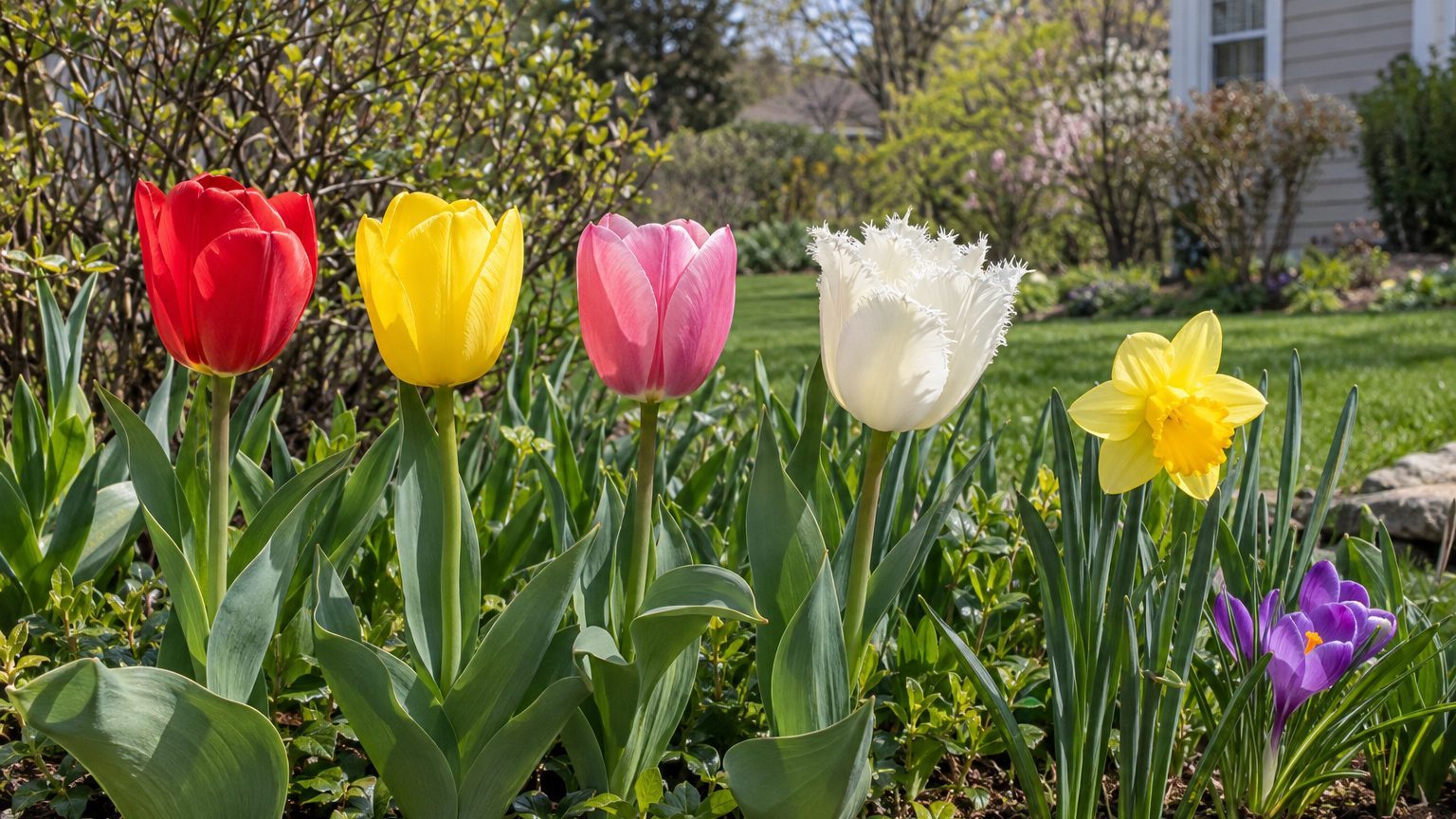
Green spears pushing through cold soil in spring are the payoff for work done months earlier, when the bulbs went into the ground in fall. Tulips, daffodils, crocus and grape hyacinths all work this way, yet they differ in height, flowering time and how much winter cold they need. Knowing those differences helps you choose bulbs that suit your bed and your climate.
What Are the Main Types of Spring Bulbs?
Across the country, spring bulbs fall into broad families: tulips, daffodils, and the small bulbs such as crocus, snowdrops, grape hyacinths and Siberian squill. All are planted in fall and flower after a winter chill. Climate and bulb type decide which ones thrive where you live.
Tulips and daffodils are sorted into numbered divisions. Tulips are grouped into 15 divisions by bloom time and parentage, which is why one catalog can offer such different flowers. Daffodils are grouped into 12 divisions in the current system.
Cold-winter yards suit nearly every type, while mild-winter yards narrow the choices. The state selector under this section leads to the page for your state.
From the almanac
Bulbs in your state
The dates on this page depend on where you live. Your state's page carries its frost dates, its USDA zones and the year laid out month by month.
Northeast
Southeast
- Alabama
- Arkansas
- Delaware
- Florida
- Georgia
- Kentucky
- Louisiana
- Maryland
- Mississippi
- North Carolina
- South Carolina
- Tennessee
- Virginia
- West Virginia
Midwest
Southwest
West
Pacific Northwest
Canada
How to Tell Bulb Types Apart

Four traits separate one bulb type from another: when it flowers, how tall it stands, how much chill it needs and whether it comes back after the first year.
- Sort bulbs by flowering window, so that color is spread across the season: in Illinois, spring bulbs bloom from early February to mid June.
- Check the stem height on the label, so that tall flowers go behind short ones: in New York, tulip blooms are borne on stems that reach up to 30 inches.
- Place low growers at the front of the bed, so that they are not hidden: in Iowa, Greigii tulips stand 8 to 12 inches tall and carry purple-striped or mottled foliage.
- Read the chill requirement before buying, so that the bulb gets enough cold to set flowers: in North Carolina, many bulbs need a 12 to 16 week chill period.
- Match the hardiness rating to your winters, so that the bulb survives them: in South Dakota, tulips should be winter hardy to Zone four or five.
- Leave the leaves in place after the flowers fade until they turn yellow, so that they keep feeding the bulb for next year.
Hardiness ratings also protect you in warm regions. In North Carolina, bulbs that overwinter carry a rating of 8 or less, and the smaller the number, the more cold hardy the plant.
Bulb Types Compared by Bulb Type
Within the tulip family alone, more than 4,000 varieties exist. Height, foliage and timing vary widely from one to the next, so a label matters more than a flower photo.
Forced bulbs and summer bloomers behave differently again, as the comparison shows.
| Bulb Type | What changes | Why it matters |
|---|---|---|
| Single early tulips | Strong stems, in various colors | Sturdy stems hold flowers upright in the middle of a bed |
| Greigii tulips | Height of 8 to 12 inches, with purple-striped or mottled leaves (Iowa) | Compact plants suit the front of a border, and the leaves add pattern |
| Paperwhites | Bloom in 3 to 5 weeks when forced (Wisconsin) | A fast route to indoor flowers |
| Amaryllis | Bloom in 6 to 8 weeks when forced (Wisconsin) | Needs a longer wait than paperwhites |
| Lilies | Bloom times range from May to September (Georgia) | Color continues well past the spring bulb season |
Daffodils have their own set of divisions, and the same habit of checking height and bloom time applies. In practice, a bed planted with several heights and timings looks fuller for longer than one filled with a single color.
Bulb Selection Mistakes to Avoid
Tulips in a Warm-Winter Yard

Tulip bulbs need consistently cold winters, and Florida winters don’t provide them. Spring there also warms too quickly, so tulip foliage dies back early. Gardeners in mild-winter places do better with bulbs that don’t depend on a long chill.
Bulbs Under Trees

Not every bulb copes with the root-filled soil under a tree. In Illinois, grape hyacinths, crocus, winter aconites, snowdrops, Siberian squill, leucojums, bluebells and early maturing daffodils perform well under trees and shrubs. Choose from those instead of squeezing in big tulips.
Bulbs Left Unplanted
A bag forgotten in the garage costs the bulbs their time to root before the ground freezes. Any bulb still unplanted goes in as soon as the soil can be dug, even if the season feels late.
Best Bulb Types for Your State
The sign to act on is cooling soil in fall, while the ground can still be dug. Chill need and hardiness decide which types fit your yard, and the planting months for each state are on that state’s page.
- Your state’s spring bulbs page gives the planting months for that state.
- Open it when bulbs first appear at the garden center, so you know whether to plant right away or wait.
Common Questions
Do Spring Bulbs Bloom at the Same Time Everywhere?
No. Bloom timing shifts with climate, and in New Hampshire, many spring species bloom anywhere from March through May. Warmer places generally flower earlier than colder ones.
Which Way Up Do Bulbs Go in the Hole?
Pointed end up, with the flat or rough root end down. A bulb planted sideways usually still finds its way, but the shoot spends energy turning toward the light.
Which Bulbs Suit a Florida Yard?
In Florida, caladiums grown from tubers produce colorful foliage all summer, and crinum lilies grown from bulbs flower from spring through summer in shades from white to deep rose. Lycoris appears in late summer and fall with red flowers rising from small bulbs.