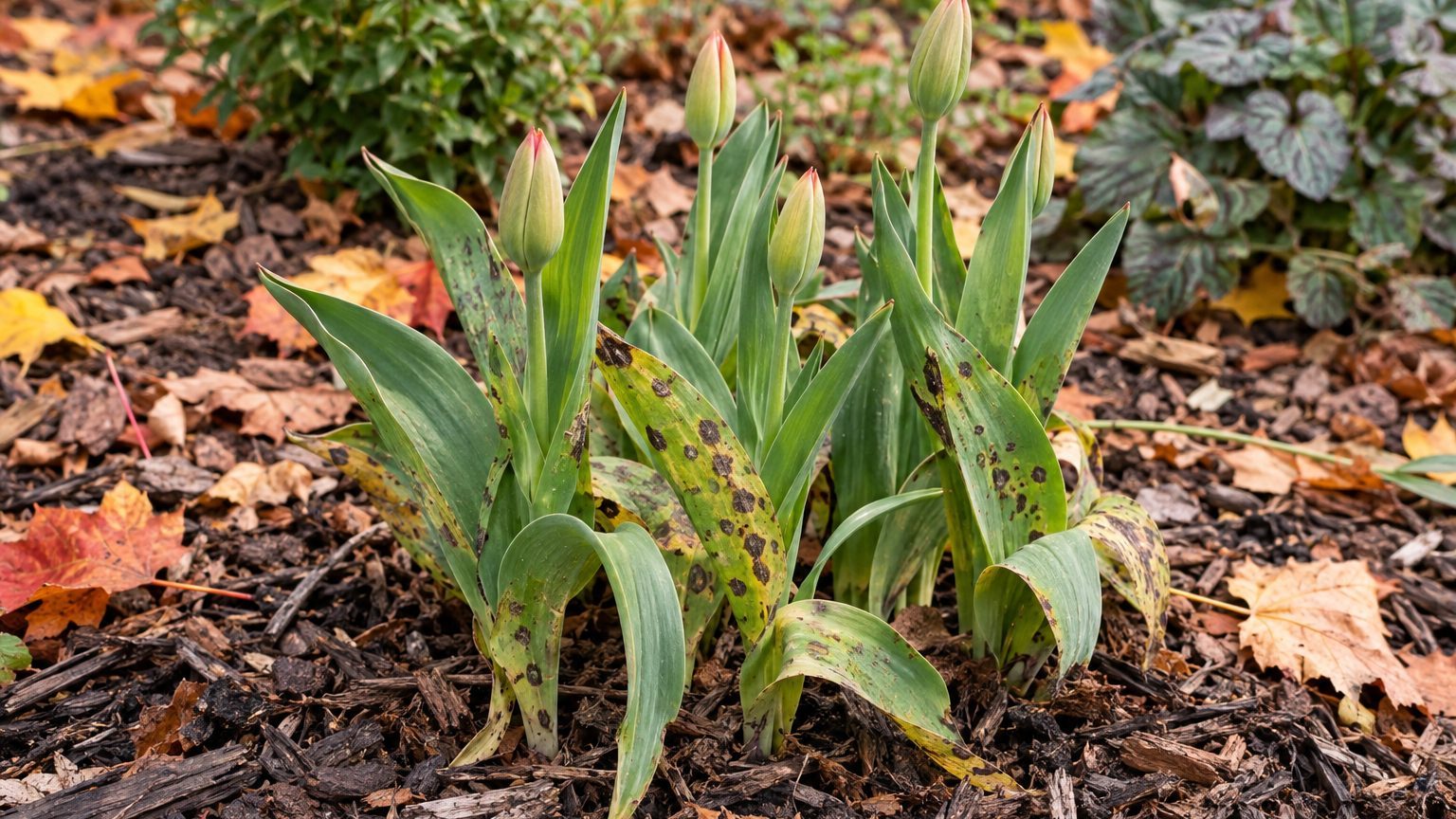
Tulip leaves that sprawl across the bed in spring, broad and lax, with no flower rising from the middle, are a common sight. It is the mark of a bulb running low on stored food. The cause is usually in how the bulb was treated after last year’s bloom, and it can be corrected.
Floppy Tulip Stems: What You See
A weak tulip clump looks different from a healthy one well before any flower should appear.
- Large, floppy leaves come up from the bulb, but no flower bud forms in the center of the plant.
- The leaves look oversized and soft, and they lean outward or lie on the soil instead of standing upright.
- The color is usually a normal green, so the plant looks healthy at a glance even though it is not flowering.
- The problem shows in the spring growing season, when neighboring tulips are sending up buds.
- Clumps that bloomed well in earlier years may now send up only leaves, often in the same spot year after year.
Look at the whole bed rather than one plant, because weak bulbs tend to cluster where conditions are the same.
From the almanac
Bulbs in your state
The dates on this page depend on where you live. Your state's page carries its frost dates, its USDA zones and the year laid out month by month.
Northeast
Southeast
- Alabama
- Arkansas
- Delaware
- Florida
- Georgia
- Kentucky
- Louisiana
- Maryland
- Mississippi
- North Carolina
- South Carolina
- Tennessee
- Virginia
- West Virginia
Midwest
Southwest
West
Pacific Northwest
Canada
Floppy Tulip Stems or Something Else?
Not every drooping tulip is a weak bulb. Timing and the condition of the leaves usually separate a real problem from normal plant behavior.
Leaves that flop after the flowers are finished, and a stalk that carries a swollen pod, are both common sights in the yard.
| Looks like | How to tell them apart |
|---|---|
| Natural dieback after bloom | Leaves turn yellow and fall over after the flowers have faded, and the plant had flowered earlier that same season. |
| Spent flowers left on the stalk | A swollen seed pod sits at the top of a stalk that leans, and the leaves are still green around its base. |
A stem bent by heavy rain or wind is another look-alike. It carries a flower or bud, which a weak bulb never produces.
What Causes Floppy Tulip Stems, and Where It Is Worst
A weak bulb is the cause. The leaves are the bulb’s kitchen, and whatever interrupts that food-making leaves the bulb too small to flower. Seed pod formation takes much of the food the foliage manufactures, and cutting the leaves too soon cuts off the supply.
Site matters as much as care. In Iowa, tulips do best in a spot with at least 6 hours of direct sun per day and well-drained soil. A shady corner or a spot where water lingers weakens bulbs year after year.
Beds under maturing trees, low spots that stay wet after rain, and borders beside a lawn that gets mowed over tulip leaves tend to show it first.
How to Treat Floppy Tulip Stems
You cannot make a weak bulb flower this season, but you can help it rebuild. Work in this order.
- Snip off spent flowers promptly after the petals drop, so that the plant does not spend its food on seed pods.
- Leave the leaves in place until they turn yellow and die back naturally, so that they keep feeding the bulb.
- Check the bed for sun and drainage while the leaves are still up, so that you know whether the site is the problem.
- Dig the clumps once the foliage has died back if the site is too shady or too wet, so that you can move them without cutting into green leaves.
- Replant the bulbs in the fall in a sunny, well-drained bed, in the ground as soon as it can be dug, so that the roots can settle before winter cold arrives.
Whether a fertilizer helps, and which products are approved where you live, is a question for your state’s extension service or a local master gardener group.
How to Prevent Floppy Tulip Stems Coming Back
A little planning around the seasons keeps bulbs well fed and keeps leaf-only clumps from showing up again.
- In early spring, note which clumps send up only leaves, so you know which ones to move later.
- As the flowers fade in mid to late spring, remove them before pods form on the stalks.
- While the leaves are still green, keep mowers, edgers and string trimmers well away from them.
- Once the foliage has yellowed and pulled away easily, tidy it up and dig any clumps that sat in shade or soggy soil.
- In fall, plant the moved bulbs and any new ones in a sunny bed that drains well, since they need winter cold to flower.
A bed set up this way usually keeps its bulbs in bloom longer than one left to chance.
Where This Comes From
The care steps here reflect university extension guidance, including advice written for Iowa. Check your own state’s extension service for timing and local conditions where you garden.
Common Questions
Will Floppy Tulips with No Flowers Bloom Again?
They can, if the bulb gets enough sun and its leaves are left to work. Recovery is not guaranteed, and a bulb that stays leaf-only after a season of better care may be worth replacing.
Should You Tie Up Floppy Tulip Leaves to Tidy the Bed?
No. Tying or bending the leaves cuts down the light they catch. If the sprawl bothers you, plant something low and leafy nearby to cover it as the foliage fades.
Do Tulip Bulbs Need Cold to Flower?
Yes. Tulips planted in fall need winter cold to set flowers, and a bulb that gets cold but little food will still produce leaves without a bloom.