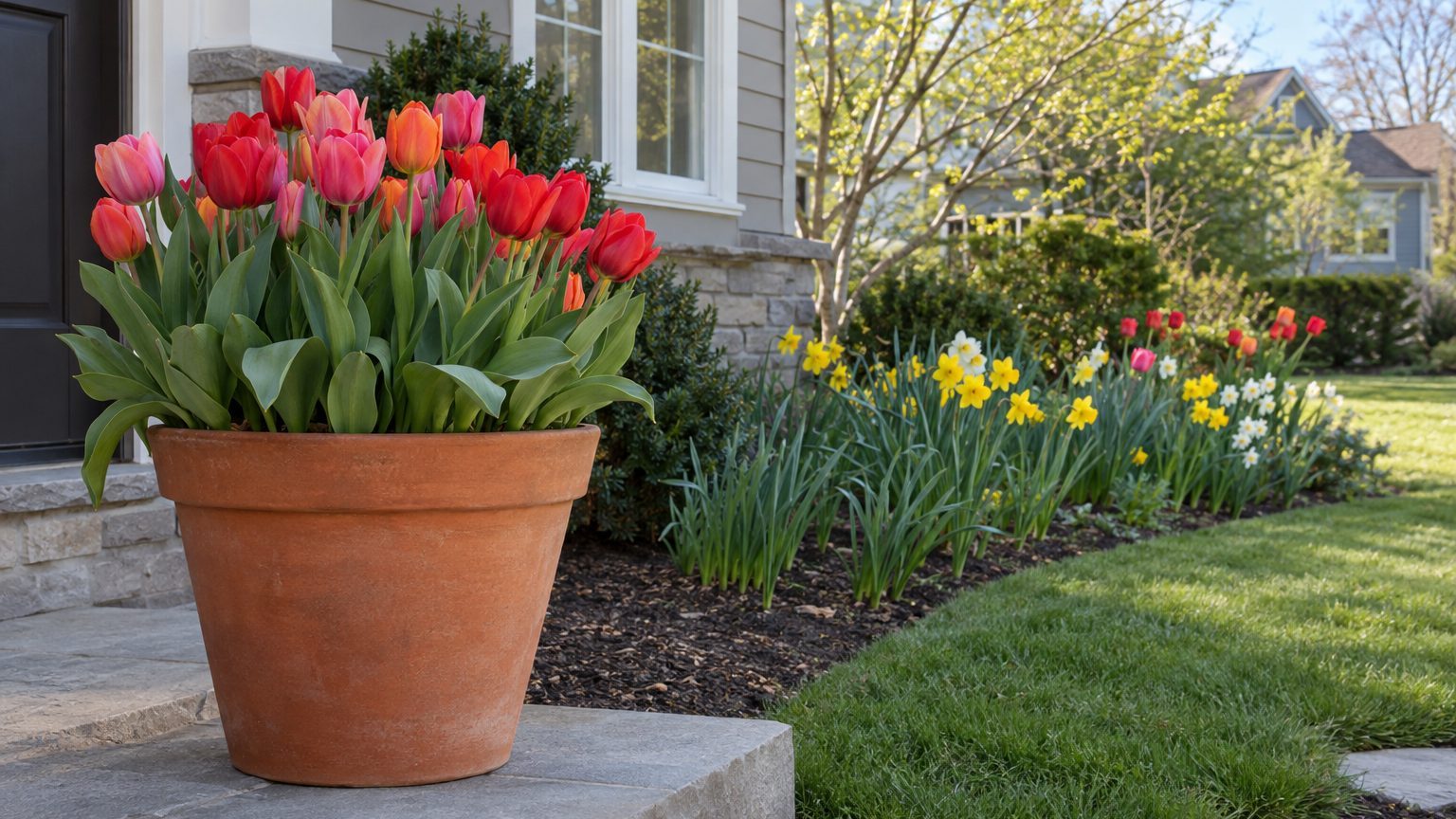
Bare pots by the front steps look empty in fall, and that is exactly when they can be turned into a spring display. A bulb in a container does the same work as one in a bed. The difference is that the pot sits above the ground, so its soil chills faster and dries out sooner. Planting bulbs in pots comes down to depth, a good mix and a stretch of winter cold.
Can You Plant Spring Bulbs in Pots?
Yes, spring bulbs grow well in pots. The general rule is to plant them in fall and give them a long, cool, moist rest before they flower. What changes the plan is the type of bulb, because sizes and spacing differ, and the climate, because it decides where the pot gets its cold.
Roots form first in the cool, and shoots come later. A pot has no ground around it for insulation, so in a hard-winter region the soil in a container gets colder than garden soil. In a mild region, such as the Gulf Coast, the pot may need help finding enough cold.
The state selector just below this section leads to the page for your state.
From the almanac
Bulbs in your state
The dates on this page depend on where you live. Your state's page carries its frost dates, its USDA zones and the year laid out month by month.
Northeast
Southeast
- Alabama
- Arkansas
- Delaware
- Florida
- Georgia
- Kentucky
- Louisiana
- Maryland
- Mississippi
- North Carolina
- South Carolina
- Tennessee
- Virginia
- West Virginia
Midwest
Southwest
West
Pacific Northwest
Canada
How to Plant Bulbs in a Container

Order matters in a pot, because roots, cold and light each take their turn.
- Choose a pot with drainage holes, so that rain and melting snow run out instead of sitting around the bulbs and rotting them.
- Spread a layer of loose potting mix first, so that, as in Pennsylvania, at least 2 inches separate the bulbs from the bottom of the pot and the roots can run downward.
- Set the bulbs pointed end up and close together without touching, so that the pot looks full in spring, with the tops about even with the top of the pot as is done in Pennsylvania.
- Fill in around the bulbs and water well, leaving the mix ½ to 1 inch below the rim, as in Iowa, so that water soaks in rather than spilling over the edge.
- Move the pots to a cold, dark place such as an unheated garage or a cold frame and keep the mix moist, so that the roots grow while the shoots wait.
- Bring the pots into a cool, bright room once roots have filled the pot and shoots show, so that the new growth bends toward the light and not toward a dark corner.
In New Jersey, pots are held at 35°F to 48°F for a minimum of 12 to 13 weeks. After the blooms fade, leave the leaves in place until they turn yellow, since they refill the bulb for next year.
Container Bulbs by Bulb Type
Size sets how many bulbs a pot can take, and the type also changes how long the cold rest runs. In Oregon, a 14- to 20-inch wide pot can easily hold 20 to 30 bulbs or more.
The counts below are for a small pot, and a larger pot simply takes proportionally more.
| Bulb Type | What changes | Why it matters |
|---|---|---|
| Crocus | Many can be packed into a single pot. | Small bulbs pack in tightly for a full look |
| Daffodil | Fewer fit per pot than crocus. | Larger bulbs need more room each |
| Hyacinth | Only a few fit per pot. | Big bulbs mean fewer to the pot |
| Tulip | Several fit in a single pot. | Crowding is fine, but touching bulbs can rot |
Cold needs vary too. In Pennsylvania, daffodils in pots are kept moist and cool, ideally 40-45° F, for 12 to 16 weeks. In Missouri, hyacinth pots go where the temperature stays constantly near 40 degrees F. Count the bulbs before you shop, and plan the cold spot before you plant.
Container Bulb Mistakes to Avoid
Cutting the Chill Short
A pot pulled out of the cold too soon holds bulbs that are not ready to grow. In Nebraska, some bulbs need 15 to 18 weeks rather than the usual minimum.
Before moving a pot, tip it gently or look at the drainage hole. Wait until roots are well developed and short shoots are showing.
Letting the Pot Freeze

A bulb that freezes solid is damaged, and a small pot with little soil around it freezes faster than a bed does. In Georgia, bulbs in cold storage must not be allowed to freeze. In Oregon, pots move indoors when temperatures drop below 28 to 30 degrees.
On the coldest nights, slide the pots into an unheated garage or against a house wall, then set them back out when the weather eases.
Letting the Mix Dry Out

Pots tucked under an eave or in a garage never catch rain, so the mix can dry out while you are not looking. In Georgia, the soil in the pots must not be allowed to dry. Dry roots stop growing, and the bulb loses the head start the cold was meant to give it.
Poke a finger into the mix regularly. Water when the top feels dry, and let the excess drain out.
Bulbs in Pots in Your State
The sign to start is cooling weather in fall, when nights turn crisp and bulbs fill the garden center shelves. The calendar for each state is on the page for that state, so the months you need are a short step away.
- The state page gives the planting months that suit your climate, so go there before buying bulbs.
- Check it again when the pots come out of cold storage, to see when shoots and roots should be ready.
Common Questions
Can You Chill Potted Bulbs in a Refrigerator?
Yes, where space allows. In Georgia, pots can sit in darkness at about 40 °F in a cold frame, an unheated garage, a basement or a refrigerator, as long as the bulbs do not freeze. In Washington, bulbs that are not in pots are refrigerated at 45-50 degrees in aerated bins for at least 6 weeks.
How Do You Know When Potted Bulbs Can Leave the Cold?
Look for roots and shoots, not just the calendar. In Georgia, after 8 to 12 weeks the roots should be well developed and shoots emerging. In Nebraska, bulbs should be well rooted with short shoots after 12 to 15 weeks.
How Warm Should the Room Be Once Shoots Appear?
Start cool. In Iowa, rooms around 60 to 65°F suit potted bulbs. In Utah, a room at about 68 F with direct sunlight gives good results after the pot has had time in indirect light.