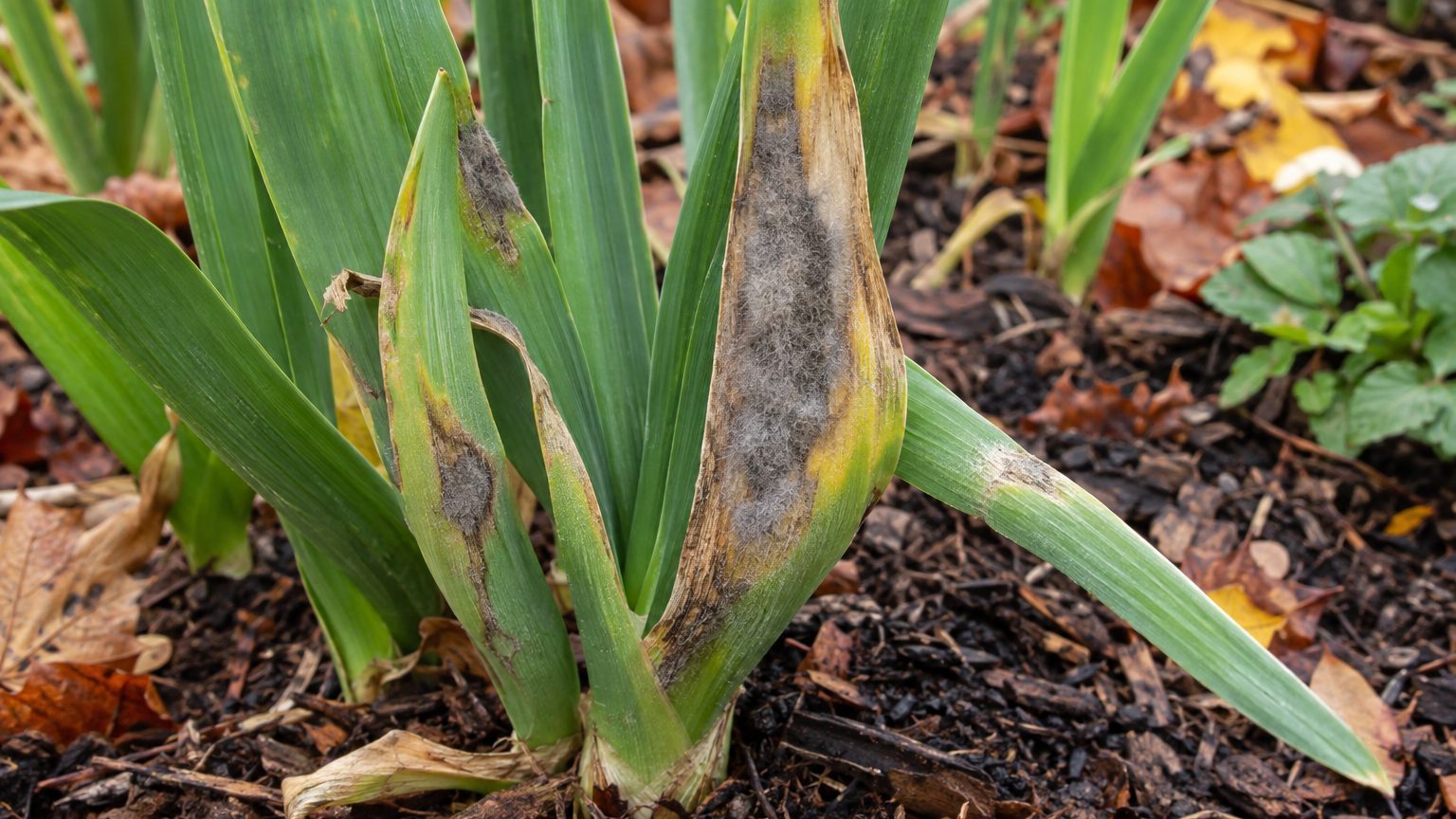
Fusarium basal rot is a fungal disease that rots a bulb from its base. You can recognize it by checking the leaves and the base of a lifted bulb, then reduce the risk through careful soil management.
Fusarium Basal Rot: What You See
Above ground the clues are subtle, and the real evidence turns up when you lift a bulb and look at its base.
- Red or brown discoloration starts at the basal plate, the flat base of the bulb where the roots attach, and a bulb cut vertically shows that brown color inside the base.
- White mold grows on the roots and on the bottom of the bulb.
- Leaves turn yellow and then die back, often ahead of the normal fading.
- In later stages the basal plate becomes pitted and dry-rotted.
- Bulbs can keep rotting in storage.
Daffodil is among the garden plants this fungus is known to attack, so a clump that fades early deserves a closer look at the base of its bulbs.
From the almanac
Bulbs in your state
The dates on this page depend on where you live. Your state's page carries its frost dates, its USDA zones and the year laid out month by month.
Northeast
Southeast
- Alabama
- Arkansas
- Delaware
- Florida
- Georgia
- Kentucky
- Louisiana
- Maryland
- Mississippi
- North Carolina
- South Carolina
- Tennessee
- Virginia
- West Virginia
Midwest
Southwest
West
Pacific Northwest
Canada
Fusarium Basal Rot or Something Else?
Yellow leaves alone prove nothing, because many problems begin that way. Other Fusarium diseases can look similar, and checking the stem and the base of the bulb helps separate them.
| Looks like | How to tell them apart |
|---|---|
| Fusarium wilt on garden flowers | Foliage yellows, wilts and turns brown, with older leaves going first. Cutting into the stem shows brown conducting tissue, and in California a cross-section of the basal stem may show brown rings. |
| Basal rot on onion and garlic | Leaves curl, yellow and die back, much like on a bulb. The rot is found on Allium crops, with red-brown discoloration along the edge where roots meet the basal plate. |
On a spring bulb, a red or brown base together with white mold on the roots matches the signs of Fusarium basal rot. Wilt shows its damage in the stem, while the bulb disease shows it at the bottom of the bulb.
What Causes Fusarium Basal Rot, and Where It Is Worst
The cause is a fungus, Fusarium oxysporum f. sp. narcissi, which lives in the soil as microscopic spores called chlamydospores. These spores can sit in the ground for long periods with no host plant at all, so a bed that once held infected bulbs stays a risk after the bulbs are gone.
Warmth wakes the fungus. In Oregon, it becomes active in early spring or early summer once the soil climbs above about 55 degrees Fahrenheit. Warmer soil speeds it along, and when the temperature moves from 77 °F to 84 °F the spores multiply and can infect.
The fungus enters through wounds on the roots or the basal plate, which is why damage during harvest or digging matters. It is usually introduced through infected seed or soil. As the bulb rots, water and nutrients can no longer reach the leaves, and the foliage declines. Infested soil can remain a risk after infected bulbs are gone.
How to Treat Fusarium Basal Rot
A bulb that is already rotting cannot be restored, so the work is to find affected bulbs early and protect the healthy ones.
- Dig up bulbs from a clump that yellows early, using a fork well away from the plant, so the base is not nicked and the fungus gets no new entry point.
- Cut a suspect bulb open from top to bottom, because brown discoloration spreading from the base is more informative than the leaves alone.
- Discard soft, pitted or discolored bulbs in the trash rather than the compost pile, since the spores survive in the soil for long periods.
- Handle firm bulbs gently, because wounds give the fungus an entry point and rotting can continue in storage.
- Replant sound bulbs promptly in fertile, well-drained soil that has not held diseased bulbs, since soggy or infested ground gives the fungus an advantage.
Leave leaves on healthy plants alone until they turn yellow on their own, as they are still feeding the bulb. Check local guidance before using a fungicide.
How to Prevent Fusarium Basal Rot Coming Back
Prevention follows the bulb through growth, lifting, storage and planting.
- In Oregon, watch clumps in early spring or early summer as the soil warms and the fungus becomes active.
- When the leaves have yellowed naturally and you lift or divide bulbs, work slowly with a fork, since cuts and bruises at the base are the way in.
- After lifting, sort bulbs and throw out any with a brown base, so that rot does not carry on in storage.
- At fall planting, choose firm, clean bulbs and set them in fertile, well-drained soil that has no history of wilt.
- When a clump has been lost to rot, plant something else in that spot, as the spores can wait in the soil without a host.
Buy clean bulbs and keep infected material out of the soil.
Where This Comes From
Check local guidance to confirm which treatments are approved where you live.
Common Questions
Does White Mold on a Bulb Always Mean Fusarium?
Not by itself. White growth on the roots and bottom of the bulb points to this disease when the bulb also shows a red or brown base once cut open. If the signs do not appear together, other decay could be responsible; seek local help with identification.
What Happens Inside the Plant as the Bulb Rots?
The rot at the base blocks the movement of water and nutrients up to the leaves. That is why foliage yellows and dies back as the rot blocks water and nutrients at the base.
Which Other Garden Plants Can Be Hit by Fusarium Rot?
Fusarium oxysporum is known to attack herbaceous ornamentals such as aster, carnation, chrysanthemum, cyclamen, daffodil, dahlia, freesia and gladiolus. Onion and garlic have their own form of basal rot, so keep an eye on them too.