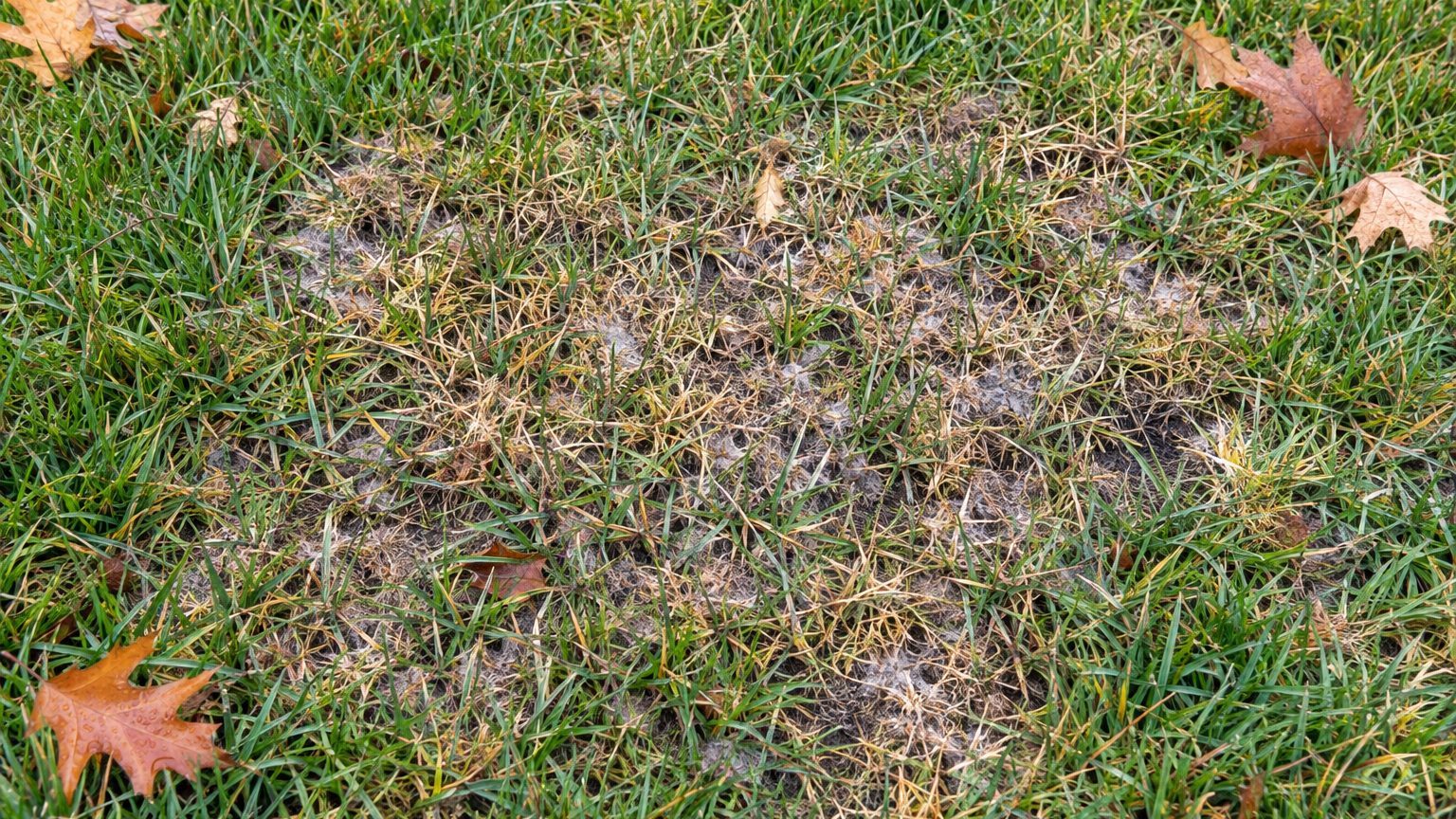
In South Carolina, circular tan or smoky patches often become evident as warm-season grass greens up in spring. A brown or smoky-gray outer edge helps distinguish large patch from other lawn problems.
Large Patch Symptoms

Look for rings and arcs in the turf, and start with the shape because it is a useful clue.
- Circular patches with brown or smoky-gray outer edges are the sign that sets large patch apart, and they may grow to 20 feet or more in diameter.
- Stand symptoms are patches from 1 foot to greater than 3 feet across, so a lawn often shows several sizes at once.
- Damaged areas range from a few inches to several feet and may coalesce or merge, leaving odd, wavy outlines instead of tidy circles.
- In South Carolina, symptoms show up mostly in spring as the lawn greens up, because the green grass around the patch makes the dead zone stand out.
- Centipedegrass, zoysiagrass and St. Augustinegrass are the warm-season grasses most commonly affected.
Bermudagrass tends to come through with less harm, since its rapid growth and spread let it recover more quickly.
From the almanac
Lawn in your state
The dates on this page depend on where you live. Your state's page carries its frost dates, its USDA zones and the year laid out month by month.
Northeast
Southeast
- Alabama
- Arkansas
- Delaware
- Florida
- Georgia
- Kentucky
- Louisiana
- Maryland
- Mississippi
- North Carolina
- South Carolina
- Tennessee
- Virginia
- West Virginia
Midwest
Southwest
West
Pacific Northwest
Canada
Lawn Problems Mistaken for Large Patch
Several other lawn troubles leave dead patches in warm-season turf. Use the shape together with a simple pull test, and note where and when the patch appeared.
Brown patch deserves a mention too. Large patch was formerly called brown patch, but the two differ in timing, symptoms, the strains of fungus behind them and the control strategies they call for.
| Looks like | How to tell them apart |
|---|---|
| Take-all root rot | Dead, thinning patch where leaves and stolons come up together when you tug the turf |
| Anthracnose | Dead, thinning patch where the plant and roots come up without stolons when you tug the turf |
| Brown patch | Browning that appears at a different time of year than spring green-up, with distinct symptoms from the smoky-edged rings of large patch |
If a pull test gives a mixed result or the timing does not fit spring, have the sample checked before treating the lawn.
What Causes Large Patch
A soilborne fungus, a strain of Rhizoctonia solani, causes large patch. It lives in the thatch and soil and attacks grass when conditions suit it, which is why the same spots can flare up again. In South Carolina, the fungus is most active during the late fall and again during the spring, which matches the way symptoms appear at green-up.
Weather sets the pace. According to Mississippi State University Extension, free moisture in any form and relatively cool temperatures (60 to 75°F) favor the disease, while cool nights and warm days prolong it. According to Texas A&M AgriLife Extension, the disease occurs when temperature is below 70 degrees Fahrenheit, so a mild, damp stretch is enough to start it.
Wet leaves speed things along. According to Clemson Cooperative Extension, the disease can spread fast when free moisture is present, especially greater than 10 hours of continuous leaf wetness. Evening watering, heavy dew and poor drainage all keep blades wet longer. Among warm-season grasses, large patch is the most common disease affecting centipedegrass, although all of them are susceptible.
How to Treat Large Patch
Treatment starts with the conditions around the grass, then moves to a fungicide only if the lawn needs more help.
- Confirm the diagnosis with a pull test and a look at the patch edge, so you are not treating anthracnose or take-all root rot with the wrong plan.
- Water only when the lawn needs it, since wet blades feed the fungus. According to Clemson Cooperative Extension, irrigate to a depth of 4 to 6 inches, generally 1 inch of irrigation water per week.
- Mow at the proper height for your grass, because stressed, scalped turf recovers slowly. In Texas, that means 2–3 inches for St. Augustinegrass and 1–2 inches for zoysiagrass.
- Mow centipede at 1½ to 2 inches in South Carolina, and clean the mower deck before moving to healthy turf.
- Contact your state extension office about fungicide, since only they know which products are approved where you live and when to apply them.
- Give the lawn time to fill in as it warms, because the grass grows over the patch once the fungus slows.
Bermudagrass fills in faster than the other warm-season grasses, while centipedegrass and zoysiagrass may need longer to cover bare circles.
How to Prevent Large Patch
Prevention focuses on keeping the lawn from staying damp as cool weather arrives.
- In South Carolina, water only when the lawn needs it as cool weather approaches.
- In South Carolina, when the fungus becomes active in late fall, water only if the lawn is truly dry and keep leaves off the turf so blades dry quickly.
- Avoid scalping the lawn while it is dormant.
- In early spring, check drainage and thatch, and water in the morning so leaves are dry for most of the day.
- At spring green-up, walk the lawn and look for rings, since early detection makes it easier to limit the damage.
Keep a note of where patches appeared this year, because large patch tends to return to the same spots.
Common Questions
Does Large Patch Kill the Grass Roots?
The fungus attacks at the base of the blades and the stolons, so a patch can look dead while the lawn still has life in it. Warm-season grasses often fill back in as temperatures rise, though weakened turf recovers slowly.
Can Large Patch Show Up in a Lawn That Is Not St. Augustinegrass?
Yes. All warm-season turfgrasses are susceptible, including centipedegrass and zoysiagrass, and bermudagrass can also be affected, though it usually recovers faster.
Is Large Patch the Same as Brown Patch?
Not any longer. The two differ in timing, symptoms, the fungus strains involved and the control strategies they require, so treat them as separate problems.