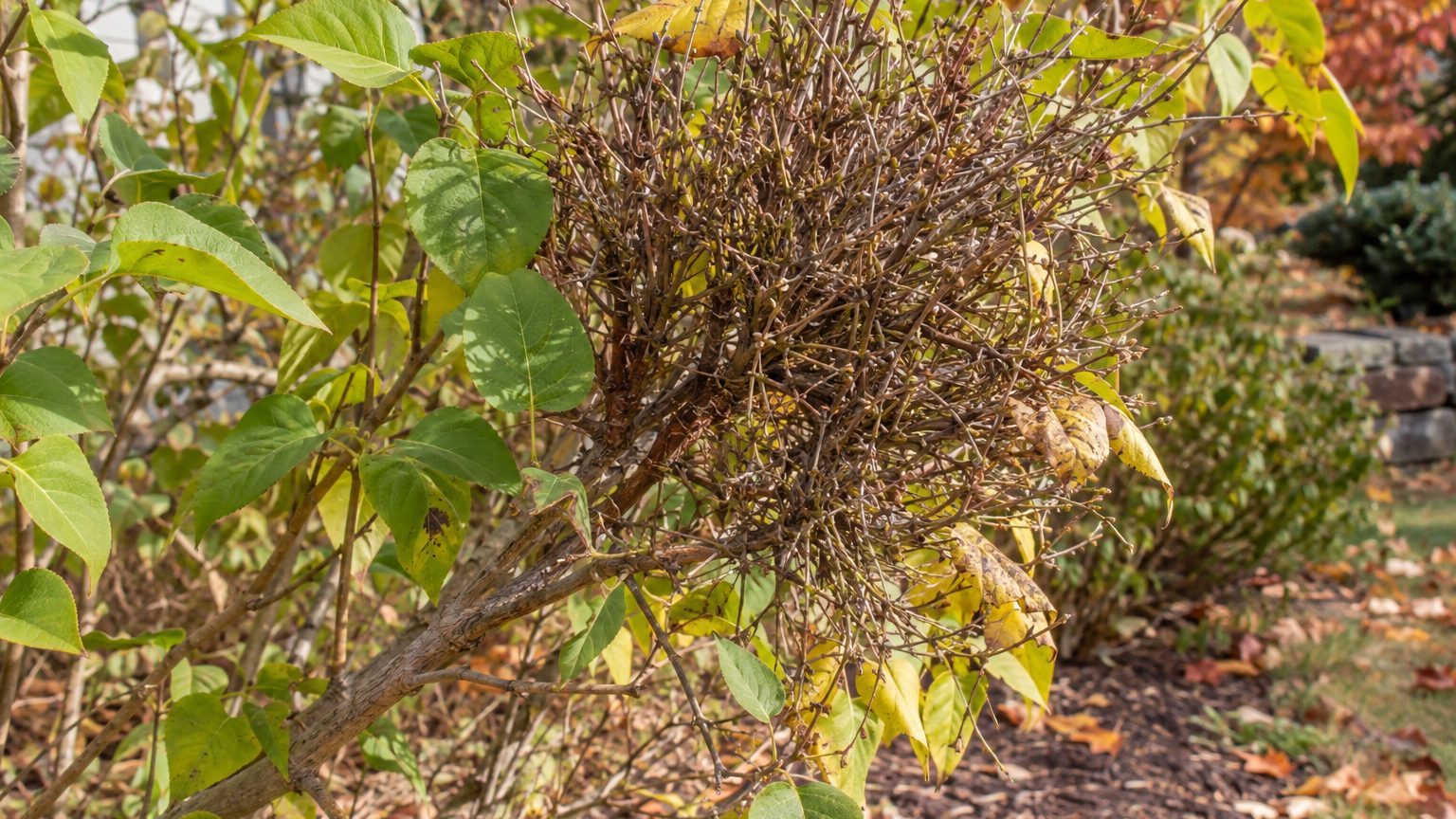
Dense tufts of thin, twiggy shoots sprouting from a single spot on a lilac stand out clearly on bare branches. That tuft is a witches broom, and it points to a disease of the plant, not just an odd growth habit. Knowing what the tufts look like, what else mimics them and what to do about them keeps the rest of the shrub healthier.
Witches Broom: What You See

The clearest sign is the broom itself, and a few other changes usually travel with it.
- A cluster of many small, weak shoots grows out of one point, like a bristly tuft where a single twig should be.
- The twigs in the tuft are short and thin, packed densely together on one area of the stem.
- Brooms turn up at the ends of branches and also bunched at the very base of the plant.
- Leaves on affected growth can be small, distorted and yellow.
- Individual branches may die back, and the shrub can slowly decline.
Bare winter branches make the tufts easiest to spot, so a slow walk around the shrub after leaf drop is worth the time.
From the almanac
Lilacs in your state
The dates on this page depend on where you live. Your state's page carries its frost dates, its USDA zones and the year laid out month by month.
Northeast
Southeast
- Alabama
- Arkansas
- Delaware
- Florida
- Georgia
- Kentucky
- Louisiana
- Maryland
- Mississippi
- North Carolina
- South Carolina
- Tennessee
- Virginia
- West Virginia
Midwest
Southwest
West
Pacific Northwest
Canada
Witches Broom or Something Else?
Several problems can leave a lilac looking tufted or off-color, and the habit of the growth tells most of them apart. A tuft that starts from one point on a stem is a different story from growth that comes from the ground or from leaves that all look scorched.
| Looks like | How to tell them apart |
|---|---|
| Root suckers crowding the base | Suckers are sturdy, upright shoots rising from the soil or roots with normal leaves, while a broom is a dense knot of thin, weak twigs on a stem. |
| Herbicide or drift injury | Curled, twisted leaves appear across much of the shrub after spraying nearby, while a broom is a tight cluster of shoots at one spot and the rest of the plant looks normal. |
| Twig dieback from winter damage | Dead tips show up on exposed branches after a hard winter, while a broom produces extra shoots at a single point instead of bare, dry ones. |
Borer damage can also cause wilting branches. It shows as small holes and sawdust-like debris near the base, which a broom never produces.
What Causes Witches Broom, and Where It Is Worst
The cause is a phytoplasma, a tiny bacterium-like organism named Candidatus Phytoplasma fraxini that lives in the plant’s inner tissue. It scrambles normal growth, and the plant answers by sending up a mass of weak shoots from one point instead of a single healthy twig.
Injury, wet foliage, crowded growth and poor nutrition can make infection or spread more likely. Wounds in the bark give an opening, overhead watering keeps foliage wet, and crowded plants hold damp air around the branches. Poor nutrition leaves a lilac less able to resist disease.
In Minnesota, shrubs with brooms may lose branches and decline. Avoiding injury and keeping the lilac healthy matter wherever the disease appears.
How to Treat Witches Broom
Treatment centers on removing diseased growth and giving the shrub conditions that help it stay healthy.
- Inspect the whole shrub, base included, so that you find every broom instead of only the obvious ones at the branch tips.
- Prune out infected tissue as soon as you notice it, cutting back into healthy wood, because the sooner a broom comes off the less chance it has to affect nearby growth.
- Destroy the cuttings by bagging or burning them where local rules allow, so that diseased wood does not sit in a pile near the shrub.
- Keep the cut material away from healthy lilacs until you can destroy it.
- Water at the base of the plant and skip overhead irrigation, so that the foliage dries quickly.
- Feed according to what the plant needs, since healthy plants resist disease better than stressed ones.
Do not count on a spray to remove infected growth. Have the diagnosis confirmed locally before you settle on a plan.
How to Prevent Witches Broom Coming Back
Prevention follows the year, from the first pruning cuts through the growing season and into cleanup.
- Remove infected brooms as soon as you notice them, and prune to thin crossing branches.
- Thin the shrub lightly to open up air circulation, which slows the spread of the disease.
- Water at the base and leave the sprinkler off the leaves.
- Mow and trim carefully around the base, since injuring the plant raises the chance of infection.
- Check again for brooms and clear fallen debris from under the shrub.
Spacing matters from the day of planting, because lilacs set with room around them slow the spread of the disease.
Where This Comes From
Local conditions and approved treatments differ, so have the diagnosis confirmed before settling on a plan.
Common Questions
Will Witches Broom Kill a Lilac?
It can. Individual branches die back, the shrub declines, and over time a badly affected plant can die. Prune and destroy infected tissue as soon as you notice it.
Is It Worth Keeping a Lilac with Brooms at the Base?
That depends on how much of the shrub is affected. Prune and destroy every infected broom you find, but continued decline may mean the shrub cannot be saved. Have a local plant diagnostic lab examine photos or a sample before deciding.
Who Can Confirm That It Is Witches Broom?
A local plant diagnostic lab can examine the growth and rule out lookalikes such as borer damage or herbicide injury. Bring a cut branch with a broom on it and a few leaves from nearby.