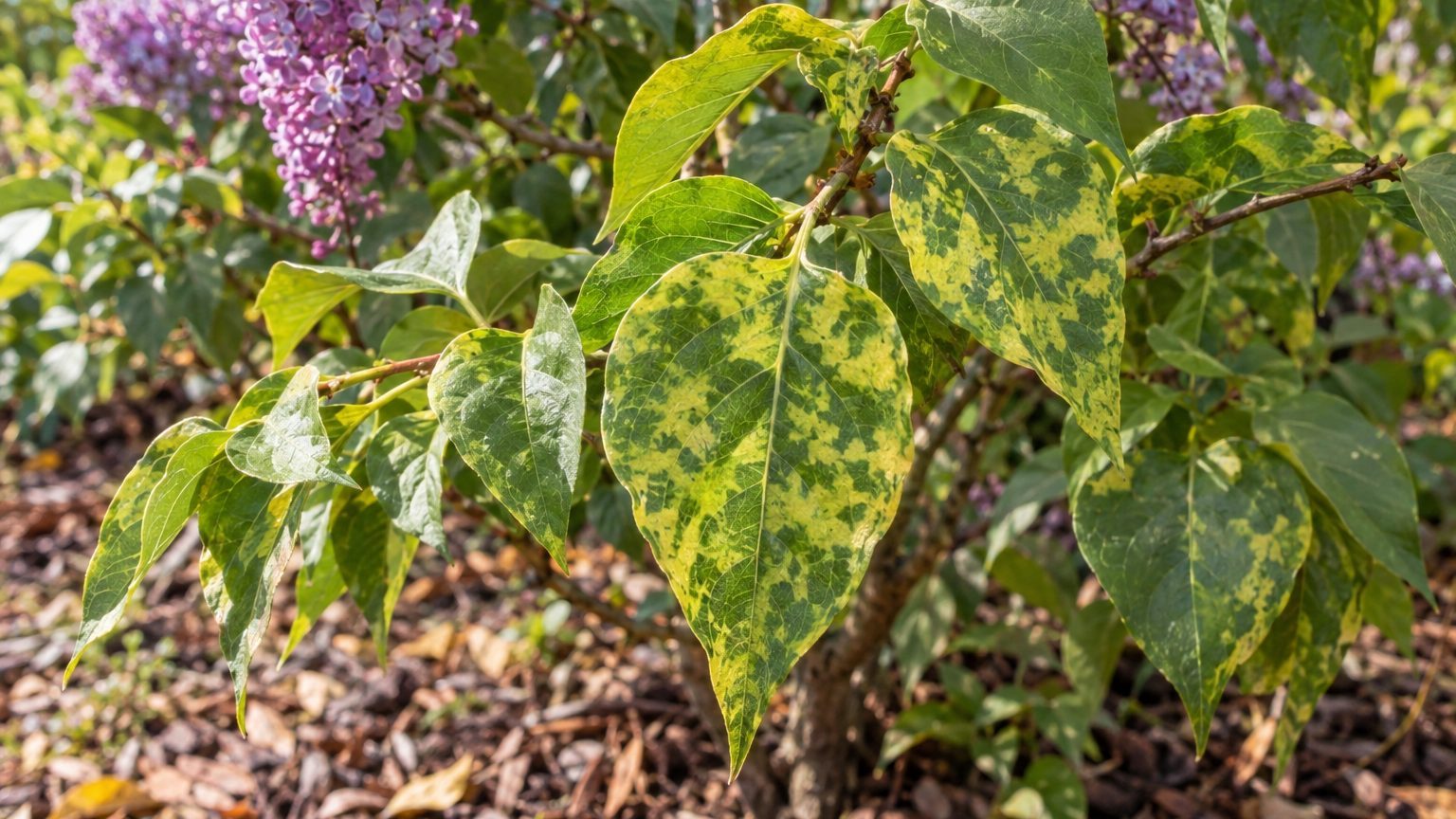
Brown spots and scorched-looking leaves on a lilac in spring often get blamed on a mosaic virus. The symptoms gardeners describe, though, match lilac bacterial blight, caused by the bacterium Pseudomonas syringae pv. syringae. Knowing which problem you have changes what you do, because bacterial blight calls for cleanup and careful attention to plant stress.
Mosaic Virus: What You See

The lilac problem that gets called mosaic virus shows up as spots, scorching and blackened tips, and the clearest sign is how fast healthy leaves change.
- Leaves look healthy at first, then suddenly seem singed, as if they had been held near an open flame.
- Dark, irregular spots appear on the leaves, sometimes ringed by yellow halos.
- Spots start pin-point small, then enlarge to 1/8 inch or more and grow together, which can leave leaves misshapen.
- Dark black streaks form on one side of young shoots, and affected shoots wilt and blacken as they are girdled.
- Flowers wilt and turn brown, and unopened buds turn black.
Leaves that darken and wilt may drop early, and in bad cases whole shoots die back.
From the almanac
Lilacs in your state
The dates on this page depend on where you live. Your state's page carries its frost dates, its USDA zones and the year laid out month by month.
Northeast
Southeast
- Alabama
- Arkansas
- Delaware
- Florida
- Georgia
- Kentucky
- Louisiana
- Maryland
- Mississippi
- North Carolina
- South Carolina
- Tennessee
- Virginia
- West Virginia
Midwest
Southwest
West
Pacific Northwest
Canada
Mosaic Virus or Something Else?
A lilac with brown leaves is not always infected. Drought and frost can leave marks that look close to blight, so one clue is never enough to name the cause.
Check where the damage sits and what the weather did before it appeared.
| Looks like | How to tell them apart |
|---|---|
| Drought scorch: browned, wilting leaves | Drought stress can make lilacs more vulnerable to disease, while bacterial blight can add irregular spots and black streaks on young shoots. Blight brings irregular spots, sometimes with yellow halos, and black streaks on one side of new shoots. |
| Frost or winter injury: blackened buds and shoots | Blight can follow rain after a late frost and produce water-soaked spots that grow together. |
A true plant virus would call for a different approach, and the leaf pattern alone rarely settles it. If the spots, streaks and wet weather do not line up, have a sample identified before treating the shrub.
What Causes Mosaic Virus, and Where It Is Worst
The cause is a bacterium. It survives winter in infected twigs and cankers, in dead plant debris, on neighboring plants and in the soil around the shrub, then moves into new growth when spring turns cool and wet. Leaf debris carries it from one season to the next.
Weather decides how bad it gets. In Oregon, cool, wet springs favor the disease, especially when rain follows a late frost or winter injury. In Maryland, rainy, mild spring weather promotes it, and in Iowa the infection begins in early spring on newly emerging shoots, flower buds and leaves.
Stress makes a lilac easier to infect. Drought, improper fertilization and wounds all set the stage. No lilac type is safe, since Japanese, Chinese, Persian and common lilacs can all be damaged. Some researchers suggest white-flowering varieties may be more susceptible.
How to Treat Mosaic Virus
Treatment for lilac blight focuses on sanitation and reducing stress on the shrub.
- Confirm the problem by checking for spots with yellow halos and black streaks on young shoots, so you do not treat drought or frost damage as an infection.
- Cut out blackened or girdled shoots in dry weather, making the cut well below the damage, so that infected tissue does not stay on the shrub.
- Disinfect your pruners between cuts, so that the bacterium does not travel from one shoot to the next.
- Bag the removed shoots and fallen leaves and throw them out with the trash, since the bacterium survives in dead debris and can start a new round next spring.
- Avoid drought stress and improper fertilization, which are associated with the disease.
How to Prevent Mosaic Virus Coming Back
Prevention works best when it follows the lilac’s year, since the bacterium waits in the debris and strikes when the weather turns cool and wet.
- In Iowa, watch new shoots and buds closely in early spring, when cool, wet weather lets the bacterium infect emerging growth.
- Check for blackened shoots after a late frost and watch for spotting if rain follows.
- Avoid drought stress and improper fertilization, which can make the shrub more vulnerable.
- In fall, rake up and discard all leaf debris around the base, because a thorough cleanup is what stops the disease carrying over to the next season.
- In late fall and winter, hold off on pruning, since in Maryland late fall or winter pruning seems to predispose shoots to infection.
Planting where air moves freely helps leaves dry faster after rain, which is plain gardening sense for any wet-spring disease.
Where This Comes From
These details come from university extension guidance for Oregon, Maryland, Montana and Iowa, including Oregon State University Extension. Spring timing and weather vary by state, so check with your own state’s extension service before you act.
Common Questions
Are White Lilacs More Likely to Get It?
Some researchers suggest white-flowering varieties may be more susceptible than other varieties. That is a suggestion rather than a firm rule, so watch every lilac in the yard the same way.
Can Japanese or Chinese Lilacs Get Blight?
Yes. The bacterium can damage Japanese, Chinese, Persian and common lilacs.
Can You Tell Blight from a Virus by Eye?
Not reliably. Spots with yellow halos and black streaks on new shoots point to bacterial blight, but those signs alone do not confirm it. If the pattern does not fit, have a sample identified before choosing a treatment.