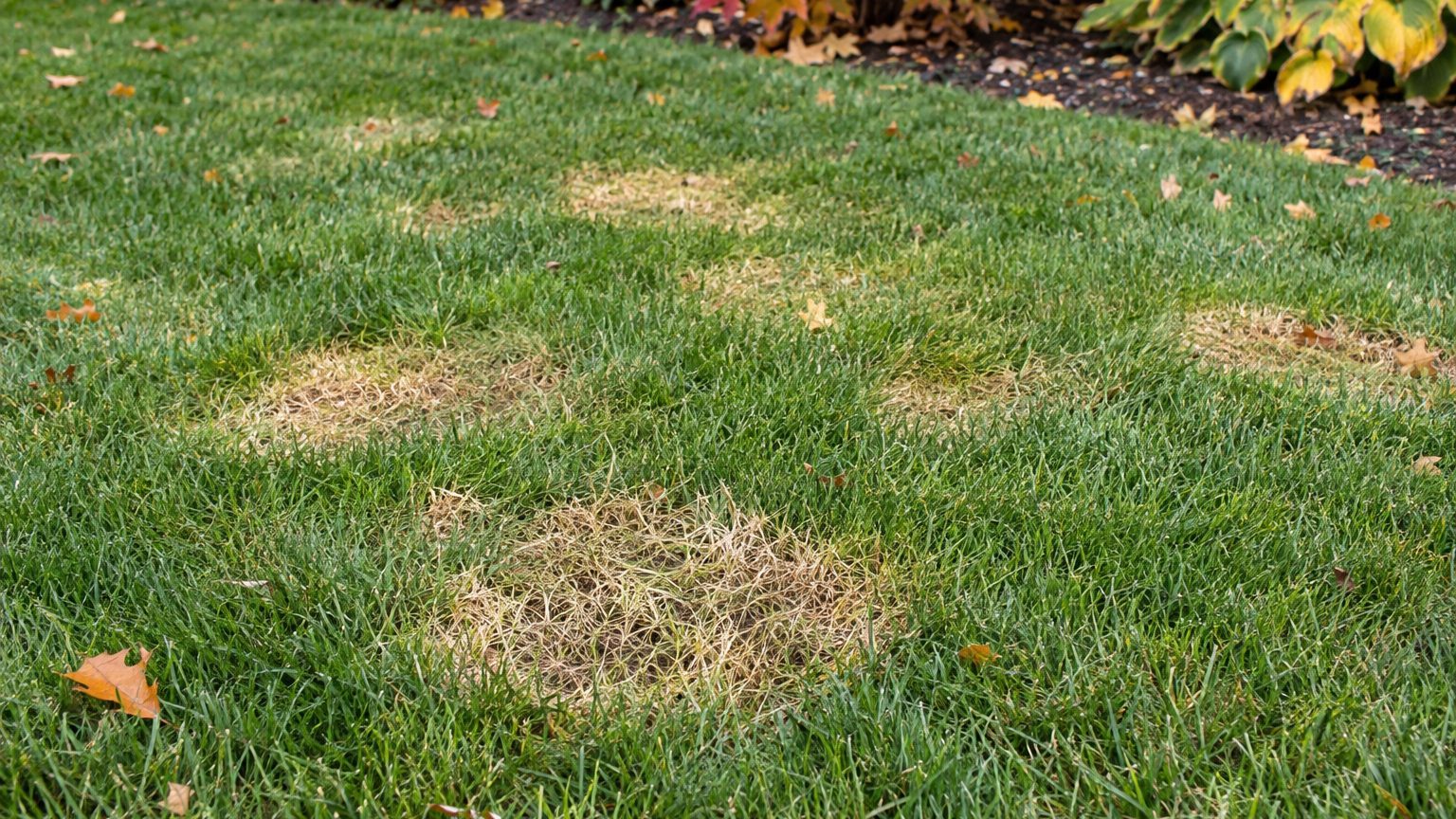
Small, straw-colored circles scattered across a closely mowed lawn are a common sign of dollar spot. The disease is a fungus that thrives in warm, damp, humid stretches, and it is manageable with the right mowing, feeding and watering habits.
Dollar Spot Symptoms

The fungus leaves a clear trail on the blades and across the turf, and the distinguishing sign appears on the blade itself.
- Look for an hourglass-shaped lesion on a single blade, which separates dollar spot from brown patch and Pythium blight.
- Check the leaves for a reddish band across the blade, often after the tissue looks watersoaked and then turns brown.
- Measure the spots on closely mowed turf, where straw-colored circles run about 2 to 6 inches across.
- Watch for small, circular spots from 1–5 inches in diameter that can merge into large, irregular areas.
- Notice white to straw-colored, circular, sunken patches that range from less than ½-inch to more than 4 inches in diameter.
Spots on taller grass such as Kentucky bluegrass and perennial ryegrass are easier to see on the leaf blades than on the turf surface.
From the almanac
Lawn in your state
The dates on this page depend on where you live. Your state's page carries its frost dates, its USDA zones and the year laid out month by month.
Northeast
Southeast
- Alabama
- Arkansas
- Delaware
- Florida
- Georgia
- Kentucky
- Louisiana
- Maryland
- Mississippi
- North Carolina
- South Carolina
- Tennessee
- Virginia
- West Virginia
Midwest
Southwest
West
Pacific Northwest
Canada
Lawn Problems Mistaken for Dollar Spot
Several lawn troubles leave brown, round patches, and a quick glance can send you after the wrong fix. Look at the blade itself and at the pattern across the yard before you decide.
The hourglass lesion on an individual blade distinguishes dollar spot from brown patch and Pythium blight.
| Looks like | How to tell them apart |
|---|---|
| Brown patch | Larger, uneven brown areas in the turf, and the blades lack the hourglass-shaped lesion that dollar spot leaves. |
| Pythium blight | Patches that develop in wet, hot weather, and the blades lack the hourglass-shaped lesion that dollar spot leaves. |
Pull a few blades from the edge of a patch and look at them closely in good light. If the lesions are hourglass-shaped and the patches are coin-sized, you are most likely dealing with dollar spot.
What Causes Dollar Spot
A fungus causes the disease, and it lives in the turf and thatch until the weather suits it. Conditions that keep the leaves wet for long stretches give it the opening it needs.
According to University of Maryland Extension, the pathogen is most active when temperatures run between 60°F and 85°F and relative humidity is above 90%. According to Purdue Extension, infection follows dew periods longer than 8 hours across temperatures of 55-80 degrees F, and the pathogen wakes up as spring temperatures rise. According to University of Georgia Extension, infections develop rapidly at temperatures between 60 and 75 degrees Fahrenheit.
Timing differs by place. Under favorable conditions the disease may appear 12 months out of the year in Maryland, while in Georgia it is most prevalent during spring and fall.
No grass is safe. Dollar spot affects all warm and cool season grasses, and it is particularly severe on bermudagrass and seashore paspalum.
How to Treat Dollar Spot
Treatment starts with changing what the lawn is doing, and the steps below go in the order you would do them.
- Confirm the diagnosis by checking blades for the hourglass lesion, so you do not treat the wrong problem.
- Mow regularly to a height of 2-3 inches, which hastens turf recovery.
- Fertilize adequately, since a lawn short on nitrogen is more open to the disease.
- Apply supplemental fertilizer at 0.2 pound of nitrogen per 1,000 square feet in midsummer, which suppresses the disease.
- In California, water for an appropriate length of time to a depth of 4–6 inches without extending the interval too long.
Fungicides are a decision for your state extension office, which knows which products are approved where you live. Start with the cultural practices above.
How to Prevent Dollar Spot
Prevention follows the season, because the fungus wakes up as the weather warms and keeps going while the leaves stay damp.
- In California, reduce built-up thatch as part of dollar spot prevention.
- Through the growing season, keep mowing regularly at 2-3 inches so the turf stays dense and recovers quickly.
- In California, water for an appropriate length of time to a depth of 4–6 inches without extending the interval too long.
- In midsummer, apply 0.2 pound of nitrogen per 1,000 square feet to keep the lawn fed when the disease can take hold.
- In spring and fall, watch closely in Georgia, where those are the seasons the disease is most prevalent.
Early morning watering is a simple habit that shortens how long the blades stay wet.
Common Questions
Does Dollar Spot Kill the Grass?
Usually the turf is damaged, not killed, and it recovers with regular mowing and feeding. Spots that merge into large areas take longer to fill in.
Can Dollar Spot Appear in Winter?
In Maryland, under favorable conditions, the disease may appear 12 months out of the year. In Indiana, the pathogen becomes active as spring temperatures rise.
Which Grasses Get Dollar Spot?
All warm and cool season grasses can. Bermudagrass and seashore paspalum are hit particularly hard, and symptoms are easier to spot on taller Kentucky bluegrass and perennial ryegrass.