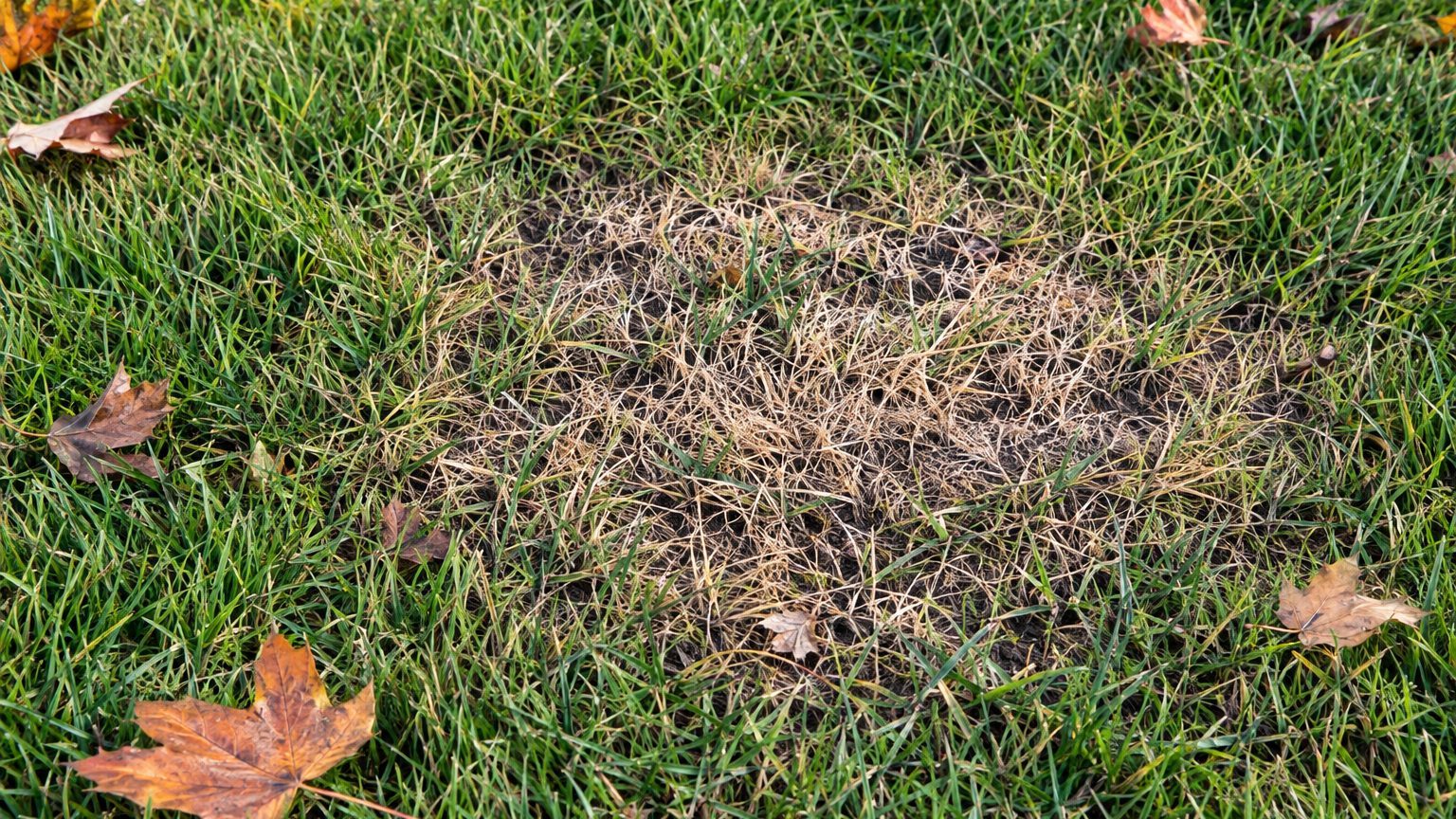
Brown patch shows up as rings of dying grass, usually when summer turns sticky and the nights stay warm. It is a fungal disease, and it spreads fast through lush, wet turf. Knowing what it looks like, what feeds it and when to act keeps a bad spell from becoming a bare lawn.
Brown Patch Symptoms

Start by looking at the shape of the damage, since the outline is a useful clue.
- Roughly circular patches appear in the lawn, and in grass mowed higher than 1 inch they run from 6 inches to several feet across.
- In close-cut turf mowed at 1 inch or less, the circles are brown or orange and can start as small as a few inches.
- On a tall lawn the patches look brown, tan or yellow, so the color alone tells you little.
- Up close on cool-season grass, individual blades carry small, irregular, tan spots with dark-brown borders.
- In the Upstate of South Carolina, symptoms often become obvious around the first week of May.
The spots on the blades are a useful sign because many other problems also leave a brown circle.
From the almanac
Lawn in your state
The dates on this page depend on where you live. Your state's page carries its frost dates, its USDA zones and the year laid out month by month.
Northeast
Southeast
- Alabama
- Arkansas
- Delaware
- Florida
- Georgia
- Kentucky
- Louisiana
- Maryland
- Mississippi
- North Carolina
- South Carolina
- Tennessee
- Virginia
- West Virginia
Midwest
Southwest
West
Pacific Northwest
Canada
Lawn Problems Mistaken for Brown Patch
Several other lawn diseases leave a similar patch, so a brown circle by itself is never enough to settle the matter. Pair what you see on the blade with where on the plant it starts.
Check the leaf and the surface of the grass before you decide anything, since each lookalike gives itself away in one place.
| Looks like | How to tell them apart |
|---|---|
| Gray leaf spot | Lesions resemble brown patch, but the growth on the grass is gray mold, unlike the cottony mycelium brown patch and dollar spot produce. |
| Large patch on warm-season grass | The fungus attacks the leaf sheaths, leaving water-soaked, reddish-brown or black lesions, rather than spotting the blade. |
Pythium blight is the other common mix-up, and it also shows up in hot, wet weather. Because the two are so easy to confuse, a sample taken to your county extension office is worth the trip before you spend money on treatment.
What Causes Brown Patch
The cause is a fungus living in the soil and thatch that wakes up when the weather turns warm and wet. Grass gets infected when blades stay damp for long stretches and the nights never really cool off.
In Maryland, the disease is favored by daytime temperatures of 70 to 90°F, overnight temperatures above 68°F, and relative humidity of 95% or higher or leaf wetness lasting more than 10 hours. In Pennsylvania, it is described as a midsummer disease, with nights above 68°F and daytime temperatures averaging 80°F or above. Ohio’s guidance points to hot wet days above 80 to mid 90s, warm nights in the mid 60s and above, and wet soils.
In California, the fungus is active at 80°–95°F with high humidity, and soft, lush growth from excessive nitrogen gives it an easy target. In the Southeast, brown patch is the most common and important disease of tall fescue. In South Carolina, cool-season grasses can also be hit during warmer periods of the winter months.
How to Treat Brown Patch
Treatment is mostly about changing the conditions around the grass, because favorable weather allows the disease to develop.
- Confirm the diagnosis by checking the blades for tan spots with dark-brown borders, so you do not treat a different disease.
- Water early in the morning when possible, so the grass dries through the day and the leaves are not wet through the night.
- In North Carolina, avoid heavy nitrogen feeding while conditions favor the disease.
- Mow when the grass is dry and keep the blades sharp, which avoids spreading infected clippings and leaving ragged cuts that stay wet.
- Bag or rake clippings from the affected area if the patches are spreading, so you are not carrying the fungus across the lawn.
- Ask your state’s extension office about a fungicide only if the damage keeps spreading, because they know what is approved where you live.
Lawns can recover once the weather cools because the disease may damage the blades while leaving the crowns alive. Expect the grass to fill back in from the roots rather than needing a full reseed.
How to Prevent Brown Patch
Prevention follows the season, with useful steps beginning before warm, humid weather arrives.
- In early spring, dethatch or core aerate if the thatch is thick, so water and air move through the soil and the fungus has less of a home.
- In late spring, keep any nitrogen to 0.5 lb per 1,000 square feet or less, which in North Carolina testing did not increase severity.
- When conditions favor the disease in summer, North Carolina advice is to apply no more than 0.5 lb nitrogen per 1,000 square feet, so skip heavy feeding in a muggy spell.
- Through summer, water deeply and early in the morning, and mow on a dry lawn so the grass is not damp all night.
- In fall, when cool-season grasses grow best, feed with no more than 1 lb nitrogen per 1,000 square feet at any one time to build strength without lush, soft growth.
Good airflow also helps, so trim back shrubs and low branches that trap humid air over the lawn.
Common Questions
Does Brown Patch Kill the Grass?
Usually not. The fungus mostly attacks the leaf blades, so the plants often regrow once cooler, drier weather returns. Severe or repeated outbreaks on stressed turf can thin the lawn enough to need overseeding.
Can Brown Patch Happen on Any Type of Lawn?
It affects many turfgrasses, and in the Southeast it is the most common and important disease of tall fescue. Warm-season lawns can get a related problem called large patch, which looks different up close.
Should You Rake Up the Patches?
Raking out dead grass and thatch helps air reach the soil and gives the lawn a cleaner start. Bag the debris from the infected spots rather than spreading it over healthy turf.