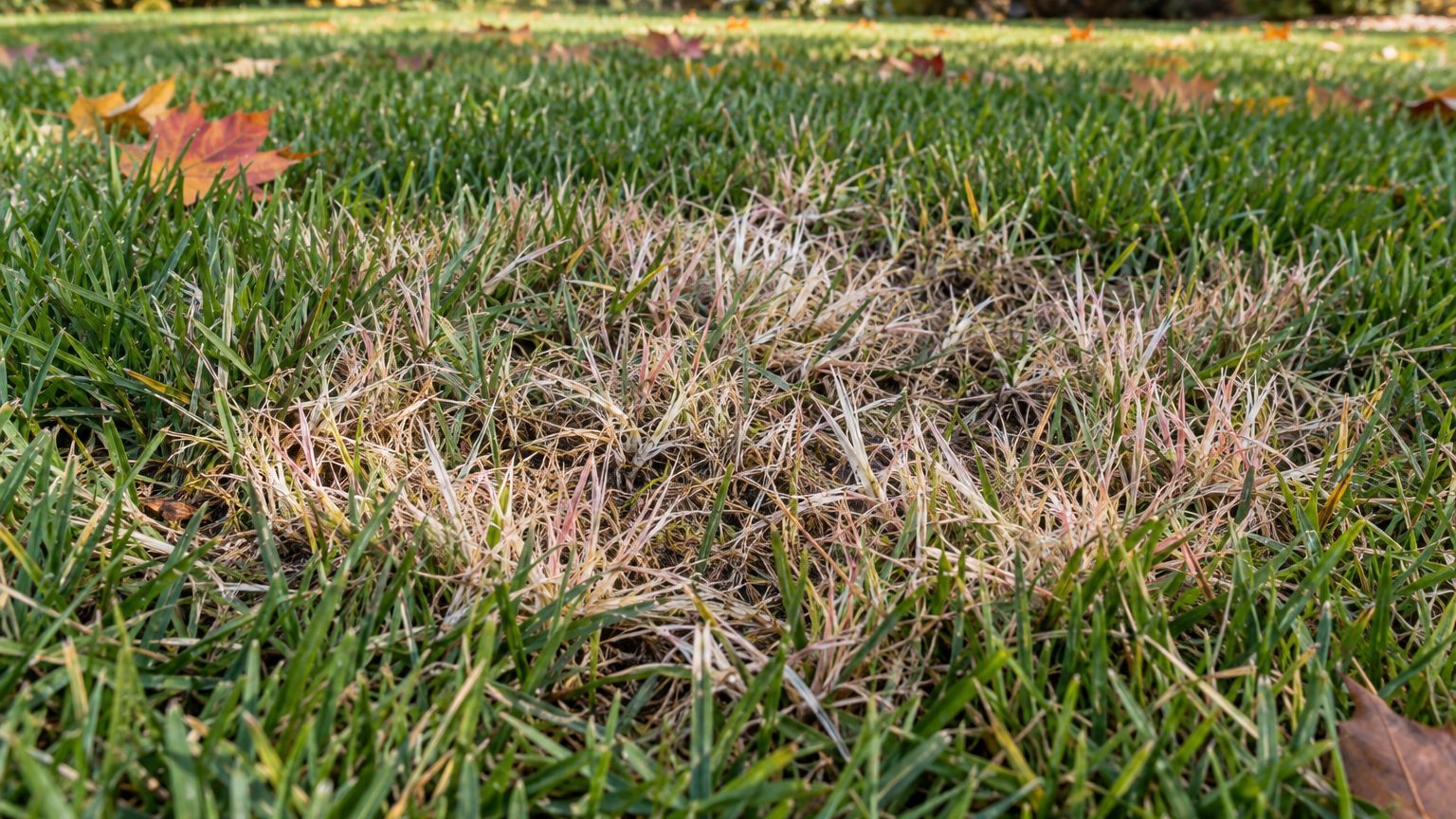
Small, straw-colored circles often appear on a Kentucky bluegrass lawn in the heat of summer, just as the grass seems to be coping fine. They are the usual calling card of Fusarium blight, a fungal disease of stressed turf. Knowing what the patches look like, what sets them off, and what to change in the yard keeps a few circles from becoming a bigger problem.
Fusarium Blight Symptoms

The shape of the damage offers useful clues that sit right in the patch itself.
- Some plants in the center of a circle may survive, which leaves a frog eye or donut look with green grass inside a ring of dead grass.
- Lawns with the disease show small, circular grayish to straw-colored areas of dead grass.
- Circular or crescent-shaped patches a few inches to 2 or 3 feet across appear in Kentucky from late July through August.
- Pull up a dead stem and look at the base, where the crown is affected with a reddish rot that feels hard and tough.
- In California, drought-stressed areas in full sun favor the disease.
A circle with a green center points toward Fusarium blight, while reddish crown rot adds support to the diagnosis.
From the almanac
Lawn in your state
The dates on this page depend on where you live. Your state's page carries its frost dates, its USDA zones and the year laid out month by month.
Northeast
Southeast
- Alabama
- Arkansas
- Delaware
- Florida
- Georgia
- Kentucky
- Louisiana
- Maryland
- Mississippi
- North Carolina
- South Carolina
- Tennessee
- Virginia
- West Virginia
Midwest
Southwest
West
Pacific Northwest
Canada
Lawn Problems Mistaken for Fusarium Blight
Necrotic ring spot and summer patch produce similar symptoms in Kentucky bluegrass. Before they were told apart, they were lumped together in an unexplained disease complex called Fusarium blight, so the confusion has a long history.
Timing helps separate them because necrotic ring spot and summer patch produce similar symptoms in the same grass.
| Looks like | How to tell them apart |
|---|---|
| Necrotic ring spot: rings or patches of dead grass in Kentucky bluegrass | Symptoms often appear in early summer, earlier than Fusarium blight shows up |
| Summer patch: circles or crescents of dead grass in Kentucky bluegrass | Develops in middle to late summer, and it is the more common of the two in Kentucky landscapes |
Plain drought stress can also leave tan, crispy turf in sunny spots. It usually lacks the ring shape and the reddish crown rot, and the grass greens up again after a deep soaking.
What Causes Fusarium Blight
A fungus living in the soil, thatch and old grass residues causes it. It stays quiet until the weather and the lawn line up in its favor, then it attacks roots and crowns.
According to UC IPM, University of California, the disease is favored by daytime temperatures of 85° to 95°F and night temperatures of 70°F or above. Drought-stressed areas in full sun are the usual trouble spots. According to University of Illinois Extension, the first root infections occur in spring when soil temperatures stabilize at 65 to 70 F at the 2-inch depth, long before any patch shows.
Lawn type matters too. Kentucky bluegrass is a susceptible grass, and annual bluegrass, a common weed in turf, is a host as well.
How to Treat Fusarium Blight
Treatment is mostly about easing the stress on the grass, since the fungus is already in the lawn and the goal is to help turf outgrow it.
- Confirm the symptoms and timing before choosing a treatment, because necrotic ring spot and summer patch can look similar.
- In California, water for the appropriate length of time to ease drought stress.
- According to UC IPM, University of California, do not apply more than 1 pound nitrogen/1,000 square foot/application.
- According to UC IPM, University of California, do not apply more than 6 pounds annually.
- Repair bare spots with grasses suited to your area when local conditions favor establishment.
If the patches keep spreading, your state extension office can tell you which fungicides are registered where you live and whether they are worth using on a home lawn.
How to Prevent Fusarium Blight
Prevention follows the calendar, and useful work starts before summer heat arrives.
- In early spring, test the soil and aim for a pH of 5.5 to 6.0, the range Illinois guidance recommends for keeping turf healthy.
- Before the hot months, check the thatch layer and dethatch if it is more than 1/2 inch thick, as California guidance advises, since the fungus survives in that material.
- Through early summer, mow at the taller end of the range for your grass so the shaded soil stays cooler and roots go deeper.
- During heat waves, water deeply enough to reach the roots and keep sunny, exposed areas from drying out.
- When local conditions favor seeding, repair thin areas with grasses suited to your area.
Watch south-facing slopes and strips beside driveways, which can dry out quickly.
Common Questions
Should You Bag Clippings from Affected Patches?
Focus on appropriate watering, nitrogen limits and thatch management instead of treating clipping removal as the main control.
Can Fusarium Blight Come Back Next Summer?
It can. The fungus stays in the soil and thatch, so the same hot, dry conditions that brought it on can trigger new circles, often in the same sunny spots. Steady watering and a thinner thatch layer reduce the odds.
Can You Reseed Dead Patches Right Away?
Wait until the weather cools and the patches stop spreading. Seed sown into hot, dry soil struggles to root, and a young seedling is more vulnerable than established turf. Loosen the surface, rake out the dead grass, and sow a blend suited to your area.