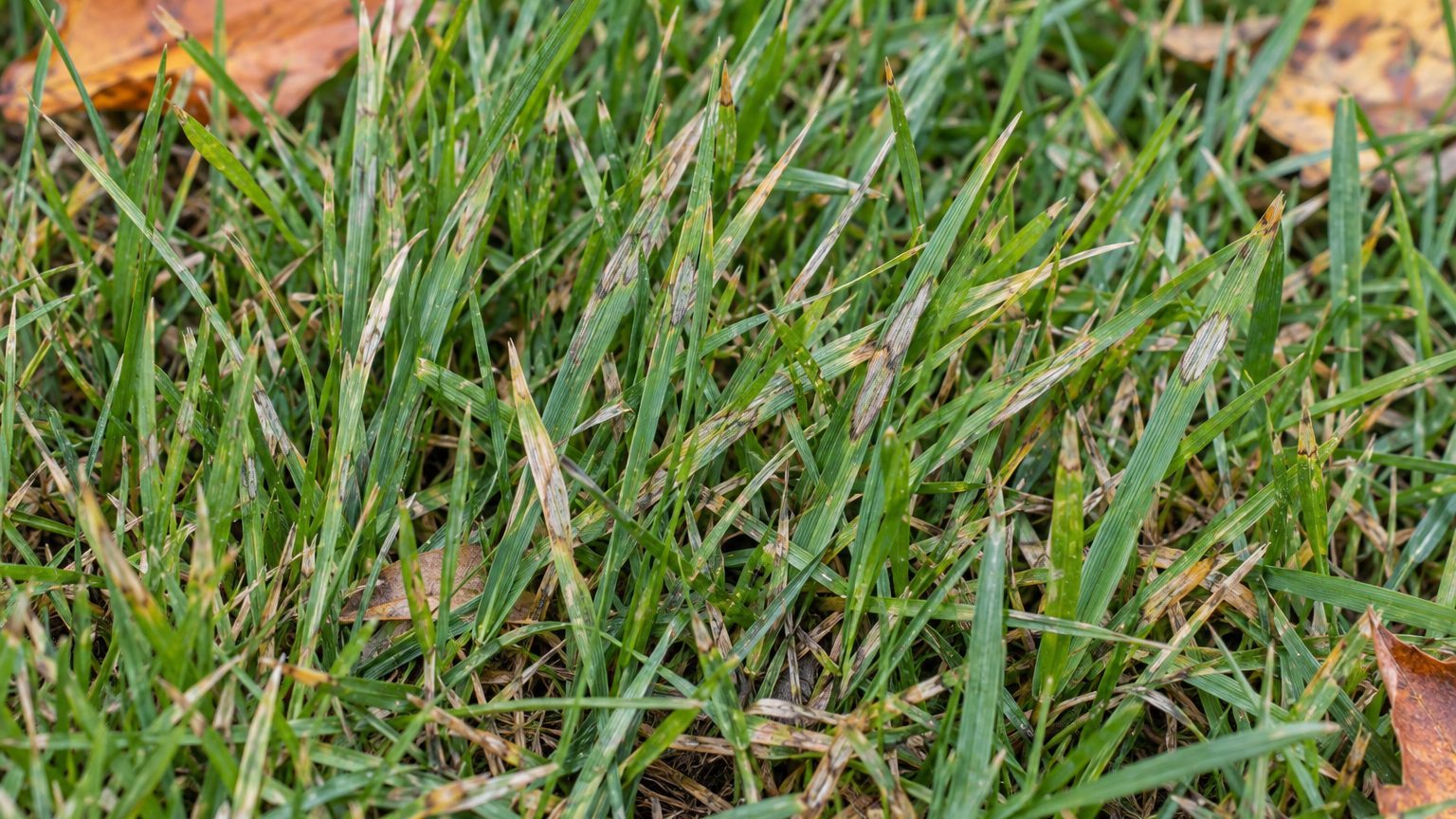
When a lawn that looked fine starts showing tan, oval spots on the blades during warm, humid weather, gray leaf spot is a likely cause. It is a fungal disease of warm-season turf and some cool-season grasses. Knowing what it looks like and what feeds it lets you step in before the thinning starts.
Gray Leaf Spot Symptoms

Look at individual blades first, because the spots tell the story better than the overall color of the lawn.
- On St. Augustinegrass, the spots grow into large, oval or elongate patches in tan to gray, edged with purple or brown.
- Young spots start small and brown before they stretch and fade to gray.
- A yellow halo may ring some spots, or whole leaves may turn yellow.
- In warm, humid weather, a grayish fuzz of mycelium and spores forms on dying foliage, which gives the spots their gray look.
- On St. Augustinegrass, the disease is most active from June through August.
- In tall fescue and perennial ryegrass, most cases appear from late July through September.
In warm, humid weather, check the blades for gray fuzz.
From the almanac
Lawn in your state
The dates on this page depend on where you live. Your state's page carries its frost dates, its USDA zones and the year laid out month by month.
Northeast
Southeast
- Alabama
- Arkansas
- Delaware
- Florida
- Georgia
- Kentucky
- Louisiana
- Maryland
- Mississippi
- North Carolina
- South Carolina
- Tennessee
- Virginia
- West Virginia
Midwest
Southwest
West
Pacific Northwest
Canada
Lawn Problems Mistaken for Gray Leaf Spot
Pythium blight and brown patch are often blamed for the same damage. Both can leave a lawn looking ragged in warm weather, so a closer look at single blades settles it.
Matching the pattern in the lawn with a clue on the leaf blade keeps you from guessing.
| Looks like | How to tell them apart |
|---|---|
| Pythium blight: matted, greasy-looking leaves in tall fescue or perennial ryegrass | Gray leaf spot also mats the leaves, but the blades carry oval spots with purple or brown borders and a gray fuzz in humid weather. |
| Brown patch: infected patches that expand rapidly across the turf | Gray leaf spot patches can also expand rapidly, but up close the blades show individual tan to gray spots with borders and sometimes a yellow halo. |
Leaf spots caused by Bipolaris fungi can also look similar. Their lesions vary in shape, so lesion shape alone is not enough to go on. Match the lesion with the season, the grass type and the gray spore fuzz before you decide.
What Causes Gray Leaf Spot
A fungus causes the disease. It thrives when warm air meets wet leaves, and the spores spread from the dying foliage it colonizes.
Temperature and leaf wetness work together. According to Penn State Extension, the disease is most severe with optimal temperatures from 82 to 90°F. According to University of Georgia Extension, gray leaf spot is favored by daytime highs from 80ºF to 90ºF and nights above 65ºF, which explains why muggy Southeast summers hit hard. According to NC State Extension, infection requires at least 14 hours of continuous leaf wetness.
Grass choice matters too. The disease occurs most commonly on St. Augustinegrass, common in lawns along the Gulf Coast and across the Southeast. It also attacks fescues, kikuyugrass and ryegrasses, and occasionally turns up on bermudagrass and centipedegrass in home lawns. A lawn of tall fescue or perennial ryegrass in the Midwest or Mid-Atlantic is therefore not safe just because it is a cool-season mix.
How to Treat Gray Leaf Spot
Treatment starts with confirming the disease, then slowing it down and getting local advice on fungicide, since labels and approvals differ from state to state.
- Confirm the diagnosis by looking for bordered oval spots on the blades together with gray fuzz in humid weather, so you do not treat for the wrong disease.
- Mow when the grass is dry and bag the clippings from affected areas, because wet blades and loose clippings carry spores to healthy turf.
- Rinse the mower deck and blade after cutting infected areas, so the spores do not travel to the rest of the yard.
- Ask your state’s extension office whether a fungicide is approved for home lawns where you live and how it should be applied.
- Time any fungicide before the disease returns rather than after the damage shows. In central Ohio, applications begin around August 1, before the onset of disease.
- Keep foot traffic off the wet, infected turf, so the spores are not tracked around the lawn.
Recovery depends on how much living turf remains and on the grass type.
How to Prevent Gray Leaf Spot
Prevention is mostly a matter of keeping leaves dry and growth steady, with each habit placed in its own part of the season.
- In early spring, sharpen the mower blade and clean off old clippings and debris, so cuts stay clean and fewer spores carry over.
- In late spring, stop nitrogen on susceptible grasses, because the soft, fast growth it brings is easy prey for the fungus.
- Through summer, water before sunrise and never in the late afternoon or evening, as North Carolina advice puts it.
- In Florida, irrigation between 2:00a.m. and 8:00a.m. generally dries quickly on sunny days and limits the wet conditions the pathogen needs.
- In midsummer, walk the lawn regularly on humid mornings to catch early brown spots before they spread.
- Through summer, do not apply nitrogen to susceptible turf.
Common Questions
Will Gray Leaf Spot Come Back Every Year?
It can. The fungus produces spores on dying foliage, so the disease may return whenever warm, humid weather and wet leaves line up again. Keeping leaves dry makes conditions less favorable for infection.
Can a Dry Week Stop Gray Leaf Spot?
Dry leaves slow it down, because infection depends on long stretches of wetness. A dry week will not repair spots already on the blades, but it can keep new ones from forming.
Will Thinned Areas Grow Back on Their Own?
Often they do once the weather cools and the grass resumes growing, as long as the crowns survived. Badly thinned patches may need repair suited to the grass type.