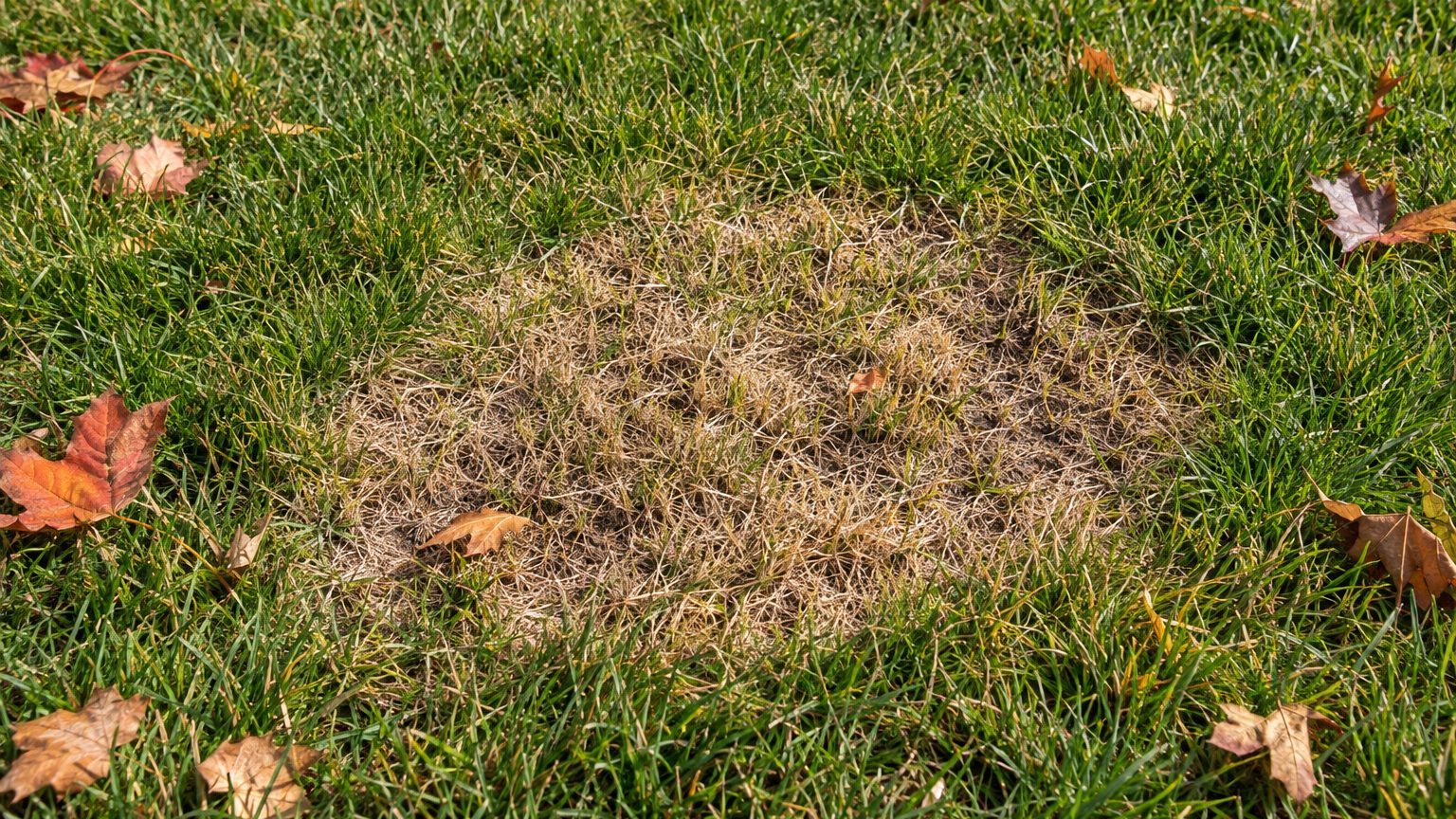
When bermudagrass wakes up in spring, some lawns show bleached, straw-colored circles in the middle of otherwise green turf. Those dead circles are spring dead spot, a root disease that harms the grass beneath the soil surface well before any symptoms show up in spring. Recognizing the patches and knowing when to act can help keep the damage from returning.
Spring Dead Spot Symptoms

The clearest clue is a circle of dead grass that shows up just as the rest of the lawn greens up.
- Well-defined, round patches of bleached, straw-colored grass appear in spring, with healthy turf right up to the edge.
- Patches may be 6–12 inches in diameter, and some are more than 3 feet across.
- Neighboring spots can run together, leaving large irregular dead areas instead of tidy circles.
- The damage becomes visible when growth resumes after winter dormancy and the surrounding grass greens up.
- Bermudagrass is the usual victim, though zoysiagrass and buffalograss can show the same circles.
Pull on the dead grass and you will find the roots, runners and crowns beneath it are damaged, which is why the patch stays bare while the grass around it fills in.
From the almanac
Lawn in your state
The dates on this page depend on where you live. Your state's page carries its frost dates, its USDA zones and the year laid out month by month.
Northeast
Southeast
- Alabama
- Arkansas
- Delaware
- Florida
- Georgia
- Kentucky
- Louisiana
- Maryland
- Mississippi
- North Carolina
- South Carolina
- Tennessee
- Virginia
- West Virginia
Midwest
Southwest
West
Pacific Northwest
Canada
Lawn Problems Mistaken for Spring Dead Spot
Two other problems leave dead grass in spring, and they are easy to mix up with this disease. You can begin to sort them out by looking at the shape of the damage and checking the soil.
| Looks like | How to tell them apart |
|---|---|
| Winter-kill: dead, brown grass as the lawn greens up | The damage forms broad, uneven areas, often in exposed or poorly drained ground, instead of sharp-edged circles |
| White grub injury: thinning, dying turf in patches | The sod lifts like a loose carpet with few roots holding it, and curled grubs turn up when you dig a small square of soil |
If the patches are round, sharply edged, in warm-season grass, and the roots are damaged but no grubs are present, spring dead spot is the likelier cause. Digging at a patch edge to check the roots and soil is more useful than guessing from above.
What Causes Spring Dead Spot
Fungi that live in the soil attack the roots, stolons, rhizomes and crowns of warm-season grass. In Arkansas, that colonizing starts in late summer or fall and picks up again in spring when soil temperatures range from 55º-70ºF.
Winter weather changes how bad the patches look. In South Carolina, symptoms are worse after cold, wet winters, while a warm and dry winter causes less damage to the lawn.
The grass matters as much as the weather. Spring dead spot is considered one of the primary diseases of bermudagrass, and common bermudagrass and its hybrids are affected. Zoysiagrass and buffalograss can also get it. In South Carolina, infections resume the following spring as the soil warms again, so a lawn that has had patches once can have them again.
How to Treat Spring Dead Spot
Treatment is mostly about helping the surviving grass fill in the dead circles once it is actively growing.
- Confirm the diagnosis by digging at the edge of a patch, so you know you are treating a root disease and not grubs or winter injury.
- Wait for the lawn to start growing, because warm-season grass cannot recover while the soil is still cool and the plants are dormant.
- Apply a quick-release nitrogen fertilizer at 1 lb N/1000 sq.ft. in late spring, which in Arkansas has been shown to hasten recovery from spring dead spot damage.
- Water the patches through dry spells, so the runners growing in from the edges have moisture to root into new ground.
- Rake out dead thatch and loose debris from bare areas, so new runners can reach the soil.
- Ask your state extension office whether any fungicide is labeled for home lawns in your state, since registrations differ from place to place.
Surviving grass can fill in dead areas once it is actively growing, and plugs or sod can repair areas that remain bare after the soil warms.
How to Prevent Spring Dead Spot
Prevention works best when it follows the lawn’s year, because the disease builds in fall and shows in spring.
- In early spring, test the soil and check its pH. According to University of Arkansas Extension, ammonium sulfate is used when the pH is higher than 7.0, and it can bring the soil down to a range of 6.0 to 6.8.
- Through the summer months, feed the lawn on schedule. According to Clemson Cooperative Extension, fertilize the lawn 3 times during the summer months, but do not apply more than 1 pound of actual nitrogen per 1000 square feet per application.
- In Arkansas, keep the grass from being stressed in late summer and fall by mowing at the usual height and watering during dry spells.
- In South Carolina, keep leaves raked and low spots draining before winter, since symptoms are worse after cold, wet winters.
- In South Carolina, check the lawn closely as it greens up after a cold, wet winter.
In South Carolina, lawns that have had patches deserve close attention the following spring.
Common Questions
Why Do the Patches Show Up in Spring If the Infection Began Months Earlier?
In Arkansas, the fungi start colonizing the roots in fall, before the damage becomes visible in spring. The dead circles become visible only when the rest of the lawn begins growing again.
Is Spring Dead Spot Milder After a Mild Winter?
Usually, yes. In South Carolina, a warm, dry winter tends to cause less damage than a cold, wet one, though the fungi may still be present in the soil.
Should You Reseed or Resod the Dead Circles Right Away?
Give the lawn time to resume active growth before deciding. Warm-season grasses spread by runners, which can help patches close from the edges once the soil warms and the lawn is fed. Plugs or sod can help with bare areas that stay open after that.