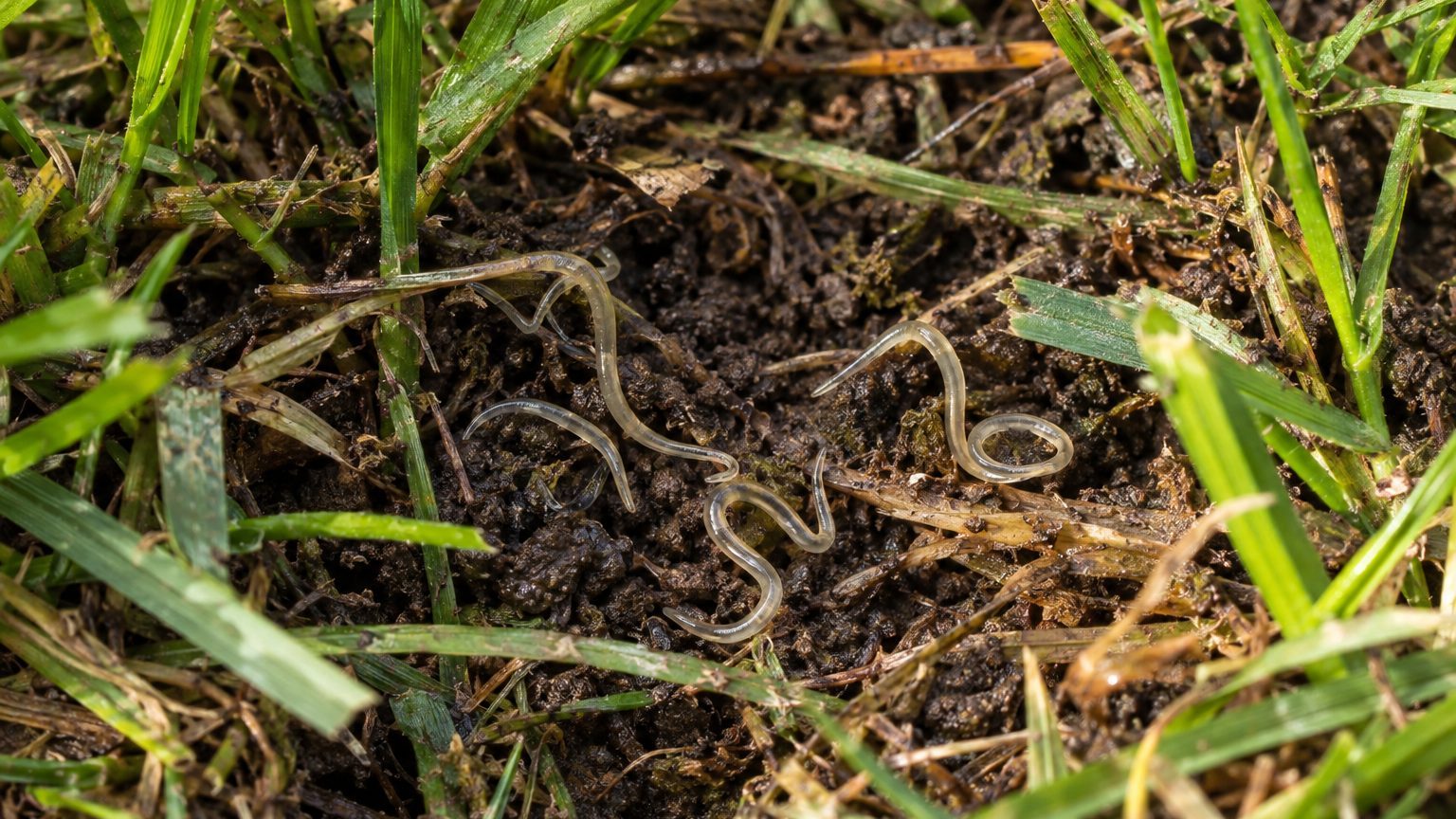
Irregular, thinning patches that widen slowly through summer, with no insects under the turf and no spots on the blades, often trace back to nematodes feeding on the roots. These microscopic roundworms live in the soil of lawns across the country. Pinning them down takes a close look at the roots and a soil sample, and managing them is mostly a matter of helping the grass root deeper.
Signs of Nematodes in a Lawn

Nematodes work underground, so the clues are on the roots first and the grass second.
- Pull up a clump from the edge of a patch and the roots often look cropped off an inch or less below the soil surface.
- The turf thins, wilts or dies in irregular patches rather than neat circles.
- Those patches spread outward slowly if left alone, so the lawn declines over seasons rather than overnight.
- Root-knot nematodes can leave pale, yellowish (chlorotic) patches in the stand.
- In North Carolina, root-knot populations climb from late April to early May and stay high through summer, so the worst thinning shows in the heat.
One sign alone proves little, but short, stubby roots under a slowly widening patch make a strong case for a soil test.
From the almanac
Lawn in your state
The dates on this page depend on where you live. Your state's page carries its frost dates, its USDA zones and the year laid out month by month.
Northeast
Southeast
- Alabama
- Arkansas
- Delaware
- Florida
- Georgia
- Kentucky
- Louisiana
- Maryland
- Mississippi
- North Carolina
- South Carolina
- Tennessee
- Virginia
- West Virginia
Midwest
Southwest
West
Pacific Northwest
Canada
Lawn Damage Mistaken for Nematodes
Root-knot damage in particular can pass for a fungal disease, and a dry, stressed lawn can look nearly the same from the sidewalk. The difference shows up when you kneel down and look at the roots.
| Looks like | How to tell them apart |
|---|---|
| Fungal disease, with yellow or off-color patches | Fungal problems tend to mark the blades, while nematode roots look cropped off an inch or less below the surface. A lab soil sample settles it. |
| Drought stress, with wilted, thinning turf in summer | Dry-spot grass has long, intact roots and perks up after a deep soaking. Nematode patches keep spreading outward and the roots stay short. |
Grub damage can also leave thin, weak patches, but the turf then lifts like a loose carpet and white grubs sit in the soil beneath it. Nematode-damaged turf stays rooted, only poorly.
When Nematodes Damage Shows Up
The cause is a tiny roundworm that lives on plant roots and pierces cells with a spear-like mouthpart called a stylet. Feeding wears down the root system, so the grass can no longer take up water and nutrients, and the top growth suffers.
Timing follows soil warmth. In North Carolina, sting nematodes begin feeding when spring soil temperatures reach 50-60 degrees F, and root-knot numbers build from late April to early May. Damage becomes visible once summer heat puts demand on those weakened roots.
According to NC State Extension, nematode activity subsides as temperatures rise above 90 degrees F, but heat can still expose damage to a weakened root system. Centipedegrass, zoysiagrass, and bermudagrass can be damaged by sting, root-knot, stubby-root, and lance nematodes.
How to Get Rid of Nematodes
Nematodes cannot be wiped out of a lawn, so the realistic goal is to confirm which ones you have and keep the grass growing a strong root system despite them.
- Collect soil cores from the problem area and the edge where healthy grass meets it, because the lab needs a sample that represents the lawn. In Florida, 12–16 cores per lawn is a good rule of thumb.
- In Florida, the count of each nematode type in 100 cc of soil sets the risk level for the turf species indicated. According to NC State Extension, labs ask for approximately 10-20 cores.
- Top dress with compost to raise soil organic matter. According to Clemson Cooperative Extension, 1/4 to 1/2 inch is the suggested layer.
- Water deeply and infrequently so roots chase moisture downward, which North Carolina turf advice recommends for the entire year.
- Feed with light, frequent nitrogen applications, which in North Carolina are recommended to build root growth and carry the lawn through stressful summer periods.
If the lab report shows a high risk level, your state’s extension office can tell you which treatments are legal and labeled where you live. Skip any shelf product that promises a quick nematode kill until you have that answer.
How to Prevent Nematodes
Prevention centers on choosing suitable turf and keeping its roots vigorous as nematode activity changes with soil temperature.
- In late winter, ask the lab or extension office which nematodes tested high before you sod, plug or reseed, so you can choose a grass that tolerates them.
- In North Carolina, note thin spots as spring soil temperatures approach 50-60 degrees F, when sting nematodes begin feeding.
- Around late April to early May, start checking patch edges, since root-knot numbers begin to rise then in North Carolina.
- In North Carolina, continue deep, infrequent watering through summer and use light, frequent nitrogen applications during stressful periods.
- In fall, mow healthy areas before affected ones and rinse soil off the mower deck afterward, so you do not carry infested soil across the yard.
A lawn that never gets the chance to stress out in midsummer tolerates nematode feeding far better than one that starts the season already thin.
Common Questions
Which Lawn Grasses Get Nematode Damage?
Centipedegrass is the most susceptible to ring nematode, and it is also commonly damaged by sting, root-knot, stubby-root and lance nematodes. Zoysiagrass and bermudagrass are commonly damaged by sting, root-knot, stubby-root and lance nematodes.
Can You See Nematodes Without a Microscope?
No. Plant-parasitic nematodes are microscopic, and identification relies on features such as the juvenile stage, the stylet, and the male spicule or female ovary. The ring nematode is named for the concentric rings around its body.
What Types of Nematodes Attack Turfgrass?
Common turf genera include ring, stunt, lance, spiral, root-knot, needle, cyst, pin, lesion, sheath, stubby root, dagger and sting. A lab sample tells you which of them are present, and that decides how the lawn should be managed.