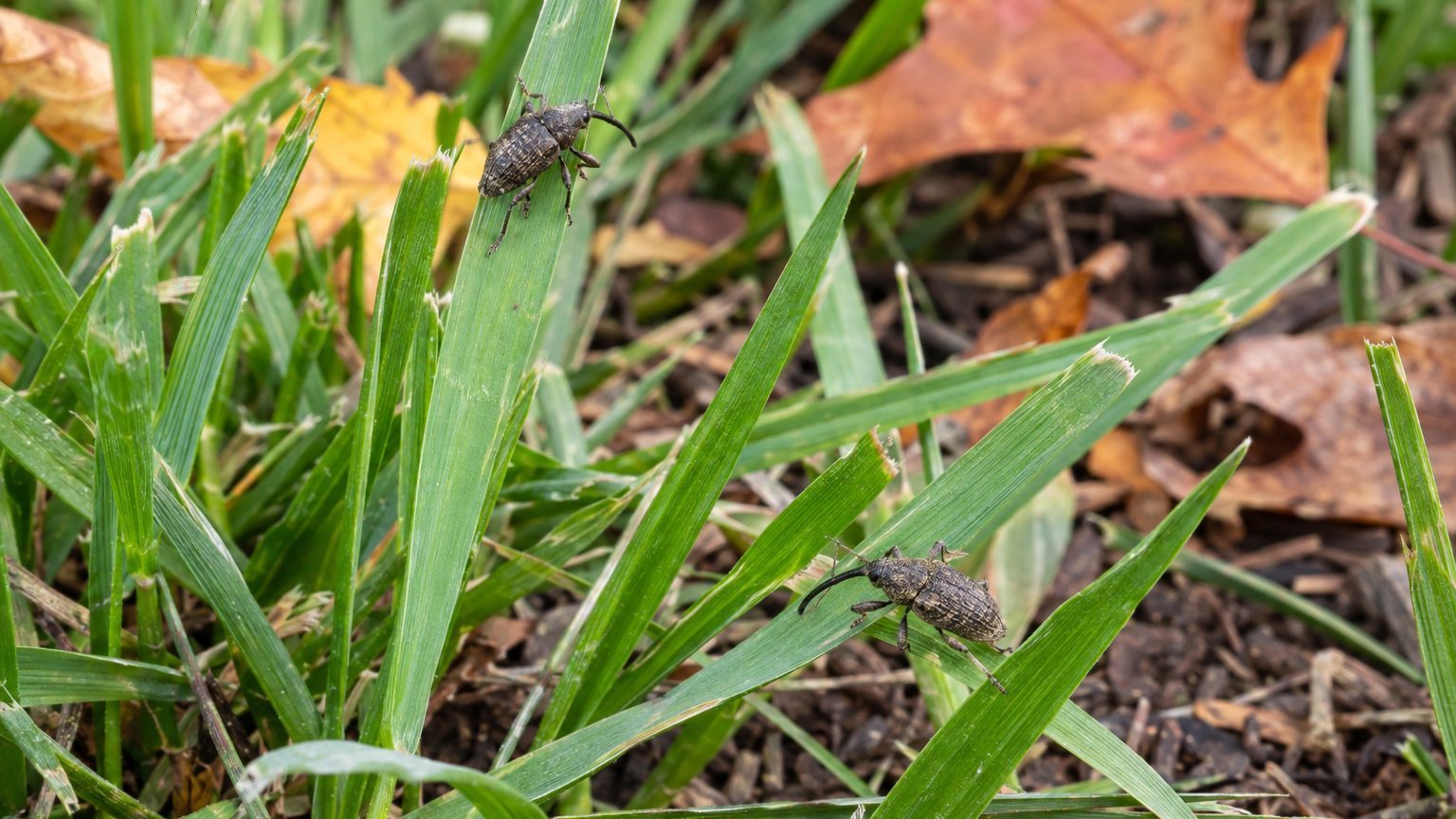
Dead patches that turn straw-colored in mid to late summer, even though you have watered, often point to billbug larvae. They feed on the crown and roots, so the damage looks like drought but behaves differently. Spotting the larvae and acting at the right moment keeps a small patch from spreading.
Signs of Billbugs in a Lawn

A useful sign is a stem that gives way when you pull on it, with other clues building around it.
- Tugging a stem upward makes it break off at the crown, revealing a hollowed stem packed with sawdust-like excrement.
- Early damage appears as dead spots about 2-3” in diameter, which can merge into larger patches.
- Brown or yellow patches are most common and most severe in the mid to late summer.
- White, legless grubs with a red-brown head capsule sit in the thatch and upper soil, growing from 1/25–1/3 inch (1mm–8mm) in length.
- Adult weevils, black to red-brown and 1/4–1/2 inch (7–12mm) long, walk across sidewalks and driveways.
Because billbug feeding can hollow the stem, the grass often dies before you see the culprit, so the tug test is worth doing early.
From the almanac
Lawn in your state
The dates on this page depend on where you live. Your state's page carries its frost dates, its USDA zones and the year laid out month by month.
Northeast
Southeast
- Alabama
- Arkansas
- Delaware
- Florida
- Georgia
- Kentucky
- Louisiana
- Maryland
- Mississippi
- North Carolina
- South Carolina
- Tennessee
- Virginia
- West Virginia
Midwest
Southwest
West
Pacific Northwest
Canada
Lawn Damage Mistaken for Billbugs
Drought stress and other grubs both produce brown patches in summer, which is why billbugs often get blamed or missed. Each has its own giveaway, and checking the turf closely keeps you from treating the wrong problem.
Pull a handful of the affected turf and look at what happens to the stems and what lives beneath them.
| Looks like | How to tell them apart |
|---|---|
| Drought stress | Grass wilts and browns evenly in the dry, sunny areas, and the stems stay intact and solid when tugged, with no sawdust-like debris inside. |
| Other white grubs | Turf lifts like loose carpet because the roots are cut, and the grubs you find have legs, unlike the legless billbug larvae. |
Leaf diseases can also leave tan patches, but the leaf blades show spotting or lesions, while billbug damage starts at the crown with stems that snap off cleanly.
When Billbugs Damage Shows Up
The cause is feeding by the larvae, not the adults. The grubs feed on the crown and roots, and the lawn shows damage when the dying grass turns brown. That delay is why the damage seems to arrive suddenly in mid to late summer.
Timing of the insects themselves varies by place. In Pennsylvania, females lay eggs in a hollowed chamber in the grass stem from late April through June, and the larvae hatch in about 7 to 14 days. In Indiana, adult bluegrass billbugs become active in April or May as soil temperatures at the surface warm to about 65°F.
Billbugs are listed as pests of all grasses, so no lawn type is exempt. Dry, stressed turf shows the injury sooner, which is why summer heat makes the patches look worse.
How to Get Rid of Billbugs
Confirm the problem before deciding whether it needs action.
- Tug a few stems in the damaged area, so you can see whether they break off at the crown with sawdust-like debris inside.
- Dig around the roots and look for whitish, C-shaped, legless grubs with reddish heads.
- Count the grubs in a square foot, since in California the suggested treatment threshold is 1 per square foot, while in Indiana densities of 10/ft 2 are not uncommon and most healthy turfgrasses tolerate them.
- In Indiana, most healthy turfgrasses can tolerate some larvae without significant damage.
- Contact your state extension office if the count is high, because it can tell you which products are approved where you live and the right timing.
- Reseed or patch the dead areas once the feeding is under control, so weeds do not move in.
Dead turf will not green up again, so repair comes after control, not before. Healthy grass around the patch can often fill in on its own if the grubs are dealt with.
How to Prevent Billbugs
Prevention is mostly about choosing the right grass and keeping it strong through the season.
- In Indiana, check lawn edges and driveways for adults walking across hard surfaces in April or May.
- When seeding or overseeding, choose perennial ryegrass or fescue with endophytes, a fungus that grows within the plant and, in Utah, is noted to reduce billbug feeding and damage.
- According to Purdue Extension, a stand made up of at least 40% plants with endophytes (E+) is generally recommended for billbug resistance, so aim for that mix when renovating.
- In Pennsylvania, scout by tugging stems from late April through June, when eggs are laid.
- In midsummer, water deeply during dry spells so stressed turf does not show damage sooner.
A thick, healthy lawn tolerates feeding better than a thin one, so good turf care offers useful long-term protection.
Common Questions
Do Billbugs Only Attack Kentucky Bluegrass?
No. Billbugs are listed as pests of all grasses, though some lawns show damage more than others depending on stress and how thick the turf is.
How Big Are Billbug Grubs?
Mature third-instar larvae are approximately 1/4 to 3/8 inch long, white with a brown head capsule and no legs, so you may need to look closely in the soil.
Will My Lawn Recover from Billbug Damage?
In Indiana, healthy turf may tolerate billbug larvae without significant damage, but dead patches still need repair after the grubs are controlled.