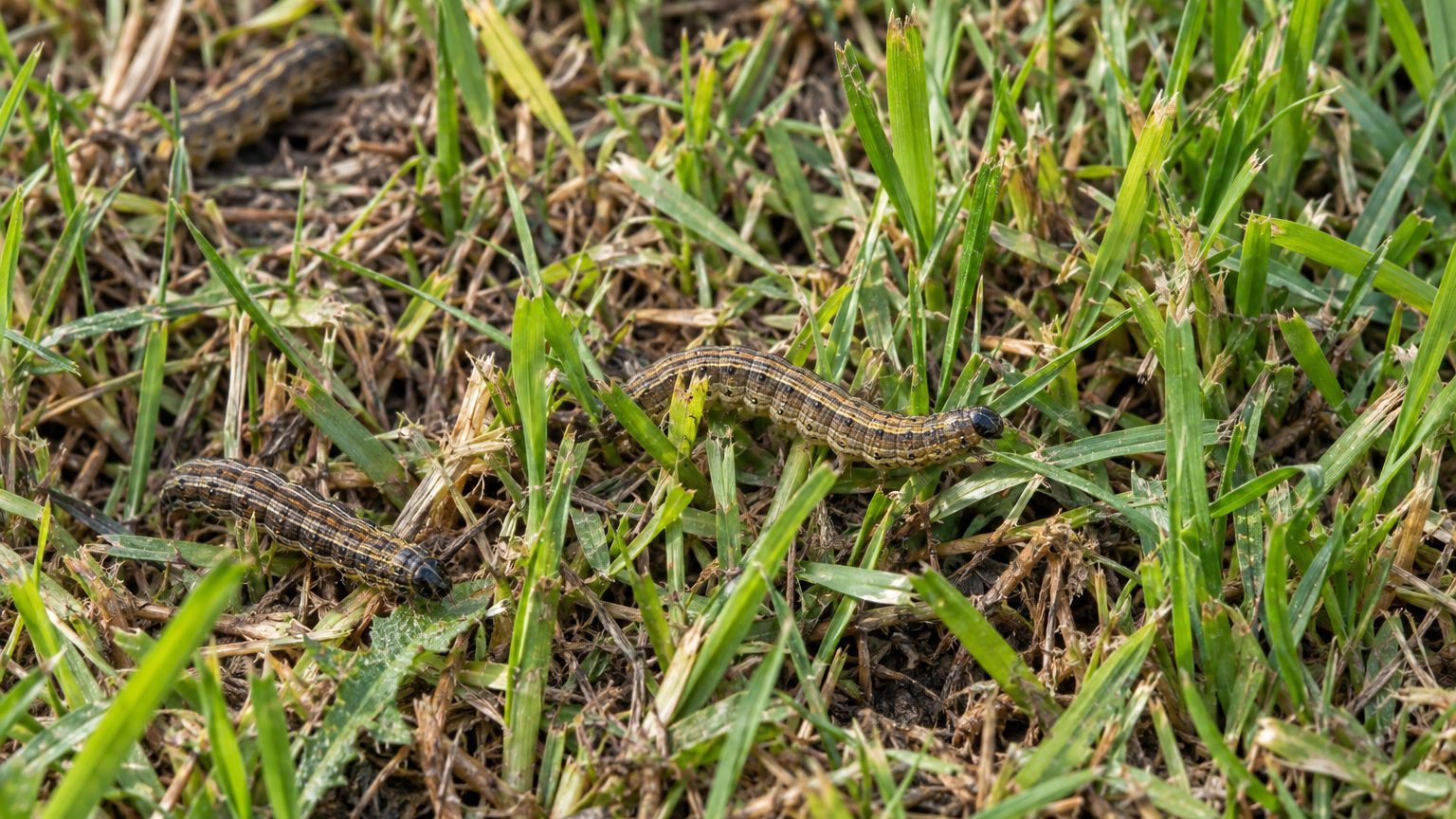
Brown, ragged patches that spread quickly, with birds working the turf, often point to armyworms. These caterpillars chew grass blades and travel in groups, so a lawn can go from green to scorched very quickly. Knowing what they look like and when they hit makes the response far calmer.
Signs of Armyworms in a Lawn

Armyworm damage shows up as a mix of chewed grass and small caterpillars hiding in the turf, so check the lawn closely.
- Birds gather on the lawn to feed, and their presence often signals a heavy infestation.
- Irregular brown patches appear and grow quickly when large masses of caterpillars are feeding together.
- Grass blades look skeletonized or have chewed margins, because young caterpillars feed at night.
- True armyworm larvae feed for 3-4 weeks and reach about 35 mm in length.
- Moths flying around the yard are a warning, with true armyworm adults reddish-brown and marked with a white dot on each wing, while fall armyworm adults are ash-gray.
Finding brown patches along with feeding birds is a good reason to scout the turf.
From the almanac
Lawn in your state
The dates on this page depend on where you live. Your state's page carries its frost dates, its USDA zones and the year laid out month by month.
Northeast
Southeast
- Alabama
- Arkansas
- Delaware
- Florida
- Georgia
- Kentucky
- Louisiana
- Maryland
- Mississippi
- North Carolina
- South Carolina
- Tennessee
- Virginia
- West Virginia
Midwest
Southwest
West
Pacific Northwest
Canada
Lawn Damage Mistaken for Armyworms
Brown patches have many causes, and several look like caterpillar feeding from the sidewalk. A quick check of the grass blades and the thatch usually sorts them out.
Armyworms leave chewed blades and live caterpillars near the soil surface, while the roots stay firmly in place.
| Looks like | How to tell them apart |
|---|---|
| Cutworm damage | Small, sunken patches with chewed blades, found along with caterpillars that curl up in the thatch, though cutworms are usually fewer and more scattered. |
| Drought stress | Grass turns dull and straw-colored in broad areas, blades stay whole with no chewing, and no caterpillars appear when you flush the thatch with soapy water. |
Grubs can also cause brown turf, but they feed on roots, so the sod lifts like a loose carpet. Armyworms are described as leaving roots and the crown undamaged, which distinguishes them from root-feeding grubs.
When Armyworms Damage Shows Up
Damage follows the life cycle. Eggs hatch into larvae that feed on the leaves, and the feeding is heaviest as the caterpillars grow large. Once they finish, they burrow into the thatch and soil to pupate, then emerge as moths that lay the next round of eggs.
The gap between pupation and new adults varies by place. In Texas, adults emerge 10-14 days later, in South Carolina the larvae pupate in the thatch and soil and emerge 10 to 20 days later, and in Utah adults emerge in 2-3 weeks. In warm climates, that quick turnaround means new waves can follow one another.
Turf type matters too. Armyworms feed on most cool-season and warm-season grasses, and they like well-fertilized, well-kept bermudagrass, which is the most common host. They are also fond of cool-season turf, and they feed and migrate in large groups, so damage can appear suddenly in part of the lawn and spread across the yard.
How to Get Rid of Armyworms
Treatment starts with confirming the caterpillars are there and counting them.
- Mix a soap flush, using 2 tablespoons of liquid dishwashing soap in 1 gallon of water (the Alabama recipe), so hidden larvae come up to the surface where you can see them.
- Pour it over a patch of lawn and watch the surface for 5-8 minutes, which is the time Utah guidance gives for caterpillars to surface.
- Count the larvae in several spots at the edge of the damage, because that is where they are actively feeding.
- Compare your count with the threshold, which in Utah is 10-15 larvae per square yard with obvious damage, and treat only if the numbers and the damage both justify it.
- Water and fertilize as usual if the count is low, since in Utah healthy turfgrass can tolerate low to moderate infestations when it is properly irrigated and fertilized.
- Call your state extension office before buying any insecticide, and if you do use a contact product, hold off on watering, because in South Carolina the advice is to avoid irrigation or rainfall for 24 hours after application.
Because these caterpillars do not damage roots or crowns, Utah guidance notes that turfgrass can usually recover over time without an insecticide treatment. Brown patches that look bad now often green up again.
How to Prevent Armyworms
Prevention is mostly about keeping turf strong and checking it when moths are active.
- Properly irrigated and fertilized turfgrass can tolerate low to moderate infestations.
- Walk the lawn regularly and watch for moths or birds feeding on the turf.
- When moths appear in the yard, do a soap flush on a small area to catch caterpillars before patches form.
- Keep checking the edges of any brown spots for feeding larvae.
- After damage appears, follow local watering and mowing guidance while the grass recovers.
Avoid overfeeding bermudagrass with nitrogen, since lush, well-fertilized turf is what these caterpillars prefer.
Common Questions
Will Grass Grow Back After Armyworms?
Usually yes. Turfgrass can recover over time because armyworms leave the roots and crown undamaged.
What Time of Day Should You Look for Armyworms?
Young caterpillars feed at night, and a soap flush can bring larvae from the thatch to the surface.
Do Birds on the Lawn Mean Armyworms?
Often, since birds are drawn to armyworms and cutworms, and heavy bird activity can indicate a bad infestation. Confirm with a soap flush before you act.