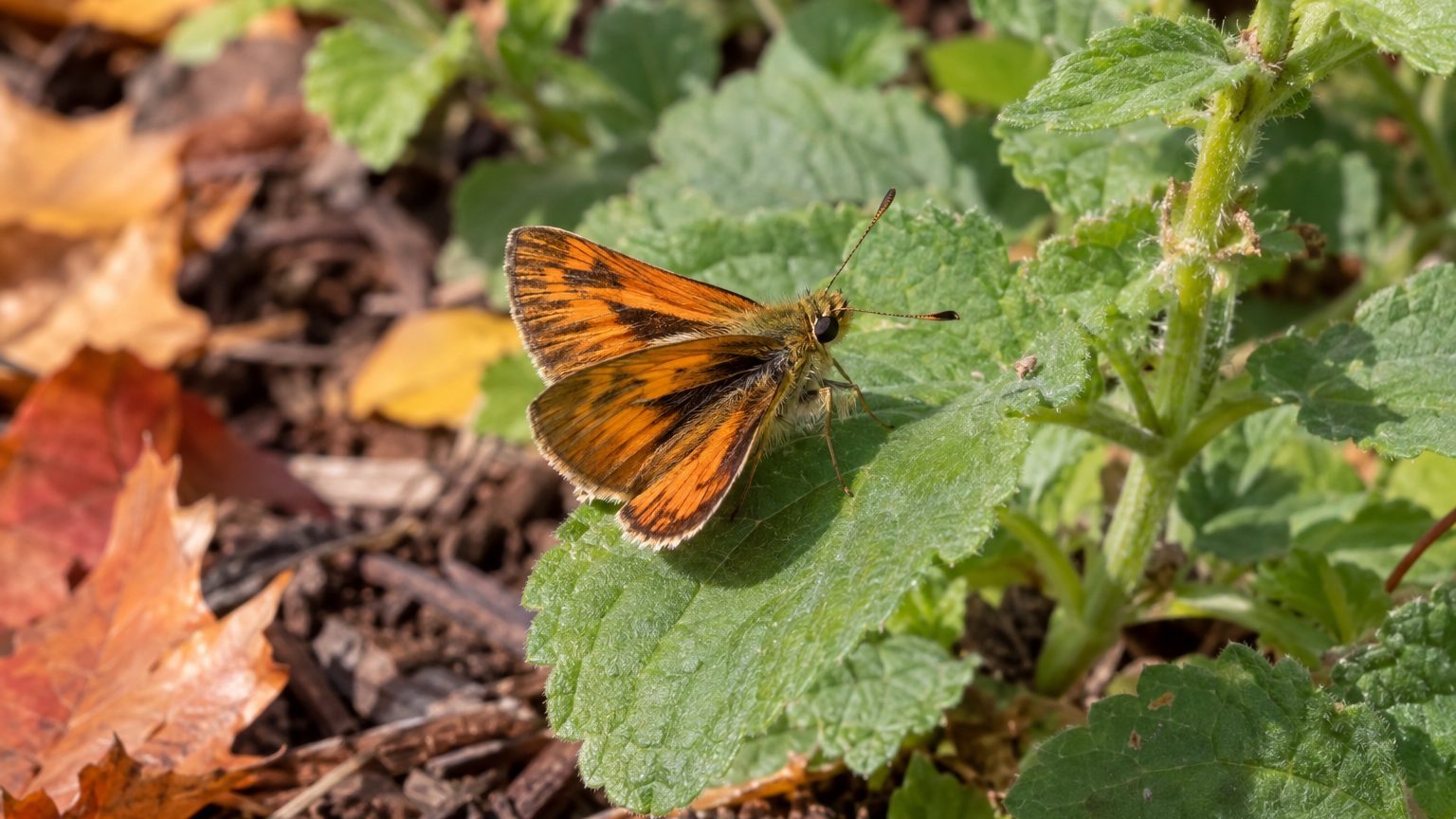
Small, round brown spots that appear in the lawn through summer are often the work of a single caterpillar. Fiery skipper larvae chew grass blades down to nothing in a tight circle, then hide in rolled leaves. Knowing what the larva looks like, and when the damage shows, tells you quickly whether you have a problem worth treating.
Signs of Fiery Skipper in a Lawn

Look low in the turf, where the larva feeds and hides, and you will see a few clear clues.
- The larva has reddish markings on the front of a black head that looks too big for its body, with a narrow neck behind it.
- Behind the neck sits a dark shield, followed by a greenish-pink body with a granulated texture.
- Full-grown larvae reach up to 1 inch long, so they are easy to spot once you part the blades.
- The first damage is a round brown spot, 1 to 2 inches across, where one larva has eaten all the grass.
- Leaves in and around the spot are rolled into small shelters, and the larva feeds on the blades right beside them.
- Damage is usually seen from May through September.
Rolled leaves with a larva inside are the confirmation, because other causes of brown spots leave no caterpillar behind.
From the almanac
Lawn in your state
The dates on this page depend on where you live. Your state's page carries its frost dates, its USDA zones and the year laid out month by month.
Northeast
Southeast
- Alabama
- Arkansas
- Delaware
- Florida
- Georgia
- Kentucky
- Louisiana
- Maryland
- Mississippi
- North Carolina
- South Carolina
- Tennessee
- Virginia
- West Virginia
Midwest
Southwest
West
Pacific Northwest
Canada
Lawn Damage Mistaken for Fiery Skipper
Brown spots have many causes, and a few look close enough to send you after the wrong fix. Treating for a caterpillar that is not there wastes effort and leaves the real problem alone.
A quick look at the edge of the spot and at the grass blades usually settles it.
| Looks like | How to tell them apart |
|---|---|
| Pet urine spots | Spots often have a darker green ring and sit where pets go. Fiery skipper spots have bare, eaten-out centers with rolled leaves nearby. |
| Grub damage | Turf lifts like loose carpet because the roots are chewed. Fiery skipper larvae eat the leaves and leave the roots in place. |
| Drought stress | Dry areas are large, irregular and often follow sun or slope. Skipper damage starts as separate round spots with grass eaten away. |
Whichever one you suspect, part the grass at the edge of a fresh spot and look for the black-headed larva before you decide on anything.
When Fiery Skipper Damage Shows Up
The cause is the larva’s appetite. It feeds on grass leaves, rolls them into a shelter, and each one clears its own small circle, which is why the damage starts as scattered spots rather than one big patch.
Fiery skippers live year-round around the Gulf of Mexico, in the desert Southwest, in most of low-elevation California and in Hawaii. In those places, lawns can see repeated rounds of larvae because the insect never has to start over from a winter die-off.
In Florida, larvae pupate after 16 days and emerge as adults seven to ten days later. That quick turnaround explains how a few spots can multiply across the lawn before you expect it.
Elsewhere, damage still tends to appear from May through September, which is the stretch to watch closely.
How to Get Rid of Fiery Skipper
Start with confirming the larvae and judging how many there are, then move to cleaning up the places they hide.
- Part the grass at the edge of a fresh spot and look for the black-headed larva, so you know you are dealing with a skipper and not a look-alike.
- Count larvae in a square yard of damaged lawn, because in California the suggested point at which treatment may be needed is more than 15 larvae per square yard.
- Dethatch the turf if larvae are damaging it, since in California this removes the layer of debris where they shelter.
- Rake up and remove clippings only if you believe the infestation needs treatment, because in Florida this limits larval habitat and works as a control.
- Check back on the damaged spots soon after, so you can tell whether larvae are still feeding or the grass has begun to recover.
If your count is high or the spots keep spreading, your state’s cooperative extension office can tell you which treatments are labeled for lawns where you live. In California, counts below that threshold usually call for cleanup and patience rather than treatment.
How to Prevent Fiery Skipper
Prevention comes down to keeping the lawn from becoming a comfortable hiding place and catching the first spots early.
- Dethatch the turf if skipper larvae are damaging it, which eliminates larval habitat.
- In late spring, walk the lawn before the damage season opens in May and part the grass in any spots that look thin.
- Through summer, mow regularly and watch for round brown spots, since the damage can continue through September.
- Remove lawn clippings and other debris only if you believe the infestation requires treatment.
- Along the Gulf Coast, in the desert Southwest, in low-elevation California and in Hawaii, keep scouting through winter, since the insect lives there all year.
Lawns farther north can ease up in cold months, because skippers that wander in during summer do not make it through winter there.
Common Questions
What Does a Fiery Skipper Egg Look Like?
Eggs are white and pearlescent when first laid, then turn blue after a couple of days. They are tiny, with an average diameter of 0.75 mm, so you are unlikely to find them without a hand lens.
What Does an Adult Fiery Skipper Look Like?
Adults resemble butterflies and measure about 1 inch long. A hooked knob at the end of each antenna is a useful identification clue.
Do Fiery Skippers Survive Winter in Northern States?
Those that stray north in summer do not survive the winter there. Lawns in those areas may see them arrive again in a later summer, but they will not carry over in the grass.