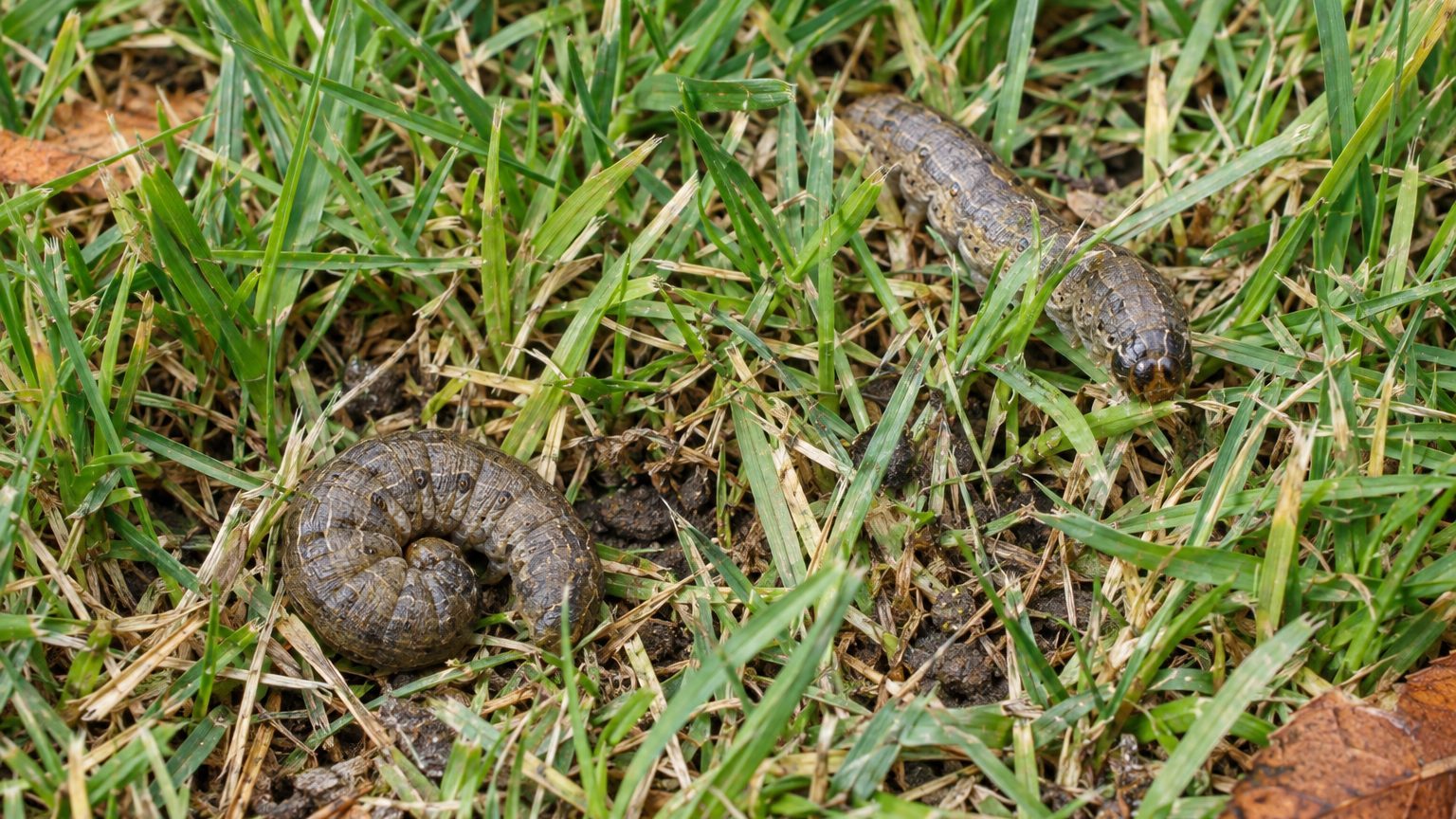
Small brown patches that appear overnight, with grass sheared off right at the soil line, usually point to caterpillars feeding in the dark. Cutworms chew stems and blades near the ground at night and hide by day, so you rarely catch them in the act. A few simple checks will tell you whether they are the cause and what to do next.
Signs of Cutworms in a Lawn

Start with the damage itself, then look for the insect and the moth that starts it all.
- Irregular pockmarked spots show up in the turf, and they grow more ragged as the caterpillar keeps feeding.
- Blades and stems are chewed off near the soil, so the patch looks clipped rather than yellowed or wilted.
- Larvae burrow through the thatch or into the ground by day, then come up to feed after dark.
- Larger areas can be stripped to ground level when the caterpillars are numerous.
- The moths are mottled brown or gray-brown, with a dagger-shaped marking on the wings of the black cutworm, and their eggs are smooth and yellow-cream, stuck singly to the tip of a grass blade.
Seeing the chewed stems and the burrowing larvae together is what settles the diagnosis.
From the almanac
Lawn in your state
The dates on this page depend on where you live. Your state's page carries its frost dates, its USDA zones and the year laid out month by month.
Northeast
Southeast
- Alabama
- Arkansas
- Delaware
- Florida
- Georgia
- Kentucky
- Louisiana
- Maryland
- Mississippi
- North Carolina
- South Carolina
- Tennessee
- Virginia
- West Virginia
Midwest
Southwest
West
Pacific Northwest
Canada
Lawn Damage Mistaken for Cutworms
Early cutworm damage on a closely mown lawn looks a lot like ball marks or small dents, which is why it gets missed. On a putting-green-style yard, those little pockmarks can be the first warning.
Other problems also leave brown patches, so pair what you see with a simple test before treating anything.
| Looks like | How to tell them apart |
|---|---|
| Ball marks or dents in manicured turf | A dent that stays the same size is just a mark. Cutworm pockmarks turn more irregular over time, and grass near the soil is chewed. |
| Armyworm feeding | Armyworms are also listed as pests of all grasses, so the patch looks similar. Flush the spot with soapy water and compare the larvae that rise, since cutworms burrow and feed at night. |
Dry-weather browning can look similar, but drought-stressed grass has intact stems rather than chewed edges at the soil line.
When Cutworms Damage Shows Up
The cause is the caterpillar stage of a night-flying moth. The moth lays eggs on grass blades, the eggs hatch, and the larvae feed on the turf until they finish growing. According to NC State Extension, eggs hatch within 3-10 days and the larvae finish development within 20-45 days, so a patch can appear quickly once the eggs are down.
How often this repeats depends on where you live. The black cutworm has four to five generations in the southern-most states, three to four in the transition zone, and 2 to 3 generations in the most northern parts of its range. A Gulf Coast lawn can face repeated waves through a long season, while an Upper Midwest lawn sees fewer.
No grass is off the list. Other cutworm species are occasional pests of home lawns of all kinds of turfgrass species. Endophyte-enhanced (E+) cultivars of perennial ryegrass, tall fescue, and creeping red fescue provide some resistance to black cutworms, which helps when you are choosing seed.
How to Get Rid of Cutworms
Confirm the pest first, then decide how far to go. Work in this order.
- Mix two tablespoons of liquid detergent into two gallons of water and pour it over one square yard of the damaged edge, because irritated larvae rise to the surface and show you what you are dealing with (this method comes from Indiana and the Midwest).
- In Indiana and throughout the Midwest, collect the larvae that surface a few minutes after the soap flush; they rise from largest to smallest and can be identified before you choose a treatment.
- Count them against the local threshold. According to NC State Extension, 2-6 larvae per square yard may indicate a need for an insecticide application, though that number can change with the site.
- Mow the damaged area and rake out the clippings, because in North Carolina, removing clippings from a recently mowed spot may help take eggs out of the turf.
- Contact your state cooperative extension office if the count is over the threshold, since it can tell you which products are approved where you live and how to apply them.
Below the threshold, healthy turf usually outgrows the loss, so patience and good care are often enough.
How to Prevent Cutworms
Prevention is mostly about keeping the turf vigorous and giving moths fewer places to settle through the year.
- Choose endophyte-enhanced cultivars of perennial ryegrass, tall fescue, or creeping red fescue where they fit your site; in Indiana and throughout the Midwest, broader turfgrass selection should match the site and use.
- Proper mowing, irrigation, fertilization, thatch management, and cultivation help keep turf healthy and vigorous.
- In Indiana and throughout the Midwest, manage thatch buildup, since cutworm larvae shelter and burrow there during the day.
- After aerating, fill the holes soon with sand or other top-dressing, because larvae readily move into aerification holes (this advice is from Indiana and the Midwest).
- After mowing in areas where you have seen moths or damage, collect the clippings, which in North Carolina may help remove eggs.
Check the lawn edges on a regular schedule in warm weather, because early detection keeps a small patch from turning into a stripped area.
Common Questions
Do Cutworms Kill Grass Roots?
They feed on stems and blades near the soil rather than the roots, so grass often recovers if the feeding stops and the lawn is cared for properly.
Why Do I Only Find Damage in the Morning?
Cutworms chew at night and burrow into thatch or soil by day, so the damage is visible while the caterpillars are hidden.
Can Moths in the Yard Mean Cutworms Are Coming?
Mottled brown or gray-brown moths near the lawn may be the adults that lay eggs on grass blades. Spotting them is a cue to scout the turf for chewed patches.