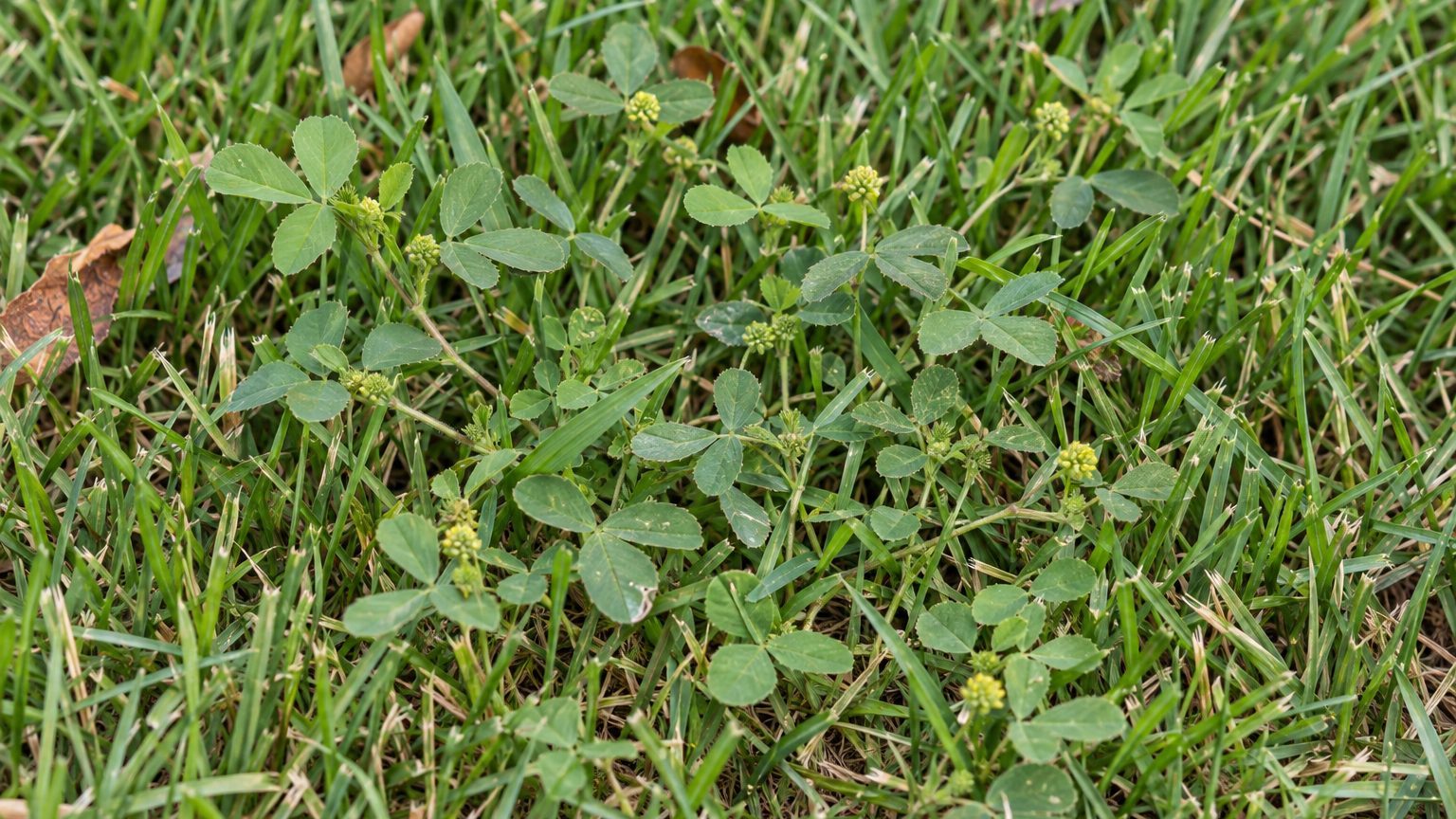
A patch of low, sprawling green dotted with tiny yellow buttons shows up in thin, dry spots of the lawn every summer. That is black medic, a clover look-alike that thrives where grass is weak and the soil runs short on nitrogen. Telling it apart from its neighbors and starving it of room is the work of a lawn season.
How to Identify Black Medic

Start with the flowers, since they set black medic apart from the clovers it grows beside.
- Small, bright yellow flowers sit in compact, rounded clusters of 10-50 tiny blooms, each cluster on a stalk rising from where a leaf meets the stem.
- Each leaf has three oval leaflets, roughly 1/2 to 3/4 inch long, set alternately along the stems.
- Look at the leaflet tip, where a small point projects, and at the edges, which are toothed.
- The plant is a broadleaf annual that sprouts from seed in spring and occasionally in winter.
- Flowers and seed keep coming from April to September, so a patch you ignore in June is reseeding all summer.
Low, mat-forming growth in a thin lawn, with those yellow clusters above it, is the pattern to look for.
From the almanac
Lawn in your state
The dates on this page depend on where you live. Your state's page carries its frost dates, its USDA zones and the year laid out month by month.
Northeast
Southeast
- Alabama
- Arkansas
- Delaware
- Florida
- Georgia
- Kentucky
- Louisiana
- Maryland
- Mississippi
- North Carolina
- South Carolina
- Tennessee
- Virginia
- West Virginia
Midwest
Southwest
West
Pacific Northwest
Canada
Weeds Mistaken for Black Medic
White clover and wood sorrel are easy to confuse with black medic. Check the leaf shape and the flower color together before you decide.
| Looks like | How to tell them apart |
|---|---|
| White clover | Grows in the same sites and often right alongside black medic, but lacks the toothed leaflet edges and the tiny point at the leaflet tip. |
| Wood sorrel (Oxalis) | Its leaves look like a trifoliate legume at a glance, yet black medic gives itself away with the pointed, toothed leaflets and the rounded yellow flower clusters on stalks from the leaf axils. |
Because black medic and white clover so often share a patch, you may be dealing with both at once. Check leaves and flowers across the area before deciding.
What Causes Black Medic in Lawns
Thin turf is the opening. Black medic colonizes dry, thin turf, gravel areas, and other disturbed ground with low soil nitrogen. Because it produces its own nitrogen, it can outcompete turf in low-fertility soils, which is why it often spreads where the lawn is already struggling.
Those conditions give black medic an opening. Compacted strips beside driveways, sidewalks and curbs, sunny slopes that dry out fast, and lawns that rarely get fed all give it a foothold.
Timing matters too. The seed germinates in spring and occasionally in winter, then the plant flowers and sets seed continuously through the warm months. Plants that set seed add to the seed bank and can make the patch harder to manage next season.
How to Get Rid of Black Medic
Work in this order, and treat the soil and grass as part of the fix, not just the weed.
- Pull young plants by hand when the soil is damp, getting the taproot and the whole mat, so no piece is left to regrow.
- Mow higher, since in Utah, raising the mower height to 3 inches or more helps suppress black medic and other lawn weeds.
- Proper fertilization helps turf crowd out black medic.
- Proper irrigation helps prevent the dry, stressed gaps where black medic can gain ground.
- Mulch bare garden beds, as in Utah, where a layer of bark or leaf mulch at least 3 inches thick suppresses weed growth, including black medic.
- Rake out thin areas and overseed them, so dense grass fills the gaps the weed would take.
According to University of Wisconsin Extension, higher mowing in the 3-inch range, proper fertilization, and irrigation help keep black medic in check. If hand work and lawn care are not enough, your state extension office can tell you which herbicide products are approved where you live.
How to Prevent Black Medic
Prevention is mostly a matter of keeping the grass dense, with lawn care timed to local growing conditions.
- In Utah, check for thin or bare spots in spring and plan to reseed them, because that is when black medic germinates.
- According to Utah State University Extension, set the mower to 3 inches or more once the grass is growing.
- In Wisconsin, irrigate dry areas properly; from April to September, watch for yellow flowers and remove plants before they produce more seed.
- In summer, pull plants before the seed sets, and bag them so the seed does not scatter across the lawn.
- Proper fertilization helps the lawn compete with black medic.
- Overseed thin turf at the locally appropriate time so grass can compete when black medic sprouts.
Healthy, dense turf competes with black medic and helps prevent it from establishing.
Common Questions
Is Black Medic the Same as Clover?
No. Both are legumes with three leaflets and often grow together in turf, but black medic has yellow flowers and leaflets with toothed edges and a small projecting tip.
Does Black Medic Come Back Every Year?
Yes, from seed. It is an annual that germinates in spring and occasionally in winter, so seed left from last year’s plants can fill the same spots again.
Why Does Black Medic Grow Where Grass Will Not?
It makes its own nitrogen, so it does well in poor, dry, thin soil where turf struggles. Fixing the soil and thickening the grass takes that advantage away.