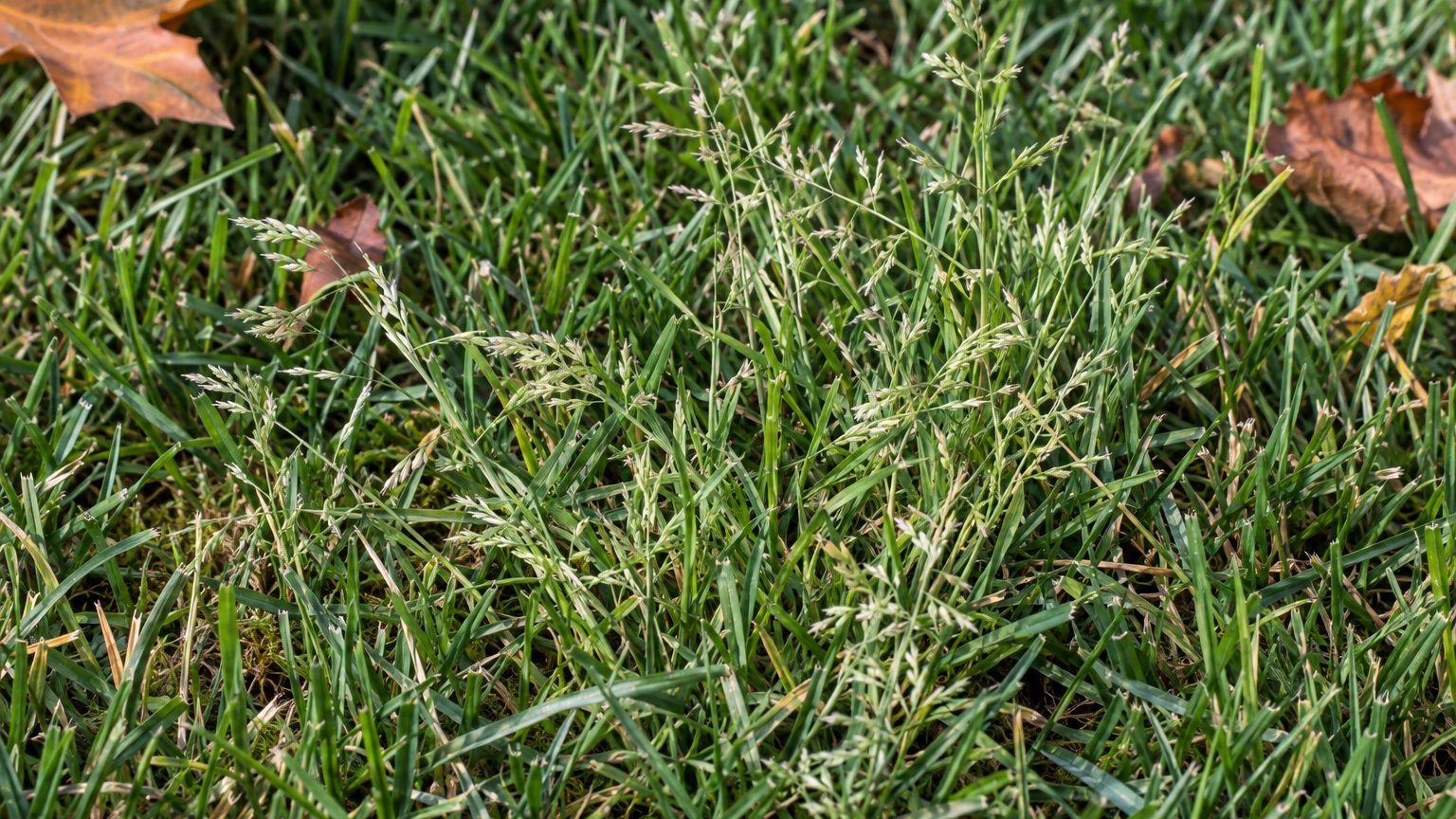
In spring, small tufts of fine grass push seedheads above the mowing line while the rest of the lawn is still waking up. That is usually annual bluegrass, a cool-season grass that fills thin spots and edges. Spotting it early, knowing why it moved in, and timing your response to its fall-to-spring cycle keeps it from spreading across the yard.
How to Identify Annual Bluegrass

Look at the tips of the blades first, then work outward to the seedheads.
- Each blade ends in a boat-shaped tip, as if the leaf were pinched closed at the very end.
- Run your eye down a blade and you will see the faint tramlines on a leaf that is flat, smooth, and slightly keeled.
- Seedheads open loosely on delicate, spreading branches, with stalked spikelets that run 3/8 to 3/4 in. long when flowering.
- Clumps often show up in spring, stay green through winter, and sit in thin turf, along driveways and sidewalks, and on compacted ground.
- The plants grow as low, spreading tufts and look lighter and more ragged than the dense turf around them.
One sign alone can mislead you, so confirm the boat tip and the tramlines together before you act.
From the almanac
Lawn in your state
The dates on this page depend on where you live. Your state's page carries its frost dates, its USDA zones and the year laid out month by month.
Northeast
Southeast
- Alabama
- Arkansas
- Delaware
- Florida
- Georgia
- Kentucky
- Louisiana
- Maryland
- Mississippi
- North Carolina
- South Carolina
- Tennessee
- Virginia
- West Virginia
Midwest
Southwest
West
Pacific Northwest
Canada
Weeds Mistaken for Annual Bluegrass
Two close relatives share the Poa genus with annual bluegrass, and both get confused with it. Neither is a winter annual, so the habit of the plant tells you as much as the blade does.
| Looks like | How to tell them apart |
|---|---|
| Kentucky bluegrass (Poa pratensis) | Plants stay put as a perennial and spread by creeping underground stems, while annual bluegrass forms loose tufts that come from seed and set seedheads in spring. |
| Canada bluegrass (Poa compressa) | Stems are flattened and wiry and grow from a perennial base, while annual bluegrass has softer tufts and tramlines on its blades. |
Kentucky bluegrass is a lawn grass many homeowners plant on purpose, so pull a sample before you treat anything. A plant that comes out as a small tuft with shallow roots and no creeping stems is the one to deal with.
What Causes Annual Bluegrass in Lawns
Annual bluegrass is a winter annual that spreads by seed. It germinates in fall, grows through winter, and sets seed in spring, so every thin patch or bare spot in autumn is an open invitation. Timing varies by place. In Maryland, seeds germinate in late summer to early September, while in North Carolina it emerges from fall through spring.
Conditions decide where it takes hold. In Maryland, cool, moist weather and compacted soil favor growth, and it spreads quickly in thin turf and along edges such as driveways and sidewalks. It prefers moist, shady areas.
Traffic does not stop it. Annual bluegrass grows in a wide variety of soils and tolerates trampling, mowing, and frozen conditions, so it is a frequent weed where people or livestock wear the lawn down. Heavy foot paths, play areas and mower turning spots are common starting points.
How to Get Rid of Annual Bluegrass
Control works best when you stop seed from forming and then keep the lawn thick enough that new seedlings find no room.
- Pull small patches by hand while seedheads are still forming, so the plants cannot drop seed into the surrounding turf.
- Mow frequently when seedheads become visible in spring, with a bagger attached, because in South Carolina the advice is to cut at approximately 2 inches to collect seeds and slow their spread.
- According to Purdue Extension, estimate how much of the lawn is annual bluegrass before you reach for a herbicide, because a preemergence treatment works best in lawns with less than 10% annual bluegrass.
- Apply that preemergence treatment right after the lawn goes dormant from drought, which in Indiana is the most effective combination, and ask your state extension office which products are approved where you live.
- Reseed or patch bare spots left behind, since open soil lets the next flush of seedlings take over.
If annual bluegrass covers a large share of the lawn, focus on preventing seed production and thickening the turf.
How to Prevent Annual Bluegrass
Prevention follows the plant’s calendar, which starts in late summer when the seeds wake up.
- In late summer, watch for soil cooling, because in Indiana germination begins once soil temperatures fall below 70 degrees F.
- Maintain healthy, dense turf in thin areas so annual bluegrass has less room to establish.
- Limit traffic on frozen and soggy turf, since annual bluegrass tolerates trampling and frozen conditions.
- Address compacted soil along walkways and driveways in Maryland, and improve drainage in damp, shaded corners in North Carolina.
- Through the growing season, maintain healthy, dense turf that can compete, because in Maryland that is how thick grass keeps weeds from establishing.
Pay close attention to edges in Maryland and to shady spots in North Carolina, since annual bluegrass is favored in those places.
Common Questions
Can Annual Bluegrass Seeds Stay in the Soil for Years?
Yes. The seeds can lie dormant for years before sprouting, so a lawn can produce new plants long after the last seedhead was cut.
Does Annual Bluegrass Grow in Winter?
It does. As a winter annual, it grows through the cold months; in North Carolina, it also tolerates frozen conditions.
How Many Seeds Does One Plant Make?
Each plant produces several hundred seeds in a season, so letting even a few seedheads ripen can restock the lawn.