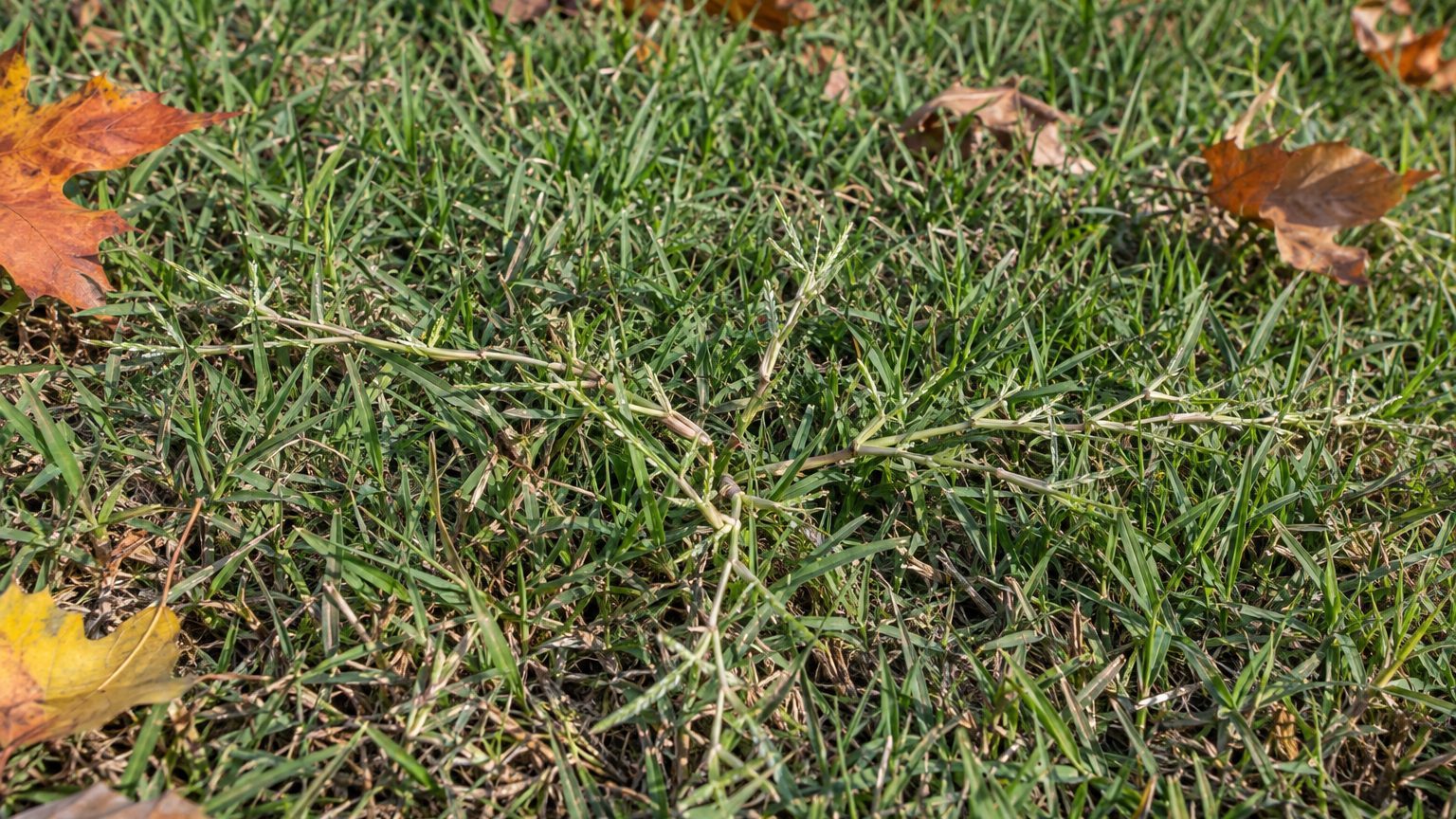
Bermudagrass shows up as a fine, fast-spreading patch of lighter green that creeps across a fescue or bluegrass lawn through summer and turns straw brown in fall. Spotting it early, knowing what it is not, and cutting off its runners decides whether you pull a few patches or fight the whole yard.
How to Identify Bermudagrass

Look first at the leaf base and the creeping stems, since those give it away more reliably than color alone.
- A conspicuous ring of white hairs sits where each blade meets the sheath.
- Blades are generally smooth and pointed, short and fairly flat, in a gray-green that stands apart from the surrounding turf.
- Stolons run across the soil surface, and rhizomes run just below it, rooting at the nodes to start new plants.
- Seed heads bear three to seven spikelike branches, usually in a single whorl at the tip of the stem, like fingers spread from one point.
- Left unmowed in summer, it can climb to 2 ft. tall, then goes dormant in the fall and turns brown while cool-season grass stays green.
That brown, tan patch in autumn often makes the invasion stand out against green turf.
From the almanac
Lawn in your state
The dates on this page depend on where you live. Your state's page carries its frost dates, its USDA zones and the year laid out month by month.
Northeast
Southeast
- Alabama
- Arkansas
- Delaware
- Florida
- Georgia
- Kentucky
- Louisiana
- Maryland
- Mississippi
- North Carolina
- South Carolina
- Tennessee
- Virginia
- West Virginia
Midwest
Southwest
West
Pacific Northwest
Canada
Weeds Mistaken for Bermudagrass
Several weedy grasses look close enough to fool a quick glance, so take care to tell them apart from similar-looking lawn grass species before you treat anything.
Check the leaf base and growth habit together. A pale patch alone proves nothing, but a pale patch with the wrong leaf base or the wrong growth habit points to a different grass.
| Looks like | How to tell them apart |
|---|---|
| Crabgrass | Wide, coarse blades radiating from one center in a star shape, and it lacks the ring of white hairs at the blade base. |
| Zoysiagrass | Stiffer, denser blades that form a tight mat, with no ring of white hairs and a slower, more gradual spread. |
| Quackgrass | Broader, flatter blades with small clasping lobes at the base, and it stays green while bermudagrass browns in fall. |
Look for creeping stems: bermudagrass spreads by aboveground stolons and belowground rhizomes.
What Causes Bermudagrass in Lawns
Bermudagrass arrives through creeping stems and seed, and it takes hold wherever the lawn is thin enough to give it light. It is a warm-season perennial widely used for lawns in the southeastern United States, so neighboring yards and roadsides there supply a steady source that creeps under fences and edging.
Fragments of stolons and rhizomes can root and regrow if cut and left on or in moist soil. A mower, a tiller, or a shovel full of infested dirt can seed the problem into a clean patch of lawn.
In California, bermudagrass grows in a wide range of environmental and drought stress conditions, and although it tolerates some drought, it grows best when irrigated. Seedlings there may also emerge in turfgrass, garden, or landscaped areas that have been treated with postemergence herbicides, because clearing the old growth opens room for new plants. Increasing shade from trees and tall shrubs reduces its growth, which is why it thins out under canopy and thrives in open sun.
How to Get Rid of Bermudagrass
Because it spreads from buried stems as well as seed, removal works best as a sequence that exposes the runners and keeps them from rooting again.
- Mark the patches in fall while dormant grass shows the visible outline, so you can return to the same area during removal.
- In California, cultivate the infested area deeply; a single cultivation down to 6 inches may be adequate to bring most shoots to the surface.
- Rake out the exposed stolons and rhizomes and bag them, because cut fragments left on moist soil will root and regrow.
- Check with your state extension office about which herbicide products are registered in your state, and follow the label, since rules differ from place to place.
- Reseed the cleared ground with a lawn grass suited to your area so the bare soil does not hand the space back to bermudagrass.
- Go back over the patch regularly and dig out any new shoots while they are small.
Expect to repeat the work. A thick, healthy lawn is what finally closes the door, so treat removal and renewal as one job.
How to Prevent Bermudagrass
Prevention follows the lawn’s own year, and the aim is to keep the turf dense and limit open ground.
- In Maryland, mow at 3-4 inches high during the growing season so the canopy shades the soil.
- In California, do not water beyond the lawn’s needs, since bermudagrass grows best when irrigated.
- In Maryland, seed bare spots so runners and seedlings have less open soil to enter.
- In fall, feed tall fescue; Virginia recommends 3.5 to 4.0 inch mowing heights with fall fertility, which builds the dense turf that crowds out invaders.
- After any edging or digging near an infested border, rake up and discard the fragments instead of composting them or leaving them on moist soil.
Cleaning mower decks and tools after working an infested area keeps stem pieces from riding into clean turf.
Common Questions
Can Bermudagrass Come Back After You Kill It?
It can, from buried stem pieces you missed. Check the area regularly and pull new shoots early, before they root and spread.
Why Does Bermudagrass Turn Brown When the Rest of the Lawn Is Green?
It goes dormant in the fall. When cool-season lawn grasses are still green, the brown patches make dormant bermudagrass easier to spot.
Is Bermudagrass a Weed or a Lawn Grass?
Both. Across the Southeast it is planted on purpose as a lawn, but in a fescue or bluegrass yard it behaves as an invader that spreads by runners.