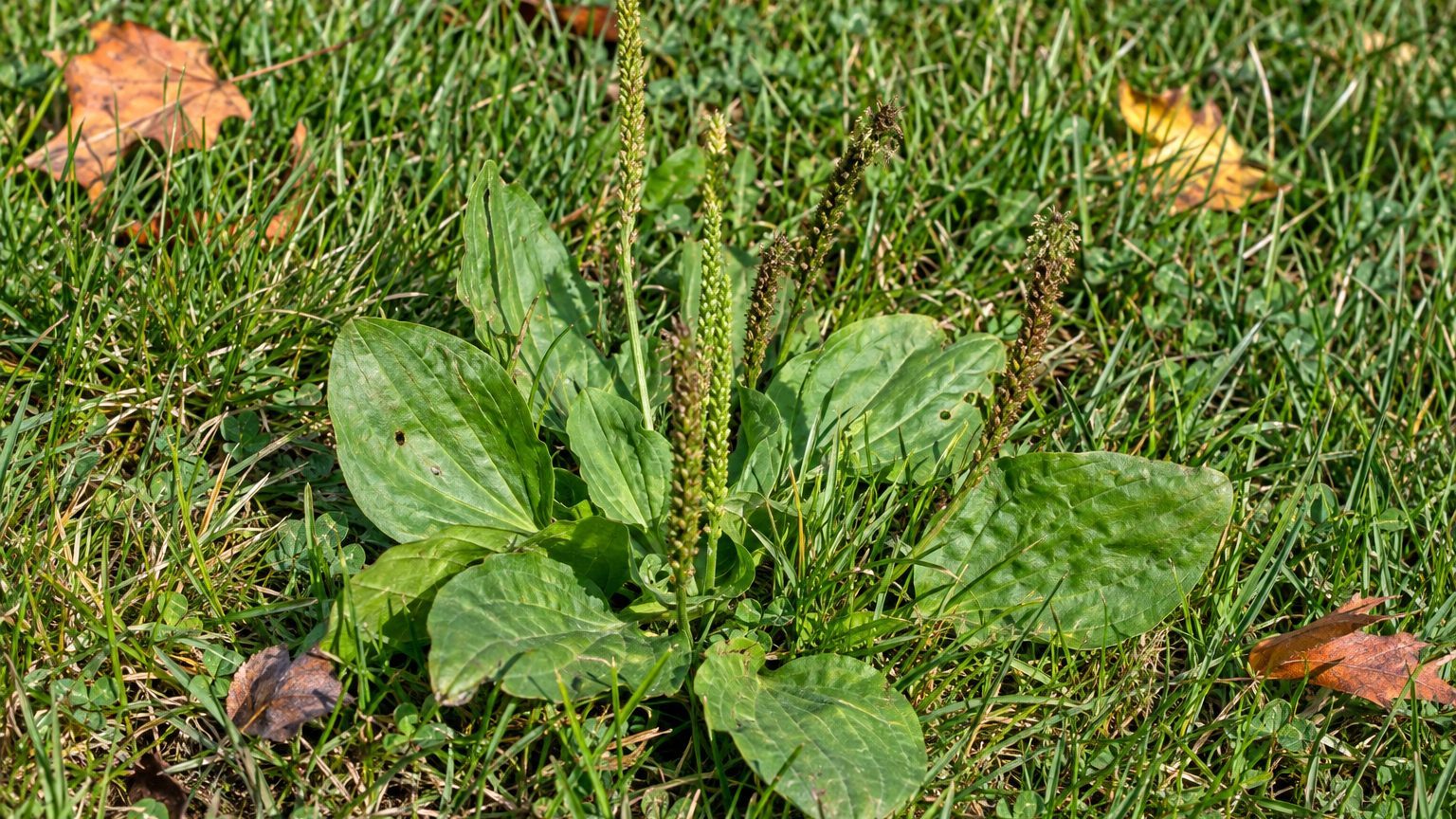
A flat rosette of broad, ribbed leaves hugging the ground, still there after the mower passes, is usually broadleaf plantain. It is a perennial that regrows from its crown, so mowing alone never finishes it. Pulling, thickening the turf and fixing the soil underneath do.
How to Identify Broadleaf Plantain
Look at the leaves first, because they give the plant away even when nothing else is showing.
- The leaf blades are smooth and oval, 2 to 7 inches long, with several veins that run parallel to the leaf edge.
- The leaves all rise from one point at the soil surface, forming a low rosette that sits flat under the mower deck.
- In summer, leafless stalks shoot up from the rosette, reaching 15 inches tall and ending in a dense spike of small flowers.
- The spikes leave behind black or brown seeds about 1/16 inch across, small enough to ride in on shoes and mower wheels.
- The plant comes back in the same spot year after year, because it is a perennial and not a one-season weed.
Dig one up and you will find a tough crown just at the soil line, which is why a clipped plant simply regrows.
From the almanac
Lawn in your state
The dates on this page depend on where you live. Your state's page carries its frost dates, its USDA zones and the year laid out month by month.
Northeast
Southeast
- Alabama
- Arkansas
- Delaware
- Florida
- Georgia
- Kentucky
- Louisiana
- Maryland
- Mississippi
- North Carolina
- South Carolina
- Tennessee
- Virginia
- West Virginia
Midwest
Southwest
West
Pacific Northwest
Canada
Weeds Mistaken for Broadleaf Plantain
Only one plant is a regular source of mix-ups, and it is a close relative. Buckhorn plantain forms a similar ribbed rosette, so a quick glance can fool you.
Check the leaf shape and the root before choosing a method, since the two plants do not grow quite the same way.
| Looks like | How to tell them apart |
|---|---|
| Buckhorn plantain | Leaves are longer and narrower, 3 to 12 inches long, compared with the broad oval blades of broadleaf plantain. Dig one up and it has a taproot. |
| Buckhorn plantain in bare ground | It grows best in disturbed sites such as bare, torn-up patches, while broadleaf plantain is the one you find in moist, compacted spots. |
In California, removal is similar for the two plants, so a mistaken ID costs little. Still, a taproot snaps off more easily when you pull, so loosen the soil first.
What Causes Broadleaf Plantain in Lawns
Thin, stressed turf gives plantain its opening. Seed lands at or near the soil surface, and wherever grass is sparse, the seedlings face little competition.
Compaction is the usual setback. In California, broadleaf plantain commonly turns up in moist areas with full sun or partial shade and compacted soil, and it is an indicator of alkaline soil with low fertility. In Maryland, dry, compacted soil and infrequent or improper fertilizer applications are what favor it.
Foot-worn paths, driveway edges and spots where the mower or kids pack the ground are the usual starting points. Seedlings can spend 8 to 15 weeks in their young stage in California, depending on growing conditions, so a weak spot can fill in before you notice.
How to Get Rid of Broadleaf Plantain
Start with your hands and the lawn itself, in this order, and call your state extension office if you want to consider a herbicide, since approved products differ by state.
- Water the area the day before, so the soil is soft and the whole crown comes out with the roots.
- Pull the plant or lift it with a weeding tool, because in Maryland these are the primary means of mechanical weed control in lawns.
- Remove every piece of crown, since plantain grows from the crown at the soil surface and can regrow from what is left.
- Cut off any seed spikes before moving them and bag them, so the seeds do not scatter across the lawn.
- Fill the bare spot with seed or sod and keep it moist, so grass claims the hole before new plantain does.
- Loosen compacted ground with aeration where the weeds clustered, so the new grass can root.
In planting beds, organic mulch 2 to 4 inches deep may control seedlings by itself in California. Pulling stays the main tool in turf, and a few missed plants are easy to catch on a later pass.
How to Prevent Broadleaf Plantain
Prevention follows the season, and it comes down to keeping grass thick and the ground loose.
- In early spring, aerate any packed areas and feed the lawn on a regular schedule, since infrequent or improper fertilizing favors plantain in Maryland.
- Once the soil reaches 50°F, watch for seedlings, because in California that is when plantain seed starts to germinate with enough moisture.
- Through late spring and summer, mow at a steady height and water deeply, so dense turf can compete and keep weeds from establishing.
- In midsummer, pull plants as soon as flower spikes appear, so black or brown seed never drops into the lawn.
- In early fall, overseed thin or worn patches so grass fills in before the next season of weed seed.
Germination speeds up as soil warms toward 77°F in California, so thin spots in warm weather deserve your attention first.
Common Questions
Does Mowing Get Rid of Broadleaf Plantain?
No. The plant grows from its crown at the soil surface, so it survives mowing and sends up new leaves. The crown has to come out.
Is Broadleaf Plantain an Annual or a Perennial?
It is a perennial, so one plant can return for years. Left alone, it also keeps adding seed.
Why Does Plantain Grow Along My Driveway and Walkway?
Those edges tend to be packed down, which suits the plant, and the turf there is often thin. Loosening the soil and thickening the grass makes them less welcoming.