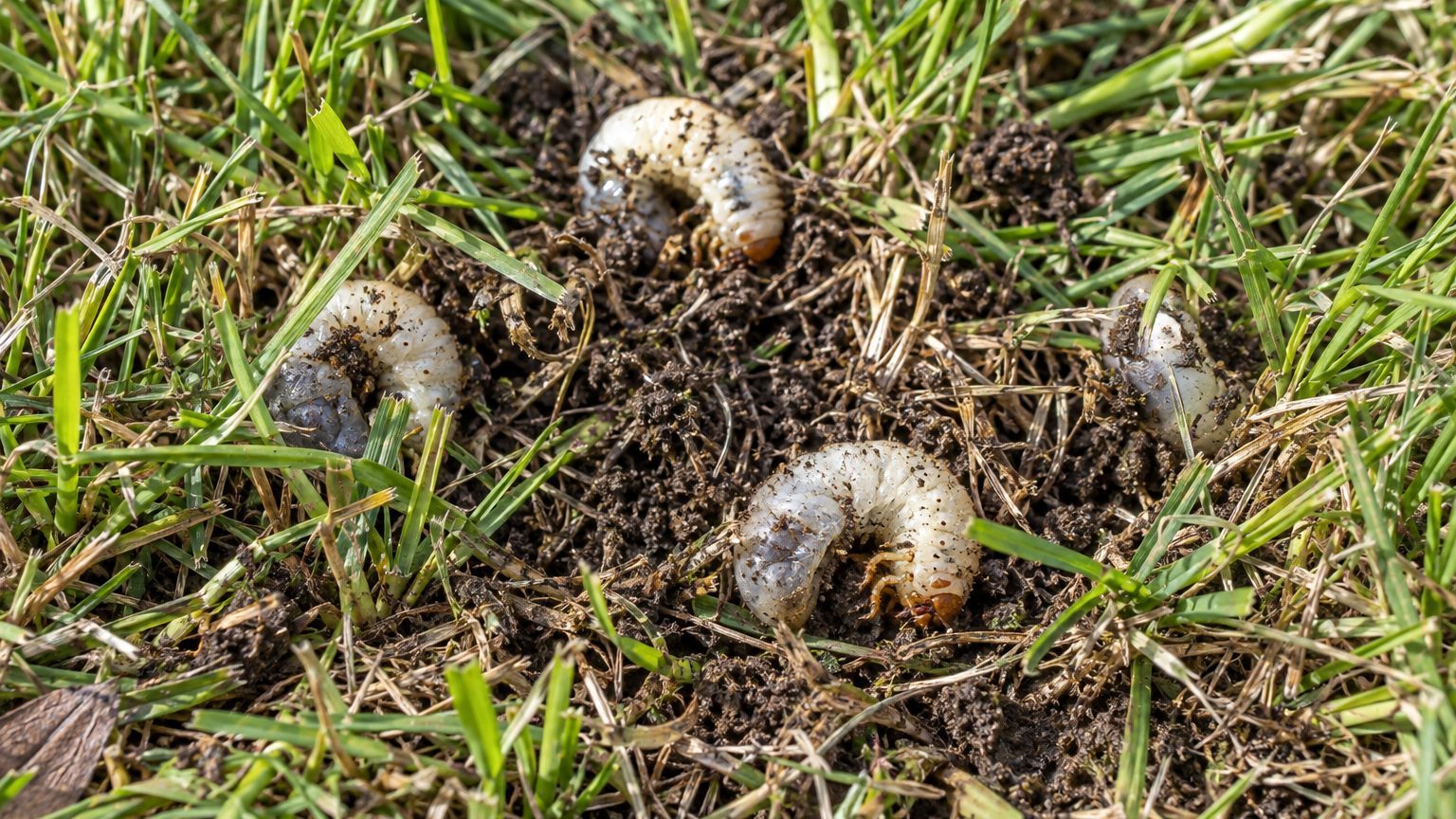
A patch of turf that goes limp and brown even after a good soaking, then lifts like a loose rug, is the classic mark of white grubs feeding on the roots. Recognizing the damage, separating it from look-alikes, and counting the grubs helps you decide whether to act.
Signs of White Grubs in a Lawn

The grub itself is easy to recognize when you lift turf at the edge of a damaged patch.
- Pull back a loose piece of sod and you find plump, off-white, C-shaped larvae with a brown head and 3 pairs of legs, sitting in the root zone.
- Older larvae reach up to 1-1/2 inches long and are wrinkled and whitish to yellow, which makes them hard to miss once exposed.
- Grass in scattered patches wilts and stays stressed even after you irrigate, because the roots that carry water are gone.
- Wilting turf may take on a blue or purple cast before it collapses into dead or very thin patches.
- The sod lifts or pulls up with little effort, and the white grubs show up underneath.
In Indiana and adjacent states, large larvae are present by September, when damage may become easier to spot.
From the almanac
Lawn in your state
The dates on this page depend on where you live. Your state's page carries its frost dates, its USDA zones and the year laid out month by month.
Northeast
Southeast
- Alabama
- Arkansas
- Delaware
- Florida
- Georgia
- Kentucky
- Louisiana
- Maryland
- Mississippi
- North Carolina
- South Carolina
- Tennessee
- Virginia
- West Virginia
Midwest
Southwest
West
Pacific Northwest
Canada
Lawn Damage Mistaken for White Grubs
Dry, brown turf is not always a grub problem. Drought and several other root problems also leave patches that look much the same from the sidewalk.
A quick dig and a tug on the grass settles most cases. Check the roots and the soil, not just the color of the blades.
| Looks like | How to tell them apart |
|---|---|
| Drought stress: grayish, wilted patches | The sod stays rooted when you tug it, unlike grub-damaged turf, which lifts easily. With grubs, turf does not respond to irrigation and the sod lifts easily. |
| Dead patches from thatch or compaction | Roots are present but shallow in hard or spongy soil, and no grubs turn up when you dig. With grubs, roots are chewed off and C-shaped larvae sit beneath the surface. |
Some fungal diseases can also leave brown patches, so confirm grub damage by lifting the turf and checking for larvae. If the roots hold firm and no larvae appear, look away from grubs.
When White Grubs Damage Shows Up
The cause is the larval stage of scarab beetles feeding on grass roots, thatch and organic matter in the soil. They damage both warm-season and cool-season grasses, and they favor bluegrass and ryegrass in particular.
Timing follows the life cycle. In Indiana and adjacent states, annual white grubs overwinter as larvae, pupate in late spring or early summer, and adults fly in early to mid-summer. Eggs hatch by the end of July, and large larvae are present by September, which is when patches usually show.
According to Iowa State University Extension, eggs hatch in 2 to 3 weeks after they are laid, and the tiny larvae begin eating roots right away. Damage often appears well after the feeding started, since the lawn holds on until the roots are mostly gone.
How to Get Rid of White Grubs
Start with a count, because many lawns carry grubs without needing any treatment at all.
- Cut a square foot of sod in a few places along the edge of a damaged patch, so you know how many grubs live in each square foot.
- Compare the count with the local threshold: in Indiana and adjacent states, populations below 5 grubs per square foot rarely require treatment, while 5 to 10 grubs per square foot are usually needed for significant damage.
- Leave the lawn alone if the count is low, because in Indiana and adjacent states most turfgrass tolerates up to 5 grubs per square foot without visible damage.
- Act when counts run high, since in Iowa 10 or more annual white grubs per square foot will kill the grass.
- Ask your state extension office which treatments are approved where you live and when to apply them, since registrations differ by state.
- According to Cornell Cooperative Extension, fall fertilization with 0.25-5 lb. of N per 1,000 square feet enhances turf recovery from grub damage.
Reseed or sod any bare patches after the grubs are dealt with, so weeds do not move into the gaps.
How to Prevent White Grubs
A thick, deep-rooted lawn shrugs off moderate grub numbers, so prevention mostly means good routine care through the year.
- In Indiana and adjacent states, choose grass species and cultivars suited to the site and its use when you reseed.
- In early summer, when adult beetles begin to fly in Indiana and adjacent states, keep mowing at the proper height so the turf stays dense.
- Use proper irrigation and thatch management to keep turf healthy and vigorous.
- By late July in Indiana and adjacent states, when eggs are hatching, scout a few spots so you catch a rising count early.
- In New York, fall fertilization can help turf recover from grub damage.
Appropriate cultivation also helps keep turf healthy and vigorous.
Common Questions
Do a Few Grubs in the Lawn Mean You Need to Treat?
Usually not. According to Purdue Extension, a few scattered grubs are not a cause for concern, and densities as high as 20 per square foot may not cause noticeable damage.
How Can You Tell If Grubs Are Eating Your Lawn or It Is Just Dry?
Tug the turf. Grass damaged by grubs lifts like a loose mat and shows larvae below, while dry grass stays rooted and perks up after a deep watering.
What Do White Grubs Look Like?
They are pudgy, off-white, C-shaped larvae with a brown head and 6 legs, and older ones can reach 1-1/2 inches in length.