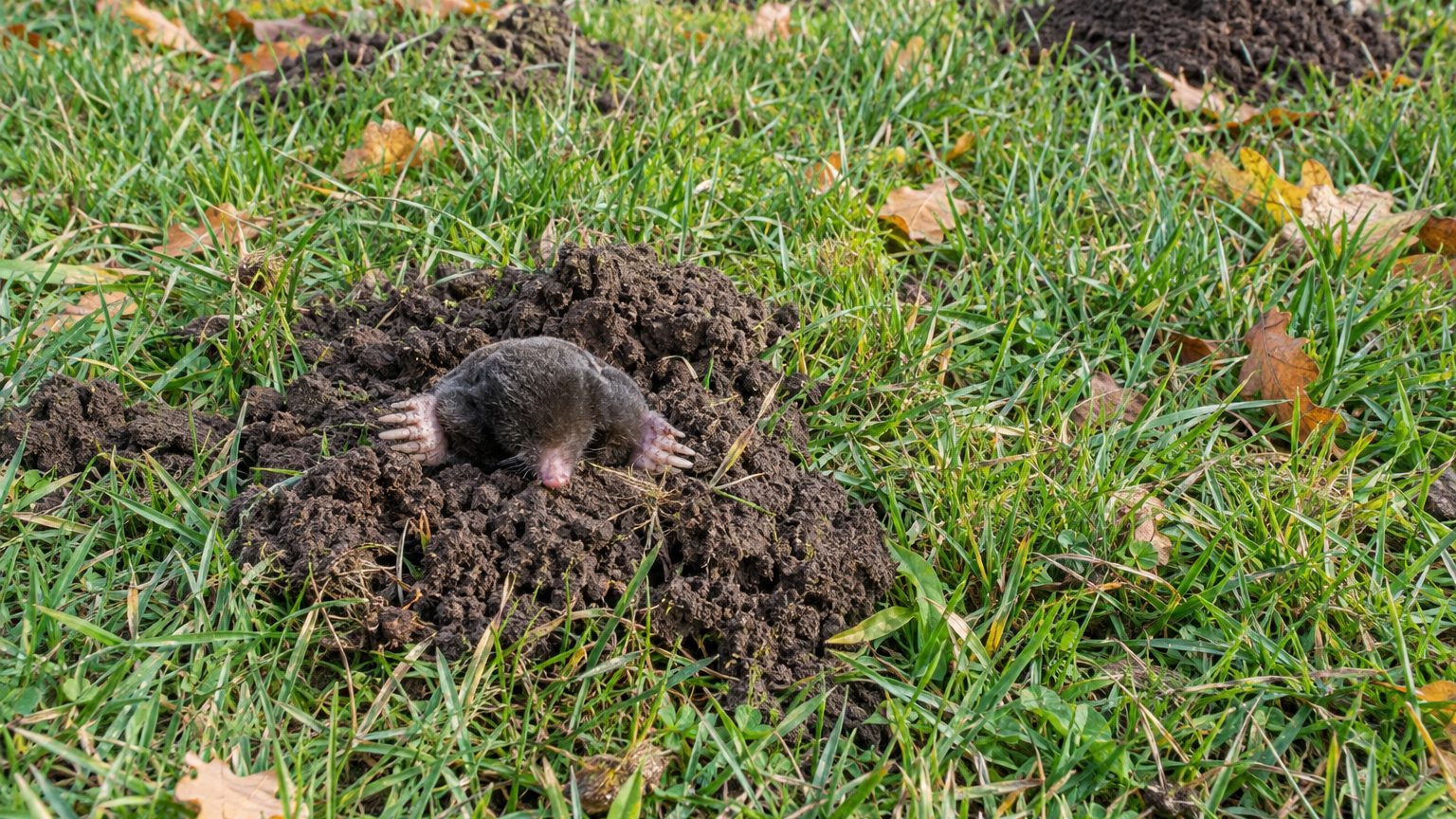
Raised, winding ridges and small cones of loose soil showing up across the grass point to a mole tunneling underneath. The animal rarely appears, but its work is easy to read once you know the signs. Spotting the right tunnel and acting on it soon keeps a small problem from spreading across the whole front yard.
Signs of Moles in a Lawn

Look for the surface signs that set moles apart from other lawn pests.
- Volcano-shaped mounds of loose, crumbly soil pushed up from deep tunnels are a sign of a mole.
- Raised ridges wander across the grass, soft underfoot, where a mole is feeding just below the surface.
- Tunnels grow fast, at a rate of 18 feet per hour, so a ridge that was not there yesterday is a fresh one.
- Ridges may be scalped by the mower, which tears the turf and can damage the blade.
- Paddle-shaped feet with prominent digging claws mark the animal itself if you ever see one, which is 4 to 7 inches long.
Mounds and ridges together, in a lawn with soft soil, leave little doubt about who is digging.
From the almanac
Lawn in your state
The dates on this page depend on where you live. Your state's page carries its frost dates, its USDA zones and the year laid out month by month.
Northeast
Southeast
- Alabama
- Arkansas
- Delaware
- Florida
- Georgia
- Kentucky
- Louisiana
- Maryland
- Mississippi
- North Carolina
- South Carolina
- Tennessee
- Virginia
- West Virginia
Midwest
Southwest
West
Pacific Northwest
Canada
Lawn Damage Mistaken for Moles
Not every disturbed patch of grass comes from a mole. Other causes leave different patterns once you look at the soil and the shape of the damage.
A quick look at the mound shape, plus where the damage sits, usually settles it.
| Looks like | How to tell them apart |
|---|---|
| Raised ridges from voles | Voles leave open surface runways and small entry holes in the grass, while mole ridges are closed and come with soil mounds. |
| Mounds from earthworms or ants | Their piles are small and scattered, often with castings or a visible hole, while a mole mound is a larger cone fed by a ridge nearby. |
Gopher mounds are also sometimes confused with mole mounds, but a mole mound is a rounded volcano shape and gophers are rarely a lawn problem in the eastern half of the country.
When Moles Damage Shows Up
The cause is food. Moles tunnel through the soil hunting for the creatures living in it, and they dig wherever that hunting is easy. Well-drained, loamy soils are their favorite haunts, so lawns with that soft, easily dug ground see the most trouble.
In Iowa, fresh surface activity shows up in early morning and late afternoon in spring and fall, and on cloudy, damp days of summer. The rest of the year, they stay in deep tunnels 6 to 24 inches under the surface, which is why ridges seem to vanish in the coldest and driest stretches.
Numbers are small even when the damage looks huge. In Iowa, moles are mostly solitary, with about 3 moles per 1 acre of land. One animal can add 150 feet of new tunnels in the lawn each day, which explains why a single mole can seem like an invasion. In New Jersey, a single litter of 3 to 5 hairless young is born in the nest chamber.
How to Get Rid of Moles
Trapping is the most dependable way to remove a mole, and a few steps in the right order make it work. Your state extension office can tell you which products and rules apply locally.
- Flatten a short stretch of ridge with your foot, so you can see which tunnels the mole repairs and which it abandons.
- Watch for the repair. In New Jersey, if the damage in a given location is repaired within 1 or 2 days, place a trap near that spot.
- Choose a permanent runway for the trap. In Iowa, traps belong on permanent runways, not the temporary, meandering feeding tunnels.
- Set more than one trap when activity is heavy. In New Jersey, 3 to 5 traps per acre give faster control, unless mole activity is very light.
- Check the traps regularly and move any that sit unused, since a mole that avoids a tunnel will not return to it.
- Press the mounds flat and roll the ridges back down once the digging stops, so the grass can knit together again.
For a small, prized lawn, a barrier is another route, described in the next section.
How to Prevent Moles
Prevention is mostly about keeping them out of the spots you care about most, and about reading the season so you act before a litter or a feeding surge.
- In Iowa, walk the lawn in early spring and flatten any ridges, so fresh digging stands out clearly when it appears.
- Roll or tamp raised ridges before mowing so the mower does not scalp the turf.
- When you build a barrier around a garden bed or small lawn, use a 3′ (91.5 cm) width of galvanized hardware cloth or aluminum sheathing. In New Jersey, the advice is to bury it 2′ (61 cm) deep (1.5′ in hard ground).
- Leave 6″ (15 cm) of the barrier above the ground, and bend the bottom 3″ (7.5 cm) outward so moles cannot dig under.
- In Iowa, check ridges often in spring and fall, when moles are close to the surface, and set traps promptly.
Lawns on loose, well-drained loam stay the most inviting to moles, so expect to repeat the checks there.
Common Questions
How Big Is a Mole?
A fully grown eastern mole measures 5″ to 8″ (13 to 20 cm) in length, with paddle-shaped feet and strong claws. The eastern mole, Scalopus aquaticus, is the one most often found in Iowa lawns.
Why Do Mole Ridges Seem to Disappear in Some Months?
Moles do not leave. They move deeper and dig less near the top, so the soft ridges fade until surface feeding picks up again with cooler, damp weather.
Can a Mower Damage a Mole Ridge?
Yes. Mowing over a raised ridge can scalp the turfgrass and harm the mower, so flatten ridges before you cut.