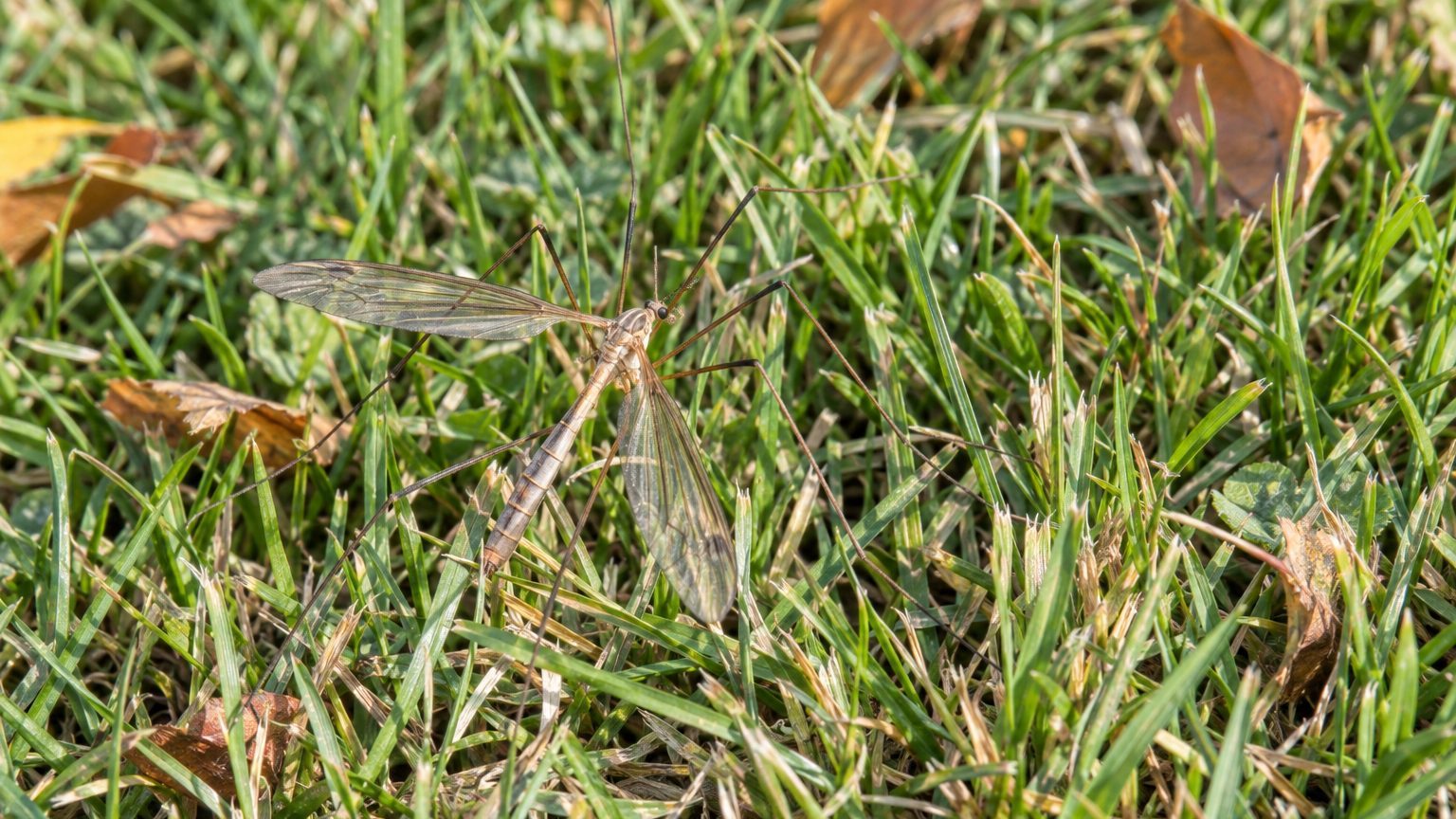
Pull back a patch of thin, yellowing turf in early spring and you may find gray-brown, legless grubs curled in the thatch and near the soil surface. Those are crane fly larvae, and they feed on grass roots and crowns. Telling them apart from other grubs, and knowing when they are worth treating, saves you from needless work.
Signs of Crane Fly Larvae in a Lawn

Larvae hide below the surface, so the lawn offers a clue and the soil confirms it.
- Dig into a thinning patch and you may find a tough, gray to brown, legless grub, 1-1.25 inches long once mature, with no obvious head.
- Dying patches of turf are most noticeable in March and April, right when the lawn should be greening up.
- The thinning tends to show up in damp spots, since larvae do very well in wet soil.
- Weeds move into the dead patches as the grass gives way.
- Gray to brown pupae, about 1 inch long, may turn up in the soil, and they do not feed.
Adults look like oversized mosquitoes at roughly 0.5 inches long, but they do not bite and do not harm the grass.
From the almanac
Lawn in your state
The dates on this page depend on where you live. Your state's page carries its frost dates, its USDA zones and the year laid out month by month.
Northeast
Southeast
- Alabama
- Arkansas
- Delaware
- Florida
- Georgia
- Kentucky
- Louisiana
- Maryland
- Mississippi
- North Carolina
- South Carolina
- Tennessee
- Virginia
- West Virginia
Midwest
Southwest
West
Pacific Northwest
Canada
Lawn Damage Mistaken for Crane Fly Larvae
Several other problems leave tan, thin turf in spring. Confirm what you see aboveground with what you find when you dig.
Digging a small square of sod helps settle these questions.
| Looks like | How to tell them apart |
|---|---|
| Winter dieback or snow mold | Matted, straw-colored or grayish patches right after the snow melts, and the soil below holds no grubs when you turn it over. |
| White grub damage | Turf that peels back like a loose carpet, and the grubs underneath are C-shaped with visible legs, unlike the legless gray crane fly larva. |
| Drought or compaction stress | Dry, hard ground in the sunniest or most trampled spots, while crane fly thinning favors the wet areas. |
Dog urine spots can also pass for crane fly damage, though they usually show a dark green ring around a dead center and no grubs in the soil.
When Crane Fly Larvae Damage Shows Up
The cause is the larval stage of the insect, which feeds on grass while it lives underground. In the Pacific Northwest, larvae are in the soil from early October until the following September, which is 11 months of the year, so the feeding is long even if the damage stays hidden for much of it.
Life-cycle timing varies by region. In Illinois, adults appear during summer, eggs hatch in the fall, and the insect overwinters as a larva. In Colorado, adults mate and lay eggs in turfgrass soon after emerging in late summer and fall, so the next generation starts feeding before winter.
Moisture decides where the trouble lands. Eggs and larvae need high moisture to survive, and most species breed in aquatic or semi-aquatic habitats. Low spots and lawns that stay soggy are favorable habitat, while improving drainage makes consistently wet areas less favorable to crane flies. Large populations combined with wet conditions are what turn a nuisance into thinning and bare patches.
How to Get Rid of Crane Fly Larvae
Start by confirming the problem and counting, since light feeding often needs no treatment at all.
- Dig a section of sod 1 foot long, 1 foot wide and 1 inch deep with a square-end shovel, as is advised in the Pacific Northwest, so you see what is living in the root zone.
- Count the larvae in that square foot, because in healthy, well maintained turf in Colorado the treatment threshold is 20 larvae per square foot.
- Skip treatment if the count is below your local threshold, since larval feeding is usually a nuisance with no significant injury.
- In Illinois, reduce moisture by avoiding watering when the lawn is already damp, because eggs and larvae need high moisture to survive.
- Improve drainage in areas that stay wet, as crane flies thrive in wet soils and drier ground discourages them.
- Reseed the bare patches once the larvae are under control, so weeds do not take over the dead spots.
If the count is high, your state extension office can tell you which treatments are approved where you live and what timing suits your local cycle.
How to Prevent Crane Fly Larvae
Prevention is mostly about keeping the top layer of soil on the dry side during the season when adults are laying eggs.
- Check low spots and downspout outlets for standing water, and improve drainage where the ground stays soggy.
- From Memorial Day to Labor Day, water in the Pacific Northwest with 0.25 inch four times per week, a total of 1 inch, rather than frequent light sprinkling.
- In the Pacific Northwest, mow once a week to a height of 2 to 3 inches to keep the turf dense.
- In Colorado, hold back extra irrigation in late summer and fall, when adults emerge and lay eggs in turfgrass.
- In early spring, walk the lawn and look for thin, damp patches so you can dig and count before the damage spreads.
Healthy, dense turf tolerates the larvae that do show up far better than a thin, stressed lawn.
Common Questions
Are Crane Flies Harmful to People or Pets?
No. The adults look like large mosquitoes but do not bite, and the larvae stay in the soil. The only damage is to the turf.
Will Crane Fly Larvae Kill a Healthy Lawn?
Usually not. Feeding is generally a nuisance, though large populations combined with wet conditions can cause thinning and larger bare patches.
Do Adult Crane Flies in the House Mean the Lawn Has Larvae?
Not by itself. Adults near lights do not by themselves confirm a lawn infestation. Check a thin patch by turning over the sod and counting what you find before deciding anything.