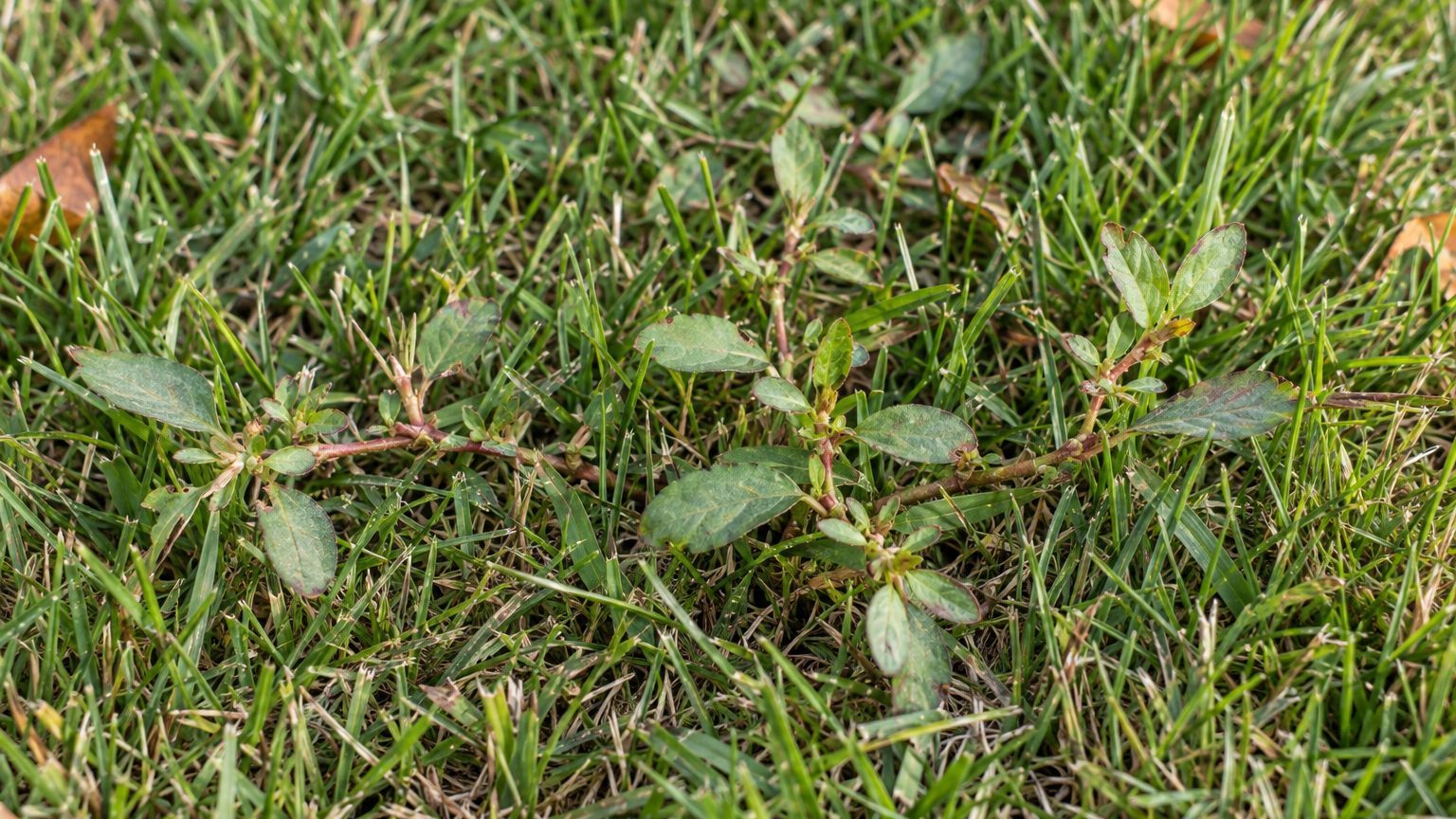
Pull back a mat of wiry, bluish-green stems from the edge of a driveway or a worn path across the grass, and you are probably looking at prostrate knotweed. Spotting prostrate knotweed early, and loosening the compacted soil that lets it thrive, are the first steps toward a healthier yard.
How to Identify Prostrate Knotweed

Start with the way the plant sits, because the habit gives it away before the leaves do.
- Mature plants lie flat and sprawl outward in tough, wiry stems that are hard to pull apart and form a tight mat.
- Leaves are small, narrow and oval, and they measure 1/2 – 1 inch wide, set alternately along the stem.
- Underneath, each plant holds on with a thin taproot, which is why a tug on the stem often snaps it.
- Seedlings in early spring have a red hypocotyl, the short stem just below the seed leaves, and the seed leaves are so narrow they look like a germinating grass.
- It is a summer annual, so the mat builds through the warm months and dies back when the season ends.
That grassy look in seedlings fools many people, so check for the red base and a broadleaf pattern as the first true leaves appear.
From the almanac
Lawn in your state
The dates on this page depend on where you live. Your state's page carries its frost dates, its USDA zones and the year laid out month by month.
Northeast
Southeast
- Alabama
- Arkansas
- Delaware
- Florida
- Georgia
- Kentucky
- Louisiana
- Maryland
- Mississippi
- North Carolina
- South Carolina
- Tennessee
- Virginia
- West Virginia
Midwest
Southwest
West
Pacific Northwest
Canada
Weeds Mistaken for Prostrate Knotweed
Two low, spreading weeds get mixed up with knotweed all the time, and both also thrive in summer heat on bare, hard ground. Each has a quick test that settles it.
Snapping a stem and checking the leaf arrangement answers the question quickly.
| Looks like | How to tell them apart |
|---|---|
| Spotted spurge or prostrate spurge | Leaves grow in opposite pairs, and young leaves carry a red spot; a broken stem oozes milky, sticky white sap, while knotweed leaves are alternate and the stem stays dry. |
| Purslane | Spurge and knotweed have thin leaves, but purslane is the odd one out here; check for thick, fleshy, succulent leaves and stems, then compare with knotweed’s wiry stems and thin taproot. |
The sap test helps rule out spurge. If nothing white appears, compare the leaves and stems next: knotweed is wiry, while purslane is fleshy.
What Causes Prostrate Knotweed in Lawns
Knotweed moves in where grass struggles. It reproduces by seed, and those seeds germinate very early in the spring, so the weed gets a head start on turf that is still waking up. Thin, weak grass leaves room for it to fill in.
Soil conditions do the rest. In Indiana, it is often found in low-oxygen soils, including compacted strips beside sidewalks and areas that have flooded before. In Pennsylvania, it specializes in stressed spots with compacted soil and low nutrients, the kind of site most plants avoid. In Maryland, it settles in heavily trafficked, compacted ground.
Timing varies with the climate. In many Midwest states, germination starts in late February and early March, and in Indiana the first seedlings have appeared in late February or the first week of March in recent years. In North Carolina, it germinates with the first warm temperatures of spring. In these places, the pattern is hard-packed, tired soil with thin turf, while North Carolina adds the trigger of an early warm spell.
How to Get Rid of Prostrate Knotweed
Because knotweed is a symptom of hard, stressed ground, the lasting fix starts with the soil and not just the plant. Work in this order.
- In Pennsylvania, pull small patches by hand, getting under the stem so the thin taproot comes out too.
- In Indiana, aerate compacted ground to reduce the low-oxygen conditions associated with knotweed.
- In Indiana, improve drainage in spots that are prone to flooding.
- In Pennsylvania, lay mulch wherever grass is not meant to grow, such as bare strips and beds.
- Restore the thin turf afterward so dense grass fills the gaps the weed left behind.
If the infestation is too large for hand work, your state extension office can tell you which herbicides are registered in your state and when to apply them. Because the plant is an annual, catching it as seedlings is far easier than fighting a mature, wiry mat.
How to Prevent Prostrate Knotweed
Prevention starts before the soil warms.
- In many Midwest states, use late winter to mark the compacted edges and worn paths where knotweed returns.
- In Indiana, aerate hard spots; in North Carolina, watch for germination with the first warm temperatures of spring.
- Through spring, mow the grass at a steady height and keep it dense, so thin patches do not give seedlings an opening.
- In Pennsylvania, check trouble spots regularly and hand weed new plants while they are still small and easy to remove.
- Restore thin areas at the right time for your grass; in Indiana, correct drainage where water collects.
Where foot traffic cannot be avoided, a path or stepping stones keep feet off the turf and spare the soil from packing down again.
Common Questions
Does Prostrate Knotweed Come Back Every Year?
Yes, from seed. The plant itself is a summer annual and dies at season’s end, but the seeds it dropped germinate again the next spring, which is why dense turf and loosened soil matter more than any single pulling.
Why Does Knotweed Grow Along Sidewalks and Driveways?
Those strips are heavily trafficked and compacted, with little oxygen in the soil, and few lawn grasses cope there. Knotweed tolerates the stress, so it fills the gap.
Can You Pull Prostrate Knotweed by Hand?
In small numbers, yes. Grip near the base and lift the thin taproot along with the stem, and the work is easier while the plants are young and the soil is soft.