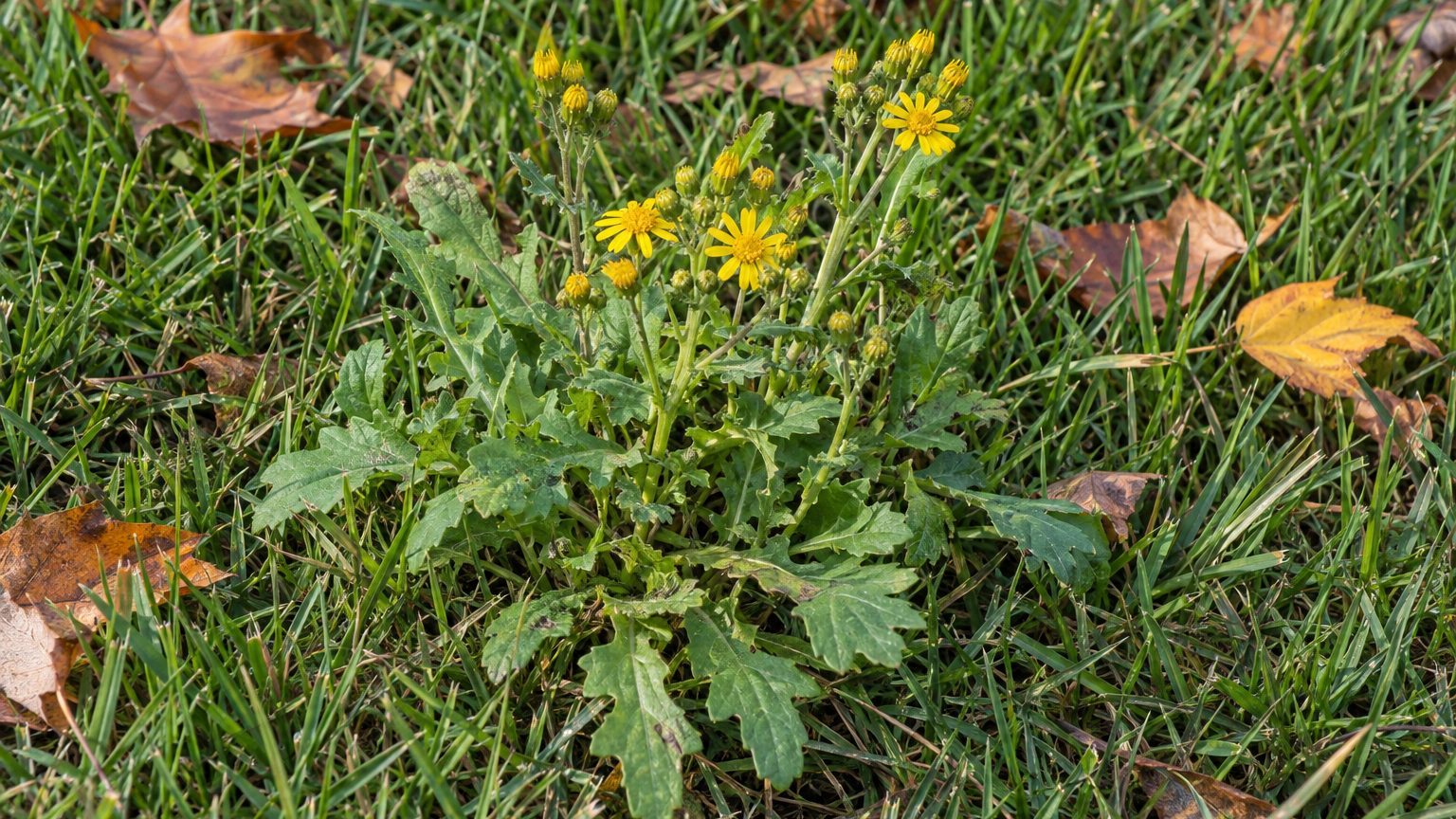
In spring, a thin patch of lawn or a bare edge can sprout upright, ragged-leaved plants topped with tufted heads that never seem to open. That is common groundsel, a quick-moving weed that gets ahead of turf in the cooler months. Knowing what it looks like and when it moves in makes it easy to stop.
How to Identify Common Groundsel

Look for an upright, branching plant with ragged leaves standing above the grass.
- The small heads stay closed and tufted, a bit like a dandelion that never opens.
- Plants stand upright and branch, reaching 5-18 inches tall where mowing has missed them.
- Older leaves are 2-4 inches long with deep, irregular lobes, coarse teeth along the edges, and no leaf stalks.
- Plants grown late in the season are often shorter than the spring ones, up to 18 inches at most.
- In Maryland, seedlings show up very early in spring (March), and in Wisconsin the heads can appear from early spring to late fall.
The deeply cut, stalkless leaves on an upright stem help distinguish it from the grass around it.
From the almanac
Lawn in your state
The dates on this page depend on where you live. Your state's page carries its frost dates, its USDA zones and the year laid out month by month.
Northeast
Southeast
- Alabama
- Arkansas
- Delaware
- Florida
- Georgia
- Kentucky
- Louisiana
- Maryland
- Mississippi
- North Carolina
- South Carolina
- Tennessee
- Virginia
- West Virginia
Midwest
Southwest
West
Pacific Northwest
Canada
Weeds Mistaken for Common Groundsel
Few lawn weeds share this look, but the closed yellow heads cause confusion with a familiar one.
Seedlings in early spring can also pass for other small broadleaf weeds that sprout in cool weather, such as shepherd’s purse or henbit. Check the leaf shape and the stem before you decide.
| Looks like | How to tell them apart |
|---|---|
| Dandelion | Groundsel heads stay closed and sit on a branched, upright stem with lobed, stalkless leaves. A dandelion’s leaves all rise from the base of the plant and its heads open wide on single stalks. |
Shepherd’s purse and henbit do not share groundsel’s combination of closed heads and lobed, stalkless leaves on a branched stem. If you see closed heads and clasping, lobed leaves together, you are looking at groundsel.
What Causes Common Groundsel in Lawns
Seed does the work. Plants drop seed after their heads finish, and there can be 2 to 3 generations per year, so a few stragglers become a patch fast. Seed that overwinters germinates from late fall through early spring in Maryland, which is why the first plants often appear before the lawn has woken up.
Thin turf gives it room. In Maryland, groundsel grows best in moist, fertile soil and cannot survive on shaded, trampled, or mowed sites. Bare soil from winter damage, worn edges or a lawn that has been left tall opens the door.
It is a winter annual that can also behave as a summer annual, since seed can germinate in spring, summer or fall. In milder climates it is hardy to zone 6a, while in Wisconsin it dies at the end of the growing season.
How to Get Rid of Common Groundsel
Groundsel gives up quickly in a lawn that is mowed and thick, so start with the mower and your hands.
- In Maryland, mow the lawn regularly at the proper height for your grass, because groundsel cannot survive on mowed sites.
- Pull young plants by hand while the soil is moist, getting the whole root so nothing regrows from the base.
- Pull plants before the heads finish, and bag them rather than composting, so the seed does not spread across the yard.
- Rake out bare spots and overseed them, so grass fills the gap before new groundsel seed germinates.
- Ask your state extension office which herbicides are approved for lawns in your state if the patch is too large to pull, and follow the label exactly.
Keep at it through the cool months, since later flushes of seedlings are common. Dense grass leaves little room for later flushes.
How to Prevent Common Groundsel
Prevention follows the weed’s habit of sprouting early and filling any open soil.
- Repair thin areas and bare patches so groundsel seed has less open soil to claim.
- In Maryland and Wisconsin, spread a coarse organic mulch about 3 inches thick in beds beside the lawn, and let the surface dry out between waterings so seedlings cannot push through.
- Once the soil warms, keep mowing on a regular schedule so any seedlings that slip in get cut before they can form heads.
- Water according to the needs of your lawn grass so dense turf leaves less open soil for groundsel.
Thick turf is the lasting fix, since this weed does not do well where grass is dense and mowed.
Common Questions
Is Common Groundsel an Annual or a Perennial?
It is an annual. It usually acts as a winter annual, though it can also act as a summer annual, so seed that lands in the lawn at almost any time of year can start a new plant.
Does Common Groundsel Grow in Sandy or Clay Soil?
In Wisconsin, it does best in moist, loamy, fertile soil but will also grow in sandy soil, heavy clay, and infertile ground. Soil type alone will not keep it out, so a dense, mowed lawn does more.
Can Heat Kill Groundsel Seed?
Steam heating of soil or potting mix at 180 °F for 30 minutes can kill dormant and non-dormant weed seed in Maryland. That suits potting mix and small beds, not an established lawn.