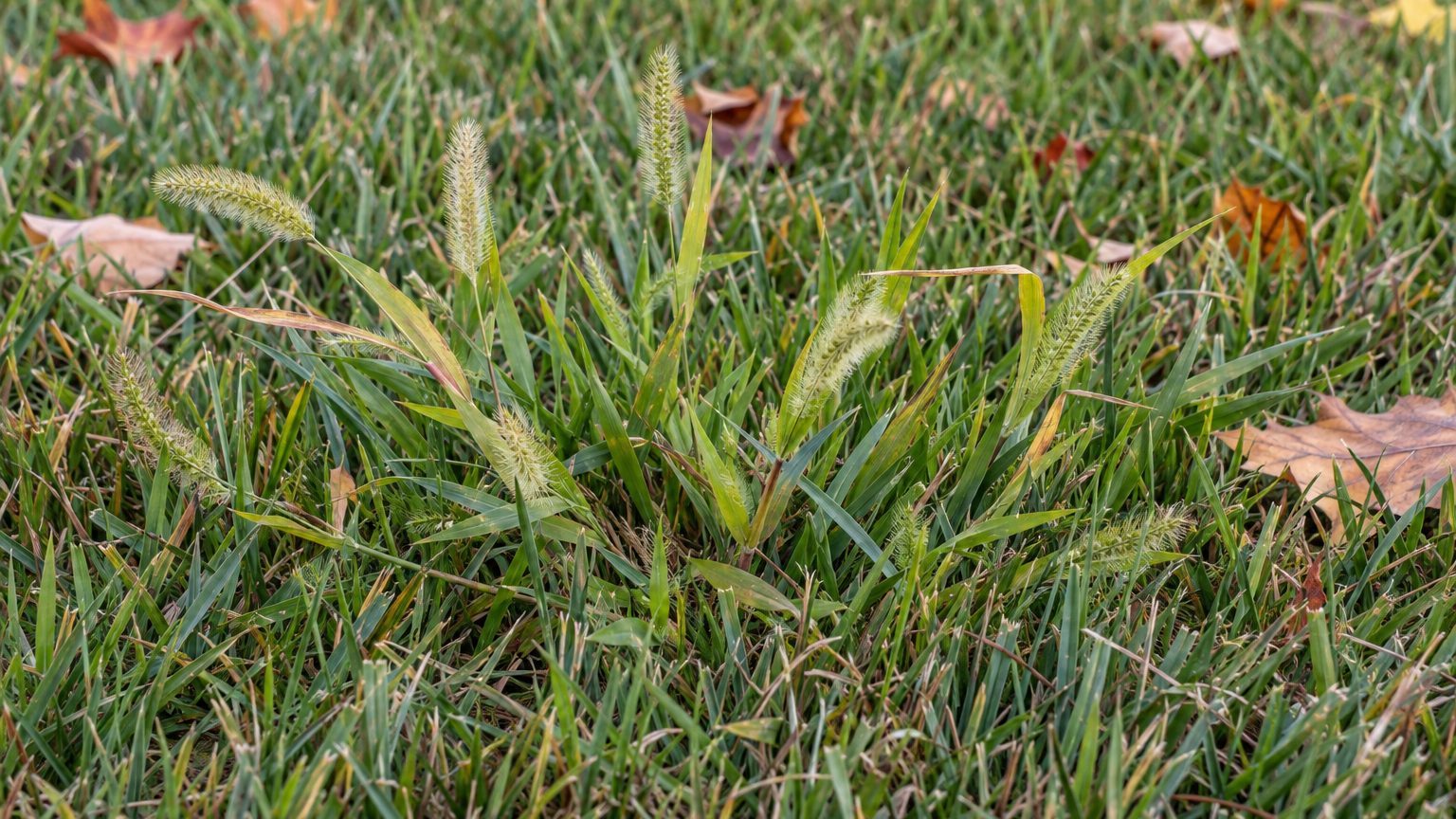
Pull a clump of grass from a summer lawn and you may find a stiff, bristly seedhead standing above the turf, soft as a bottlebrush. That is foxtail, a grassy weed that moves into thin or bare patches and spreads by seed; learning to recognize it helps you remove it before it seeds again.
How to Identify Foxtail

The seedhead is a useful sign, so look up from the blades first.
- On yellow foxtail, the flowering head is yellow, cylindrical, dense, bristly and erect, growing 2 to 5 inches long.
- A yellow foxtail seedhead can be as short as 0.75 inch and as long as 6 inches, and it is about 0.5 inches wide, making it the smallest of the three species.
- At the collar, where the blade meets the stem, a fringe of fine hairs about 1 mm long stands in for a ligule.
- No auricles (small clasping flaps) sit at the collar, so the base of the blade looks plain.
- The plant appears in spring, grows through summer and dies in fall, so its seasonal growth is a useful clue.
Short mowing can hide the seedheads below the mower deck, where they still drop seed.
From the almanac
Lawn in your state
The dates on this page depend on where you live. Your state's page carries its frost dates, its USDA zones and the year laid out month by month.
Northeast
Southeast
- Alabama
- Arkansas
- Delaware
- Florida
- Georgia
- Kentucky
- Louisiana
- Maryland
- Mississippi
- North Carolina
- South Carolina
- Tennessee
- Virginia
- West Virginia
Midwest
Southwest
West
Pacific Northwest
Canada
Weeds Mistaken for Foxtail
Timothy grass and crabgrass can be confused with foxtail in lawns and fields. Look closely at the seedhead and leaf base before identifying the weed.
| Looks like | How to tell them apart |
|---|---|
| Timothy grass | The seedhead looks much the same at first glance, but dig up the base of the stem. Timothy has an enlarged bulbous corm there, and foxtail has none. |
| Crabgrass | Both are summer annual grasses that fill thin turf, but crabgrass has a membranous ligule at the collar, while foxtail has a hairy one. |
A hand lens helps with the ligule, which is tiny. Check collars across the patch because an atypical clump can mislead you.
What Causes Foxtail in Lawns
Foxtail comes from seed, and it is a prolific seed producer. Unchecked plants can load the soil with seed, so the weed returns wherever turf is thin enough to let seedlings in.
Open ground is the invitation. In Illinois, yellow foxtail turns up in moist, fertile soil in the middle to late part of the growing season, and it is often found in new seedings, open turf or bare spots. Sun helps it too. In Pennsylvania, these species do best in sunny areas but can also survive in partly shaded lawns.
Timing follows soil warmth. According to Penn State Extension, seeds can germinate once soil reaches 65°F, and germination is best between 70 and 85°F. In Maryland, foxtails tend to emerge from mid-spring to early summer, though later flushes are not uncommon. Regular close mowing adds to the trouble because seedheads can form below the mower height and keep making seed.
How to Get Rid of Foxtail
Work with the plant’s one-year life, and stop seed from reaching the soil.
- Pull small infestations by hand or lift them with a trowel, since in Pennsylvania a few plants in a lawn can be removed this way, and it keeps the plants from setting seed.
- Remove the whole plant, roots included, and bag it rather than composting, so ripened seedheads do not spread into clean turf.
- Avoid mowing so short that foxtail seedheads form below the mower deck.
- Repair the bare spots at the recommended seeding time for your grass type, because open soil is where foxtail can start.
- Keep heavy traffic off new lawn seedings while their roots develop.
- For a larger infestation, ask your state extension office which preemergence products are approved where you live, and follow the label.
Timing matters if you do use a preemergence product. According to UC IPM, University of California, apply it 2 to 3 weeks before weeds germinate, and a lawn that is already full of seedlings will not be helped by a late application.
How to Prevent Foxtail
Prevention is a matter of keeping turf thick and acting before the seeds sprout.
- Rake out dead patches and reseed thin areas at the recommended time for your grass type.
- According to Penn State Extension, foxtail seed can germinate once soil reaches 65°F, so any approved preemergence treatment must be in place before germination.
- Keep the mower at the appropriate height for your grass type so the canopy shades open soil.
- When seedheads appear, pull the plants before the seed ripens and bag them.
- After the plants die back, rake up the dead stalks and repair bare ground at the recommended seeding time for your grass type.
A dense lawn leaves foxtail little room to start where grass already covers the soil.
Common Questions
Is Foxtail a Perennial or an Annual?
Foxtail is a warm-season annual that lives one year, so each plant dies in fall and future plants grow from seed.
Can You Mow Foxtail Down to Get Rid of It?
Mowing alone rarely works, because plants cut short can still make seedheads below the blade. Combine mowing with pulling and thicker turf.
Does Foxtail Grow in Shade?
It prefers sun, but in Pennsylvania these species can also survive in partly shaded lawns, so shade alone will not keep it away.