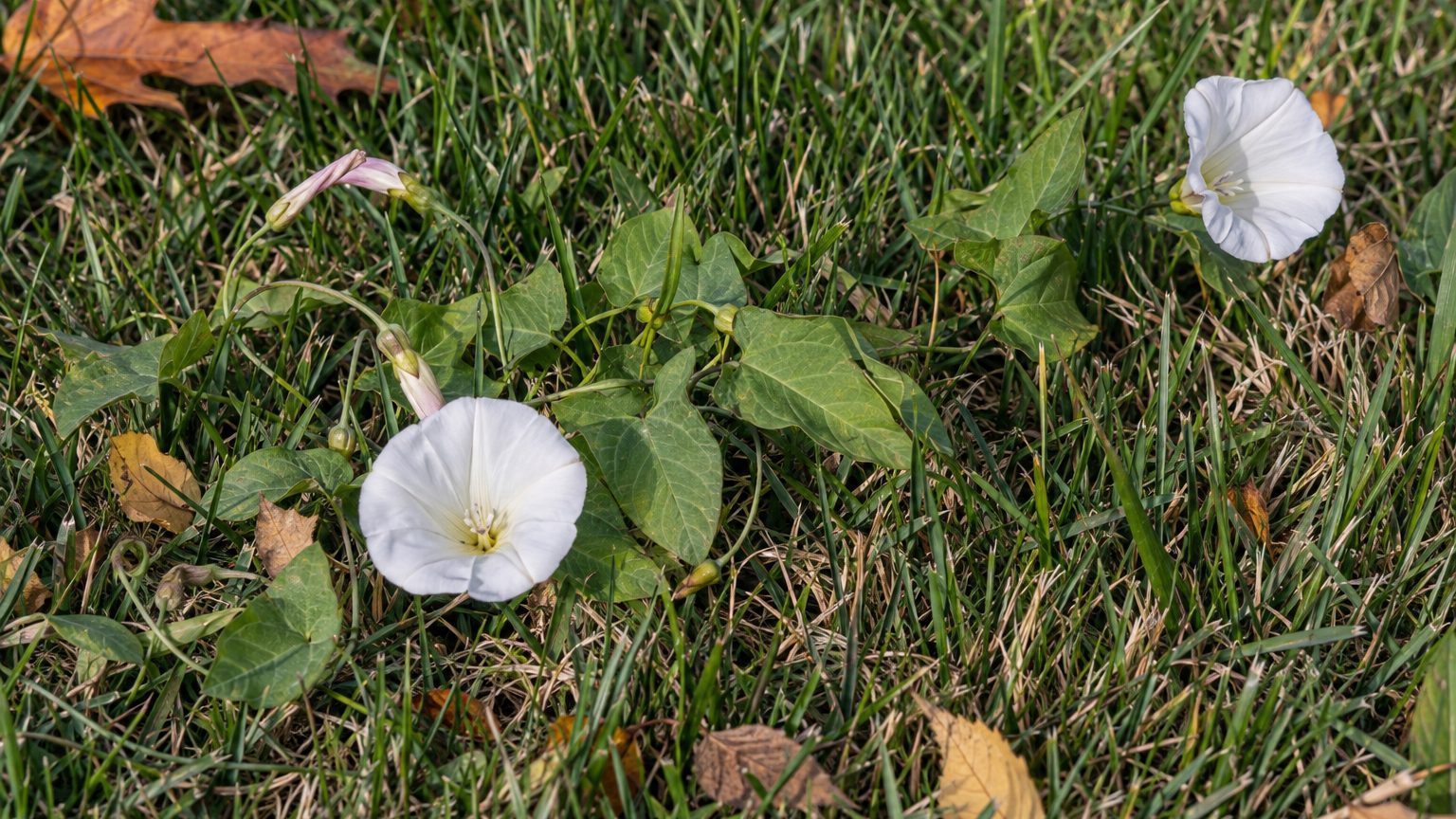
Slender vines twist through the turf in summer, pulling at the grass blades and sending arrowhead-shaped leaves across the lawn. That is field bindweed, a perennial that lives mostly underground, which is why mowing never ends it. Telling it from similar vines comes first, then digging out the roots and keeping it from returning.
How to Identify Field Bindweed

Start with the leaves, then confirm with the vine and the blossoms.
- The leaves are shaped like arrowheads, with pointed lobes at the base, and mature ones can be 1/2 to 2 inches long depending on conditions.
- The thin stems twine around grass blades, fence wire and anything else upright, or trail flat across the soil.
- The trumpet-shaped flowers are white to pink and 1 to 1 1/2 inches wide.
- Flowering months run from June through September, so summer is when the vines show most clearly in the lawn.
- Pulling a stem gives little resistance at first, then it snaps, because the plant is anchored by deep vertical roots and creeping rhizomes you cannot see.
If the leaf has that pointed, backward-reaching shape and the stem winds around its neighbors, you are almost certainly looking at the right plant.
From the almanac
Lawn in your state
The dates on this page depend on where you live. Your state's page carries its frost dates, its USDA zones and the year laid out month by month.
Northeast
Southeast
- Alabama
- Arkansas
- Delaware
- Florida
- Georgia
- Kentucky
- Louisiana
- Maryland
- Mississippi
- North Carolina
- South Carolina
- Tennessee
- Virginia
- West Virginia
Midwest
Southwest
West
Pacific Northwest
Canada
Weeds Mistaken for Field Bindweed
Several twining vines share the same trumpet blossoms and sprawling habit, so a quick glance can mislead. Check the leaf shape and the size of the flower together before choosing a control method.
| Looks like | How to tell them apart |
|---|---|
| Ornamental annual morningglory | The flower is larger at 2 inches wide and more showy, white to blue or purple, and the stem is thicker and sometimes hairy, with heart-shaped leaves 1 1/2 inches wide and 2 inches or more long. |
Hedge bindweed is the other close relative. The easiest way to separate it from field bindweed is the leaf shape, so hold a leaf in your hand and compare the outline with the arrowhead described above. Morningglory is an annual, so it will not return from the roots the way bindweed does.
What Causes Field Bindweed in Lawns
Field bindweed is a perennial that came from Eurasia and spreads by seed and by rhizomes. Once it is in the soil, it does not need much help. Seed lands in a thin spot, the roots settle in, and the plant keeps coming back each year from the same root system.
Moving soil or tools can spread it. Fragments of vertical roots and rhizomes as short as 2 inches can form new plants, so tilling an infested patch or dragging a shovel through it sends pieces into new ground. In California, seed can germinate at 41° to 104°F once the seed coat has weakened.
Irrigation alone does not discourage field bindweed. Field bindweed survives with sprinkler or drip irrigation, so regular watering alone is no protection. Thin, bare or worn turf is the usual opening, because open soil gives seedlings light and room, while a dense lawn crowds them.
How to Get Rid of Field Bindweed
Field bindweed cannot be beaten in one pass, so the work is a steady wearing down of the roots, done in this order.
- For a small patch, loosen the soil carefully and remove as much of the root system as possible, because fragments as short as 2 inches can regrow into new plants.
- Collect every piece of root you find and bag it, so nothing is left to resprout in the loosened soil.
- On bare ground, cultivate about every 2 to 3 weeks and repeat whenever necessary, as practiced in California, to keep the plant from rebuilding its energy.
- Smother patches in beds and borders beside the lawn with a light-blocking cover, and expect it to take 3 to 5 years in California for the plant under mulch to die completely.
- Watch for new shoots and remove them as soon as the arrowhead leaves appear, since each leaf feeds the roots below.
- Ask your state’s extension office which lawn herbicides are labeled for bindweed where you live, because approved products and timing differ from state to state.
Patience matters more than force here. According to UC IPM, University of California, it might take more than 3 years of light exclusion before the bindweed dies, so a single season without regrowth does not mean the job is finished.
How to Prevent Field Bindweed
A thick lawn helps resist new bindweed seedlings, and timely lawn care helps keep bare soil covered.
- Overseed thin and bare spots at the recommended time for your grass type, so seedlings fill the gaps before bindweed does.
- In late spring, set the mower at the taller end of the range for your grass type, because taller turf shades the soil and slows weed seedlings.
- From June through September, walk the edges of the lawn, fences and beds, and pull any twining runners before they climb and spread.
- Through summer, water deeply and not too often, which favors the grass roots over shallow weed seedlings, though irrigation alone will not stop an established plant.
- After working a patch that had bindweed, clean soil from digging tools before moving to clean areas so root pieces do not travel.
These habits help keep turf dense and leave less open soil for new bindweed seedlings.
Common Questions
Will Mowing Kill Field Bindweed?
No. Mowing removes the leaves and vines, but the deep roots and rhizomes stay alive and send up new shoots. Mowing only keeps the plant from climbing and slows its spread until you dig or smother it.
Does Field Bindweed Grow in Sandy Soil?
It can, but in California it seems to prefer heavy clay soils rather than sandy soils. A sandy lawn is not safe, so keep an eye out for arrowhead leaves whatever your soil type.
Does Field Bindweed Grow at High Elevations?
It is a hardy perennial found throughout California below the 5,000-foot elevation line. Use the leaf shape, not elevation alone, to identify any twining vine you find.