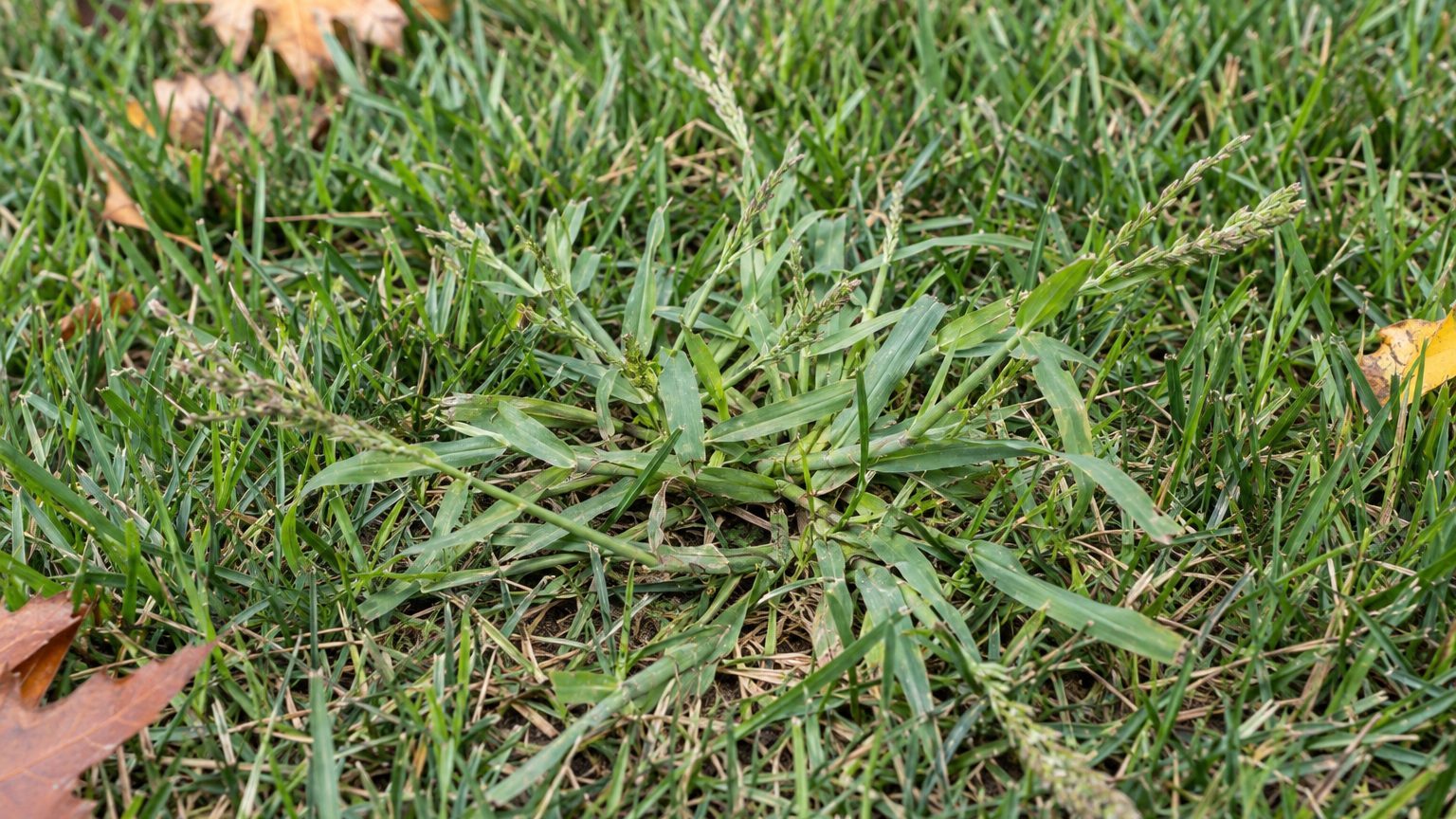
Coarse, sprawling grass that fans out from thin spots and driveway edges each summer is usually crabgrass. It sprouts in spring, spreads through the warm months, and leaves seed behind before the season turns. Knowing what it looks like and what feeds it tells you when to pull it, when to mow, and when to ask your state extension office about a lawn product.
How to Identify Crabgrass

Look first at the seedheads, then at the leaves and the base of the plant.
- The seedheads look finger-like, with spikes arising from different points at the top of the stem.
- Large crabgrass has leaves and leaf sheaths covered in dense hairs, so a hand run along the blade feels fuzzy.
- Smooth crabgrass is hairless and turns purple at the base of the plant.
- Both kinds sprawl outward from the center in a low, wide clump that stands out against fine, upright turf.
- Each plant can make thousands of seeds that may germinate the next spring.
Check along sunny edges and thin areas first, since that is where the clumps usually start.
From the almanac
Lawn in your state
The dates on this page depend on where you live. Your state's page carries its frost dates, its USDA zones and the year laid out month by month.
Northeast
Southeast
- Alabama
- Arkansas
- Delaware
- Florida
- Georgia
- Kentucky
- Louisiana
- Maryland
- Mississippi
- North Carolina
- South Carolina
- Tennessee
- Virginia
- West Virginia
Midwest
Southwest
West
Pacific Northwest
Canada
Weeds Mistaken for Crabgrass
Other summer grasses sprawl and seed in much the same way. Telling them apart matters because the timing and the fix are not always the same.
Foxtail can be confused with crabgrass in a lawn, and it gives itself away once it flowers.
| Looks like | How to tell them apart |
|---|---|
| Foxtails | Late summer seedheads hold bristly awns, and the plants sprout 3 to 4 weeks after crabgrass in New Jersey. |
Goosegrass is another sprawler that gets mistaken for crabgrass. In New Jersey, it turns up in hard, compacted soil where foot or equipment traffic is heavy and the turf cover is poor, so a clump growing in a packed path or beside a drive is worth a second look before you decide what it is.
What Causes Crabgrass in Lawns
Crabgrass moves in where the turf is thin and weak. In Iowa, extension guidance points to thin, poorly growing stands as where it becomes a problem, because open soil gives the seed light and warmth with no competition from grass.
Warm soil is the trigger. According to Iowa State University Extension, seeds begin germinating once soil reaches 55°F, and sprouting continues from spring into mid-summer, so new plants keep arriving long after the first flush.
Feeding at the wrong time makes it worse. In New Jersey, nitrogen fertilizer applied from mid-June through mid-August favors crabgrass and other summer weeds more than the lawn grass.
Seed already in the ground keeps the problem going. Seeds stay viable in the soil for several years, so a lawn can keep producing crabgrass after the visible plants are cleared.
How to Get Rid of Crabgrass
Once crabgrass is up, act on small plants and then fix the conditions that let them in.
- Pull young plants by hand when the soil is moist, so the roots come out whole and the clump cannot regrow.
- Cut and bag any seedheads before they ripen in late summer, so fewer seeds drop into the soil for next year.
- Rake out dead clumps and loosen the bare spot, so new grass seed can reach the soil.
- Overseed the patch with a grass suited to your region, so turf fills in before more crabgrass can.
- Mow the surrounding lawn high and regularly, so the grass shades the soil and holds back new sprouts.
- Contact your state’s extension office about herbicides labeled for lawns in your state, and ask when to apply them, since products and timing differ from place to place.
Expect to repeat the work as seedlings emerge from seed already in the soil. The plants die with the first frost, but seed left in the soil can remain viable for several years, so dense turf matters after the visible plants are gone.
How to Prevent Crabgrass
Prevention is mostly a matter of keeping the turf dense and the soil shaded through the months when seed is germinating.
- In spring, rake away leaves and debris and look for thin areas where crabgrass can start.
- Once the soil warms, mow at 3-4 inches, which is the height Iowa guidance gives to reduce crabgrass germination.
- According to Rutgers Cooperative Extension, grasses mowed above 2.5 inches rarely need supplemental irrigation in spring.
- In late summer, remove any seedheads that appear so the plants cannot refill the soil with seed.
- After the first frost, rake out the dead plants so the lawn is clear for fall seeding.
- Repair thin spots with grass suited to your region so dense turf can compete with crabgrass.
Dense turf leaves less open ground for crabgrass the following season.
Common Questions
Which Crabgrass Is More Common in the Northeast?
Smooth crabgrass and large crabgrass are common in the Northeast. In the northeastern and mid-Atlantic regions, smooth crabgrass is more prevalent than large crabgrass.
Does Crabgrass Come Back After Winter?
The plants themselves do not. Crabgrass is a true annual in the northeastern United States, so it sprouts in spring, makes seed in late summer, and dies at the first frost. New plants come from the seed left behind.
When Does Crabgrass Start Growing in New Jersey?
In central and northern New Jersey, it typically germinates in mid- to late April. In the southern parts of the state, it starts in early to mid-April.