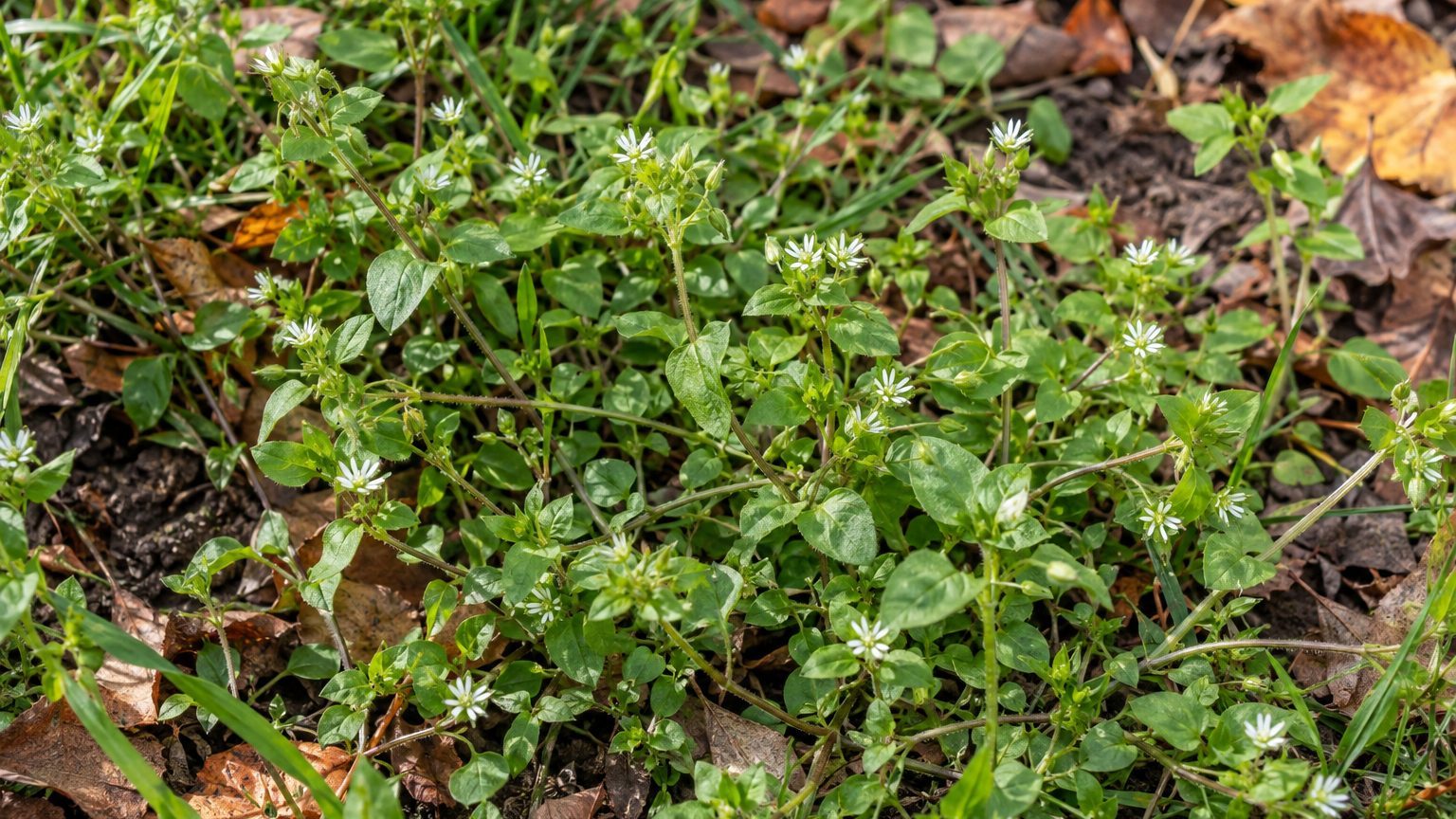
A low, bright green mat that looks fresh while the rest of the lawn sits tired and thin is usually chickweed. It thrives in cool weather and leaves seed behind in the soil. Knowing the plant, and which lookalike you are really facing, decides how you deal with it in your lawn.
How to Identify Chickweed

Start with the stems, because they give the plant away more reliably than the leaves do.
- Each stem carries a single vertical line of hairs, which separates common chickweed from its fuzzier relatives.
- Leaves are small, oval, pointed, and bright green, arranged opposite each other along thin stems.
- In sun, the plant stays low and sprawling at 3-6″ tall.
- In shade, it stretches up to 18″ and looks loose and leggy.
- Creeping stems root where they touch soil, so one plant spreads into a mat.
- It sprouts in fall and grows through the winter, then sets seed from spring to early summer before dying back.
Those brown, collapsed patches in early summer are often chickweed finishing its season.
From the almanac
Lawn in your state
The dates on this page depend on where you live. Your state's page carries its frost dates, its USDA zones and the year laid out month by month.
Northeast
Southeast
- Alabama
- Arkansas
- Delaware
- Florida
- Georgia
- Kentucky
- Louisiana
- Maryland
- Mississippi
- North Carolina
- South Carolina
- Tennessee
- Virginia
- West Virginia
Midwest
Southwest
West
Pacific Northwest
Canada
Weeds Mistaken for Chickweed
Close relatives share the opposite leaves and mat-forming habit. Telling them apart matters because perennial mouse-ear chickweed can spread from rooted stems, while common chickweed spreads by both seed and creeping stems.
Check the hairs and the stems together. A hand lens helps, and so does gently lifting a runner to see whether it has rooted.
| Looks like | How to tell them apart |
|---|---|
| Sticky chickweed | Fuzzy, opposite leaves like mouse-ears, and the whole plant is hairy and larger than common chickweed. It is a mat-forming winter annual. |
| Perennial mouse-ear chickweed | Fuzzy leaves like sticky chickweed, plus creeping stems that often take root and start new plants. |
| Field chickweed | Shorter hairs on stems and leaves, and narrower, more linear leaves. Its petals are 2-3 times longer than the sepals, and it is a perennial. |
Mouseear chickweed can grow up to about 20 inches long, so a sprawling, fuzzy patch with rooted stems points to it rather than to common chickweed.
What Causes Chickweed in Lawns
Seed is the starting point. Common chickweed sheds it in spring, and in Maryland that seed can stay viable up to 10 years, so a lawn can carry a hidden supply long after you clear the plants.
Open ground gives that seed its chance. In South Carolina, common chickweed commonly infests thin or dormant lawn areas, where grass is not shading the soil or competing for room. In South Carolina, fall germination gives seed room to establish in thin turf.
Conditions matter as well. In Washington, common and mouseear chickweed grow best in cool, moist spots with rich soil. In mild regions, common chickweed grows vigorously in cool weather and produces seeds throughout the winter, so the cycle never fully pauses there.
How to Get Rid of Chickweed
Work in the order below, starting while the plants are still green and growing in the cool season.
- Pull small patches by hand when the soil is moist, lifting the whole stem, because pieces left behind can root at the nodes.
- Bag the pulled plants instead of composting them, so no rooting stems or seed stay on the lawn.
- Treat larger patches with a broadleaf weed killer labeled for chickweed and for your type of grass, since some lawn grasses are harmed by products meant for others.
- Read the label for weather limits and application rules, and apply only as directed.
- Check the area again later and spot-treat or pull any regrowth, because survivors will keep spreading by creeping stems.
- Reseed or patch bare spots once the weeds are gone, so grass fills the gap before new seedlings do.
Timing matters. In South Carolina, control this weed before it produces seed. Your state extension office can tell you which products are labeled in your state and when to apply them.
How to Prevent Chickweed
Prevention follows the weed’s own calendar, from fall germination through seed production from spring to early summer.
- In Washington, maintain healthy turf so it can compete with chickweed seedlings before they establish.
- Through fall, walk the lawn and pull tiny seedlings while they are easy to lift.
- In winter in mild regions, keep checking, because chickweed grows and sets seed all winter there.
- In early spring, pull or treat any survivors before they flower and set seed.
- According to Clemson Cooperative Extension, in ornamental beds along the lawn, spread a 2- to 3-inch layer of mulch to suppress germinating weed seeds.
- In early summer, rake out the dead mats and mow at the height recommended for your grass so the lawn can fill in.
A dense lawn through the cool months leaves chickweed little bare soil to start in.
Common Questions
How Do You Tell Chickweed from Clover in a Lawn?
Look at the leaves and the stems together. Chickweed has simple, oval, opposite leaves along thin trailing stems with a line of hairs, while clover leaves are divided into leaflets that meet at the end of a leaf stalk.
Why Does Chickweed Show Up in a New Lawn?
Young turf is thin, and chickweed favors cool, moist places with rich soil. New lawns are among the spots where common and mouseear chickweed turn up.
Can Chickweed in a Flower Bed Spread to the Lawn?
Yes. It grows in flower beds and ornamental plantings as well as lawns, and it spreads by seed and by creeping stems, so beds and turf can pass it back and forth. Clearing the weed from both keeps the supply down.