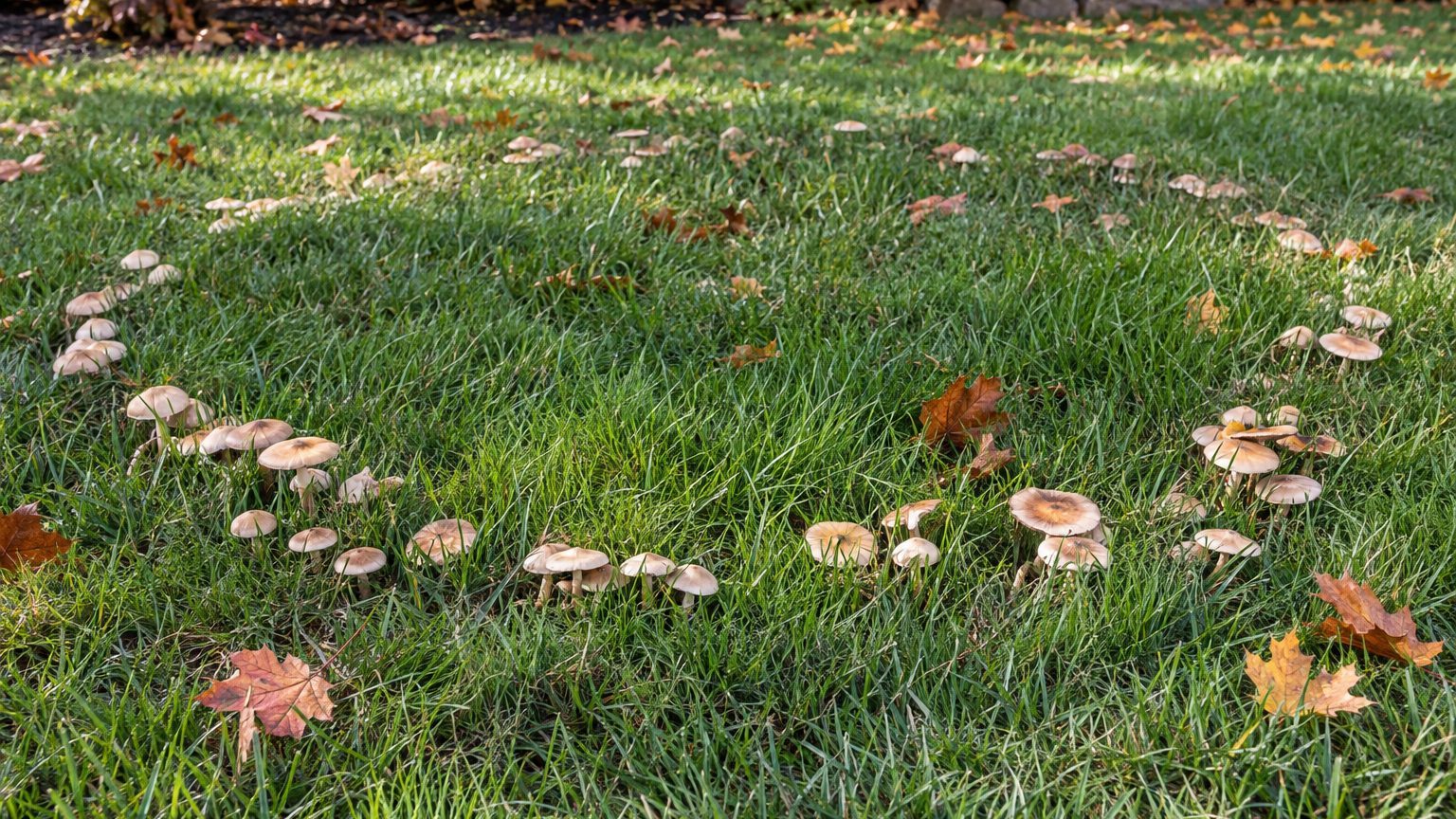
A ring or arc of darker, faster-growing grass, sometimes with mushrooms along its edge, can appear in a lawn in any year. Fungi living in the soil cause this pattern; recognizing it helps you choose how to restore water penetration.
How to Recognize Fairy Rings

Start with the shape, because a circle or arc is the signature, and the other signs vary with the fungus involved.
- Look for a circle or arc of grass that is darker green and grows faster than the lawn around it.
- Measure the span, since most rings run from 2 to 15 feet across but some pass 50 feet.
- Check the soil just inside the ring, where grass may be thin, brown or dead because the soil there has turned dry and hard to wet.
- Watch for mushrooms along the ring after wet weather, though some rings never produce any.
- Notice that sometimes the only effect is the green arc, with no dead grass and no mushrooms at all.
In California, a ring that keeps growing outward for many years is consistent with fairy ring rather than an isolated spill or patch.
From the almanac
Lawn in your state
The dates on this page depend on where you live. Your state's page carries its frost dates, its USDA zones and the year laid out month by month.
Northeast
Southeast
- Alabama
- Arkansas
- Delaware
- Florida
- Georgia
- Kentucky
- Louisiana
- Maryland
- Mississippi
- North Carolina
- South Carolina
- Tennessee
- Virginia
- West Virginia
Midwest
Southwest
West
Pacific Northwest
Canada
Problems Mistaken for Fairy Rings
Other lawn troubles can also make curved or circular patches. Look for a supporting clue before settling the diagnosis.
Probing the soil is a useful check. Push a trowel, shovel or long screwdriver into the affected area and look for a white, cottony mass in the soil.
| Looks like | How to tell them apart |
|---|---|
| Dead ring of grass from a dry, compacted strip | Compacted soil is hard to probe, and it lacks the white, cottony mass associated with the fungal mat. |
| Dark green arc from fertilizer or a spill | The edges match the spread or spill pattern; the absence of mushrooms does not rule out a fairy ring. |
| Ring of dead turf where a tree stump or buried lumber once sat | In Illinois, buried wood is identified as a potential food source for a fairy ring, so this clue does not rule one out. |
Other causes can also leave brown patches, so color alone does not confirm a fairy ring.
What Causes Fairy Rings
Around 50 species of fungi can cause fairy rings, and all of them feed on decaying organic matter buried in the soil. Tree stumps, large roots and construction lumber left under a lawn are identified as potential food sources.
The green growth comes from the fungus itself. As its threads break down organic matter, they release plant nutrients, and the grass above responds with a burst of color and growth.
The dead zone has a different cause. The soil just inside the ring can become so full of fungal growth that water struggles to penetrate, and the grass there grows poorly or dies. All grasses are susceptible, and several mushroom-forming fungi can be involved.
How to Fix Fairy Rings
The right fix depends on how thick the fungal mat is, so probe first and then pick the level of effort you want.
- Probe the ring with a trowel, shovel or long screwdriver to determine the depth of the fungal mat.
- Aerate the ring a few times a year if the mat is under 3 inches thick, because the cores open the soil and let water in.
- Pull cores at least 1/4 to 1 inch in diameter and slightly deeper than the mat, as advised in California, since shallow cores miss the layer that repels water.
- Water the ring well after aerating, so moisture follows the new holes into the dry soil.
- Dig out the soil and sod when the mat is over 3 inches thick, because an aerator may not pull cores long enough to reach it.
- Remove turf and root zone to a depth of 12 inches and 2 feet beyond the outer edge of the ring if you want it gone, as advised in California, then refill with clean soil and reseed or resod.
Grass that is still alive can reestablish if the dense fungal mat is broken up and water penetration improves. Your state extension office can say whether any treatment is approved where you live.
How to Prevent Fairy Rings
Prevention is mostly about food supply and thatch, and the timing follows the stage of the lawn.
- Before planting a new lawn, clear out tree stumps, large roots and construction lumber, as advised in Illinois, because they feed the fungus.
- Apply adequate nitrogen.
- During regular lawn care, check the thatch layer and verticut if more than 1/2 inch accumulates, as advised in California.
- Break up the dense fungal mat so grass that is still alive can reestablish once water penetrates again.
Old rings may fade as their food source runs out or conditions change. They may persist for several years, but in Illinois they are expected to disappear as their food source runs out or conditions change.
Common Questions
Do Fairy Rings Go Away on Their Own?
Sometimes, depending on local conditions. In Illinois, they may persist for several years and fade once the buried food is used up or conditions change. In California, rings can keep enlarging for many years, with the older center dying off.
Are the Mushrooms in a Fairy Ring Dangerous to Pets or Kids?
Mushroom species vary, and you cannot judge safety by looking. Keep children and pets away from them, and remove them by hand or mow them off before they are tempting to touch or chew.
Why Does the Grass Inside My Ring Look Dry Even After Rain?
The fungal growth in the soil can block water from soaking in. Water runs off or sits on top while the roots stay dry, which is why opening the soil with a lawn aerator helps.