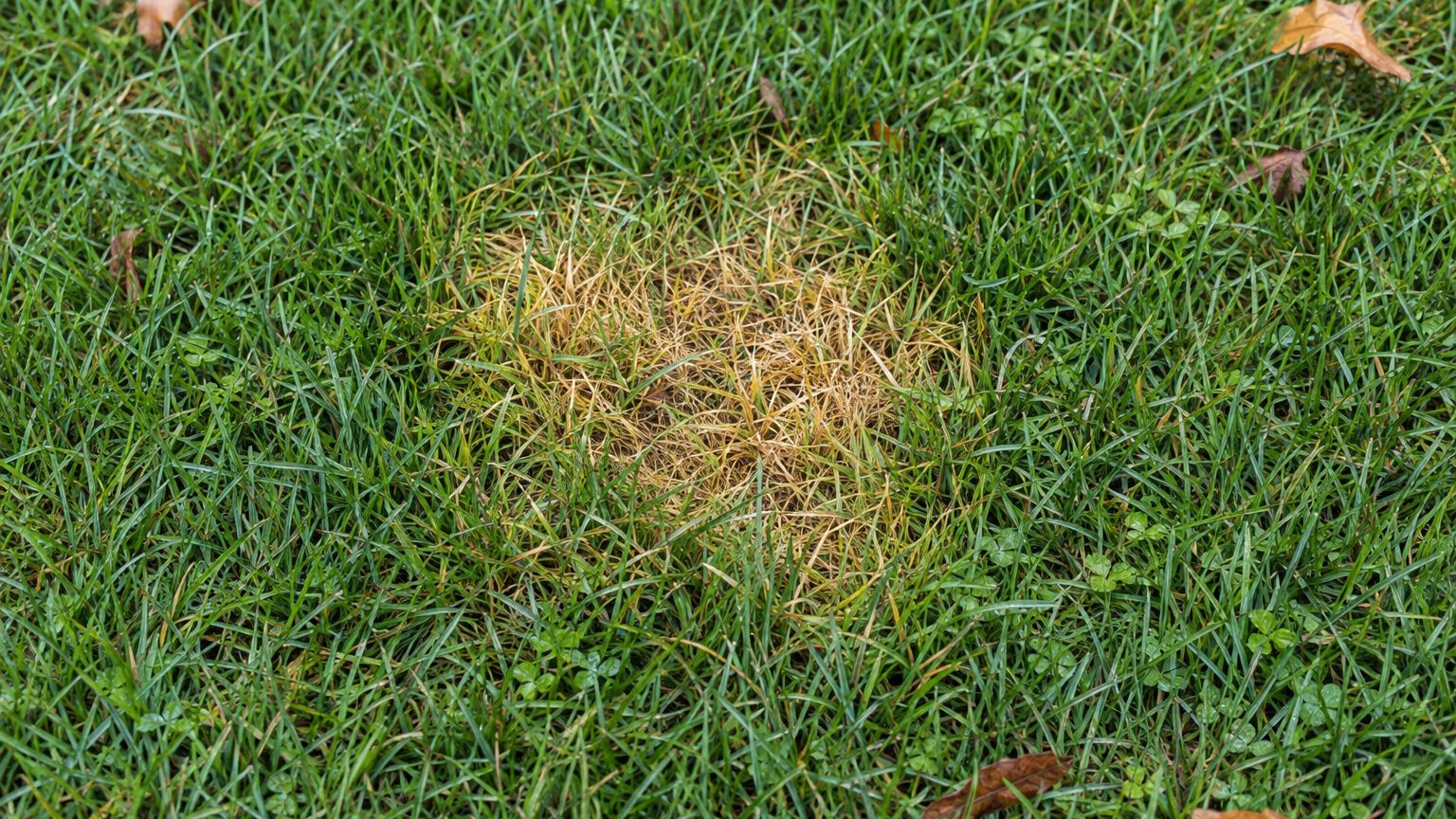
A round patch of straw-colored grass, often ringed by a band of unusually lush green, can show up where a dog has a favorite spot. The patch is urine burn, and it comes from concentrated salts rather than acidity.
How to Recognize Dog Urine Spots

Look first at the edge of the patch, because that is where urine spots give themselves away.
- A ring of darker, greener grass surrounds the dead center, since the diluted edge acts like fertilizer and the turf there grows faster than the lawn around it.
- The center turns tan or straw-colored and looks dry, as if scorched.
- Patches are often rounded and scattered over the lawn.
- Spots may cluster where the dog repeatedly stops, such as along the fence line, near the back door or at corners of the yard.
- Damage is most severe during dry periods, when soil moisture is low and the turf is poorly hydrated.
Pull gently on a dead patch and the leaf blades often come away dry, while the crowns and roots may still be alive.
From the almanac
Lawn in your state
The dates on this page depend on where you live. Your state's page carries its frost dates, its USDA zones and the year laid out month by month.
Northeast
Southeast
- Alabama
- Arkansas
- Delaware
- Florida
- Georgia
- Kentucky
- Louisiana
- Maryland
- Mississippi
- North Carolina
- South Carolina
- Tennessee
- Virginia
- West Virginia
Midwest
Southwest
West
Pacific Northwest
Canada
Problems Mistaken for Dog Urine Spots
Several lawn troubles leave brown patches too. Fungal disease and fertilizer burn can be confused with urine damage, and a close look at the blades and the pattern helps sort them out.
Check the grass blades up close, then look at where the patches fall across the yard.
| Looks like | How to tell them apart |
|---|---|
| Turf disease | Fungal patches show cottony threads on the grass, and the dying blades look water-soaked or mat down. Urine damage shows neither, and the spots sit where the dog goes. |
| Fertilizer burn | Scorched streaks or stripes follow the path of the spreader, while urine spots are separate rounds with a green rim. |
| Drought stress | Large, uneven dry areas fade on the sunniest or highest ground, and the grass greens up again after a deep watering. Urine spots stay brown and keep their green rings. |
Grubs can also thin a lawn into brown patches, but the turf feels loose and lifts like carpet. Dog spots stay rooted until the damage is deep.
What Causes Dog Urine Spots
Dog urine has a pH between 6.0 and 8.0, yet the pH is not what kills the grass. Damage is believed to occur mainly because of the highly concentrated salts the urine carries. A dose that concentrated pulls moisture out of the leaf and root tissue, much like pouring salt on a garden bed.
Conditions decide how bad it gets. The most severe damage seems to occur during dry periods, when soil moisture is low and the turf is poorly hydrated. Dry soil cannot dilute the salts, so they stay near the roots.
According to Kansas State University Extension, turf death may occur in 24 hours or less under favorable environmental conditions. Lawns with a dog that visits the same patch repeatedly will keep losing that ground.
How to Fix Dog Urine Spots
Repair depends on how much of the lawn died, but the order of work stays the same.
- Rake out the dead grass and loosen the surface, so water and new seed can reach the soil.
- Increase irrigation amount and/or frequency to dilute salts in the soil.
- Remove 0.5-1 inch of soil where the turf is completely killed, since in Washington that is the advised depth before re-sodding, and it takes out the salt-laden layer.
- Re-sod or reseed the bare area with grass suited to your lawn, then keep it moist so the new roots can settle.
- Mow as high as practically possible, 2 ½ to 3 inches for most lawn turfgrass species, so taller blades shade the soil and the new grass stays healthy.
Small spots may need no repair at all. According to University of Wisconsin Extension, if the spot is smaller than your fist, the surrounding grass will fill in after just a few weeks. Check your state extension office for what suits local grasses and seed timing.
How to Prevent Dog Urine Spots
Prevention is especially important during dry periods, when soil moisture is low and the turf is poorly hydrated.
- Keep the dog off the most visible parts of the lawn or train it to use a designated low-visibility area.
- Set the mower to the tall end of the range so the grass stays dense and shades the soil.
- Increase irrigation during dry periods to help dilute salts in the soil.
- Right after each visit, flood the spot with water as soon as possible, because in Washington that quickly dilutes the salts before they burn.
- In any season, if neighborhood animals are the culprits, commercially available animal repellants have been suggested in Kansas for cases where the animals are not yours.
Prompt watering after the dog goes out is far easier than patching a bare lawn.
Common Questions
Will the Grass Grow Back on Its Own After a Dog Urine Spot?
Often it does when the spot is small. According to University of Wisconsin Extension, a spot smaller than your fist fills in from the surrounding grass in just a few weeks. Fully killed turf is repaired by removing the surface soil and re-sodding the area.
Does the pH of Dog Urine Kill the Grass?
No. Urine falls between pH 6.0 and 8.0, and acidity is not the cause. The concentrated salts do the harm, which is why dilution with water works better than trying to change the soil.
Why Is the Grass Around the Dead Spot Extra Green?
The edge gets a weaker dose of urine, which feeds the turf instead of burning it. The affected grass there often looks greener and grows faster than the lawn around it, leaving the telltale ring around the dead center.