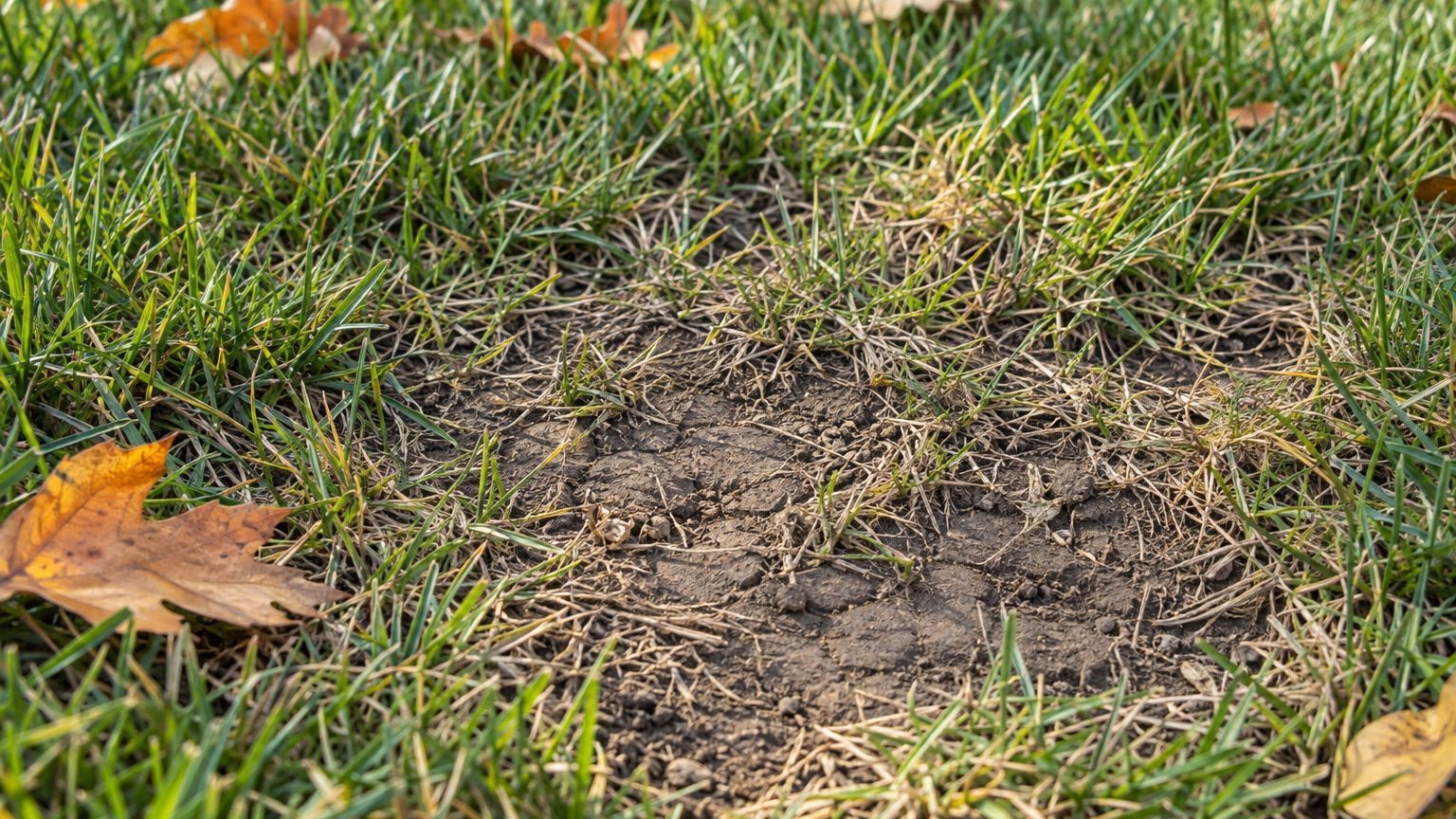
Footpaths worn bare across the grass, puddles that linger in the same low spot after a storm, and a screwdriver that will not sink into the turf all point to the same thing. Compacted lawn soil is soil pressed so tight that roots, air and water cannot move through it.
How to Recognize Compacted Soil

The clearest sign is how the ground resists a probe, and a few signs on top of the grass back it up.
- A soil probe or hollow metal pipe barely enters the ground when you push it in.
- Water puddles after rain in the same spots instead of soaking in.
- Grass is sparse along tracks and pathways where people regularly walk.
- The soil feels hard packed at garden gates and along the edges of driveways or sidewalks.
- Roots come up badly formed, and the grass shows nutrient deficiencies even when you feed it.
These symptoms usually progress slowly, so a lawn can slip from healthy to struggling before you notice.
From the almanac
Lawn in your state
The dates on this page depend on where you live. Your state's page carries its frost dates, its USDA zones and the year laid out month by month.
Northeast
Southeast
- Alabama
- Arkansas
- Delaware
- Florida
- Georgia
- Kentucky
- Louisiana
- Maryland
- Mississippi
- North Carolina
- South Carolina
- Tennessee
- Virginia
- West Virginia
Midwest
Southwest
West
Pacific Northwest
Canada
Problems Mistaken for Compacted Soil
Thin, weak turf has many causes, and compaction is only one of them. No sign settles it on its own, so pair what you see with a simple check.
The probe test helps sort out the cause. If the probe slides in easily, look elsewhere.
| Looks like | How to tell them apart |
|---|---|
| Nutrient deficiency in the grass | Pale, weak turf across the whole lawn, but the probe goes in easily and water soaks in normally. |
| Poor drainage from a low spot | Puddles in a dip after rain, but the soil around the dip is soft to the probe and the grass beside it grows well. |
| Foot-traffic wear on healthy soil | Thin grass along a path, but the probe sinks in and the turf fills back in where people stop walking. |
Where several of these signs show up together and the probe stops short, compaction is the likely cause.
What Causes Compacted Soil
Pressure is the cause. Heavy foot traffic, cars and trucks parked on the grass, and construction equipment all squeeze the soil particles together and damage its structure. Working or walking on wet soil does the same thing, because wet ground gives way under weight and packs down.
Construction is a major source of compaction, so a lawn laid over a builder’s graded and driven-over yard often struggles from the start.
Soil type matters too. Soils high in clay are more likely to compact than sandier soils, which is why a clay yard can turn hard under traffic that a sandy yard shrugs off.
How to Fix Compacted Soil
Loosening the soil means opening channels for air and water, and timing the work to the grass keeps the lawn from suffering for it.
- Confirm the problem with a probe or hollow pipe, so you know which areas need work.
- In Nebraska, wait until the lawn is actively growing before you aerate, because the grass then recovers quickly from the damage and puts out new roots.
- Pull cores at least 3 inches deep, as Nebraska guidance advises, since shallow holes do little to open the soil.
- Spread compost evenly over the site if you are amending a bed, and in Delaware the advice is to till it in to a depth of 18 inches.
- Dig trenches around established trees, 4-6 inches wide and 12 inches deep from the trunk out to the drip line at about three-foot intervals, following Delaware guidance.
- Keep traffic off the treated ground so it does not pack down again.
For tools, rates and timing that suit your grass and soil, your state extension office can give local advice.
How to Prevent Compacted Soil
Prevention is mostly about keeping weight off the soil, and a few habits through the year carry most of it.
- When the ground is wet, stay off the lawn and beds, since walking on wet soil packs it quickly.
- Once beds are planted, cover the soil with mulch or a groundcover. According to University of Delaware Cooperative Extension, a layer of plants or 2-3 inches of mulch is recommended to keep compaction from setting in.
- Lay a path of wooden planks or permeable fabric covered with gravel wherever temporary traffic across a bed is unavoidable. Delaware advice also allows a mulch layer of 6+ inches for temporary traffic.
- According to University of Maryland Extension, a 3-inch layer of organic mulch is suggested.
- All season, park cars and trucks on the driveway rather than under trees or on the turf.
Where a shortcut keeps wearing a path, a stepping-stone walk is easier than fighting the bare strip.
Common Questions
Can You Fix Compacted Soil Without Aerating?
For lawns, aeration is the usual route; in Delaware, compost and trenching are also used in beds and around trees. Fixing the cause also helps prevent the soil from compacting again, so keep weight and wet-soil work off the area.
Do Clay Soils Compact More than Sandy Soils?
Yes. Clay compacts more readily, so a clay yard needs more care about where people and vehicles go.
How Do You Know the Lawn Has Recovered?
Run the probe again. If it goes in more easily, puddles clear after rain, and the thin tracks fill in with grass, the soil has opened up.