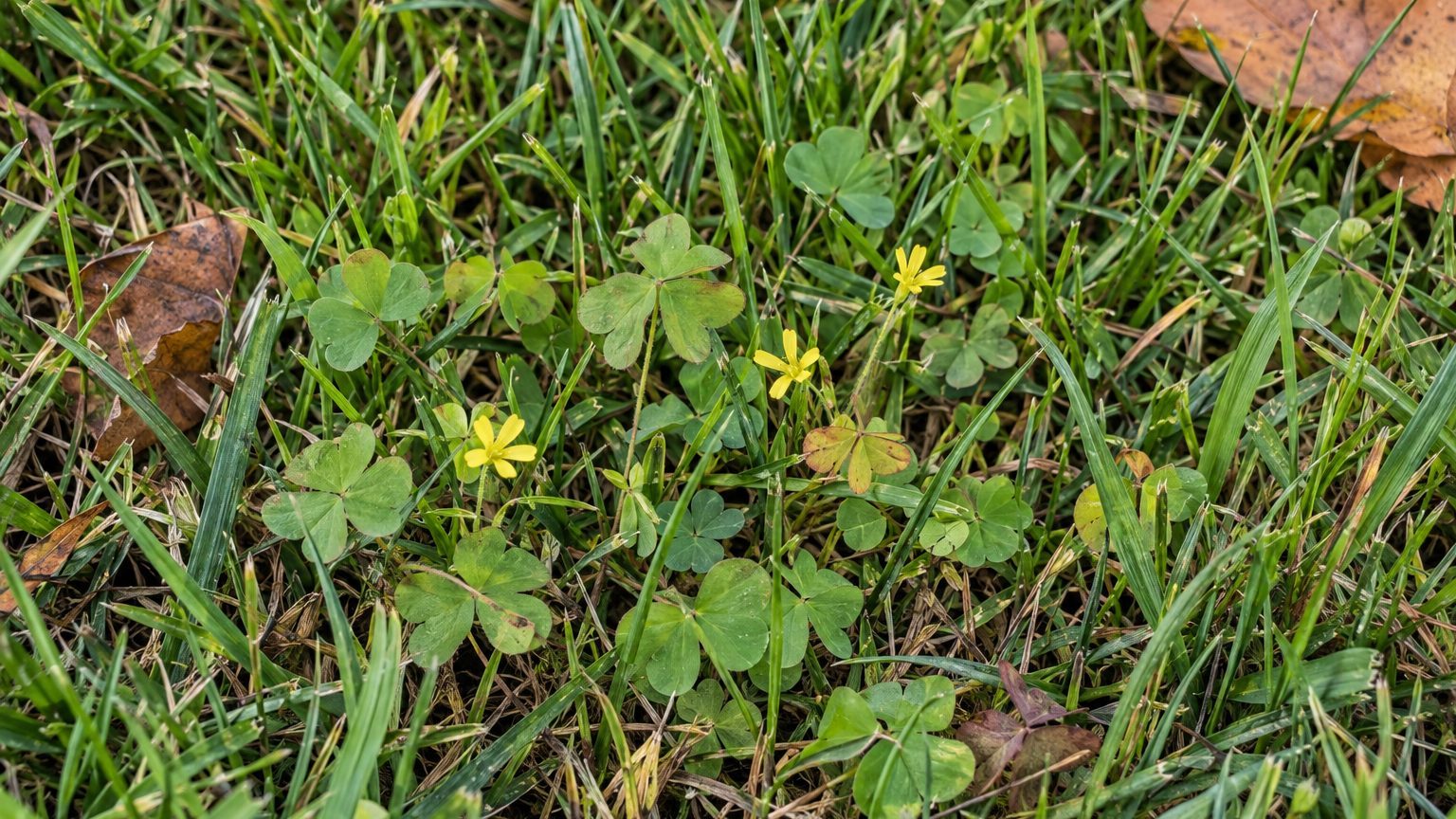
A patch of clover-like leaves that keeps coming back after you pull it, and then shoots tiny seeds across the lawn, is usually creeping woodsorrel. It is a low perennial that spreads by stems rooting along the ground and by seed pods that fire.
How to Identify Creeping Woodsorrel

Look low to the ground, because this weed hugs the turf and hides well among the blades.
- The leaves are made of 3 heart-shaped leaflets, folded down the middle like tiny butterflies.
- Many leaves carry a purple tint, which helps you pick the plant out of green turf.
- Hairy stems creep along the surface and root where they touch soil, so the plant grows into a mat.
- Stems stay around 4 inches tall, though they can stretch as long as 20 inches when left alone.
- Slim, cylindrical seed pods stand upright, and the ripe ones burst open to throw seed.
In North Carolina, plants in warmer climates can remain present year-round.
From the almanac
Lawn in your state
The dates on this page depend on where you live. Your state's page carries its frost dates, its USDA zones and the year laid out month by month.
Northeast
Southeast
- Alabama
- Arkansas
- Delaware
- Florida
- Georgia
- Kentucky
- Louisiana
- Maryland
- Mississippi
- North Carolina
- South Carolina
- Tennessee
- Virginia
- West Virginia
Midwest
Southwest
West
Pacific Northwest
Canada
Weeds Mistaken for Creeping Woodsorrel
Clover-like leaves can be misleading. White clover and black medic are the usual suspects, and an upright cousin in the same plant family also gets mixed up with it.
Check the leaflet shape, then look at how the plant sits on the ground. Together, those clues help separate the lookalikes.
| Looks like | How to tell them apart |
|---|---|
| White clover | Leaflets are rounded or oval rather than heart-shaped, so a heart-shaped notch on each leaflet points to woodsorrel. |
| Black medic | Leaflets are oval and not heart-shaped, while woodsorrel leaflets are distinctly heart-shaped and often purple-tinted. |
| Oxalis stricta | It grows more upright, while creeping woodsorrel lies flat, roots at the nodes and often shows purple-tinted leaves. |
Oxalis corniculata, the creeping type, is often confused with Oxalis stricta. Confirm the creeping habit before using the control steps below.
What Causes Creeping Woodsorrel in Lawns
Seed is the root of the problem. The pods can eject seed up to 16 feet away.
Seed sprouts at the soil surface when temperatures are between 60-80°F. Thin turf lets light and warmth reach the soil, which gives the seedlings an open spot to start in.
Moisture and fertility help it along too. Yellow woodsorrel thrives in moist, fertile soils but grows under a wide range of conditions. In North Carolina, it is treated as a weed in many turf and garden areas, and it grows best in spring or fall there, with plants present year-round.
Once it is in the lawn, the creeping stems carry it further. Creeping stems can root at nodes that touch soil, so pieces left behind after pulling may restart a patch.
How to Get Rid of Creeping Woodsorrel
Pulling and good lawn care can help with small patches, and acting before pods form limits new seed.
- Pull young plants early, before pods form, so no seed gets thrown into nearby turf.
- Dig out established patches, taking the whole stem and root, because pieces left at the nodes can regrow.
- Bag the pulled plants instead of leaving them on the lawn, since stems that touch soil can root again.
- Fill bare spots with fresh seed or sod, so open soil does not give new seedlings a place to start.
- Keep the turf dense with regular mowing and watering suited to your grass, so shade from the blades crowds out sprouts.
- Where the weed has taken over a large area, ask your state extension office which herbicides are approved for your lawn and your grass type.
Keep the plants from going to seed. Check the patch again soon after clearing it, because seed already in the soil will keep sprouting.
How to Prevent Creeping Woodsorrel
Prevention follows the weed’s growth, from emergence until seed set.
- Walk the lawn edges and beds during active growth and pull seedlings before they root and spread.
- When soil temperatures are between 60-80°F, seed can germinate at the surface. According to Utah State University Extension, apply a mulch layer 3 inches deep on planting beds to reduce seed germination.
- Keep turf dense with mowing and watering suited to your grass, so the blades shade the soil.
- In North Carolina, the weed grows best in spring or fall in warmer climates, so check thin spots during those seasons.
- Sanitation is critical for controlling woodsorrel in container plants, especially in propagation areas, so keep pots, tools and nursery areas clean.
Weed beds near the lawn edge as faithfully as the lawn itself, since a neglected bed is where the seed that lands in your turf often comes from.
Common Questions
Does Creeping Woodsorrel Come Back Every Year?
Yes, because it is a perennial and it also drops seed. Surviving plants and seed in the soil can restart patches, so follow-up is often needed.
Can You Mow Creeping Woodsorrel Away?
Mowing alone does not remove it. The stems lie so close to the ground that the mower often passes over them, and the weed keeps rooting at the nodes.
Why Does Woodsorrel Appear in My Flower Beds and Lawn at the Same Time?
Seed thrown from ripe pods can land in flower beds and lawns. Bare soil in beds and thin turf can let seedlings appear at the same time.