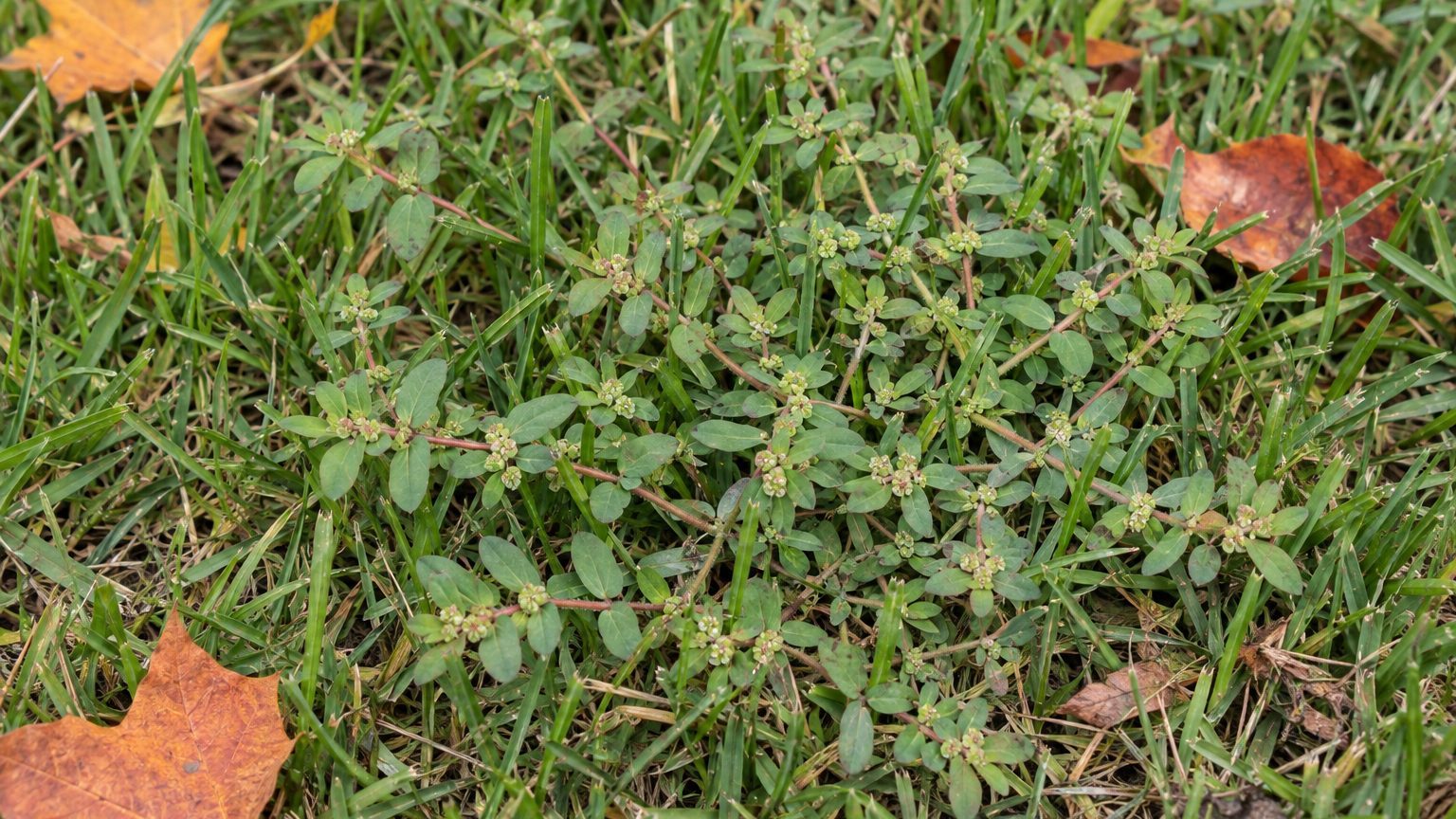
A flat green-red mat spreading outward from a crack in the driveway or a bare patch near the curb is how spotted spurge usually shows itself in summer. It is a summer annual that lives on seed, so it finds thin spots in a lawn and fills them fast. Knowing it on sight, and what lets it in, makes it far easier to stop.
How to Identify Spotted Spurge

Look low and close, because this weed hugs the ground and hides in short turf.
- A small reddish spot usually sits near the center of the leaf, which helps distinguish spotted spurge from other flat, creeping weeds.
- The leaves are small and oval, and they grow in opposite pairs along the stem.
- The stems lie flat or rise slightly, forming a mat that can reach 3 feet across when conditions suit it.
- Tiny three-celled seed capsules, 1/16 inch or less, form along the stems, each cell holding one seed about 1/25 inch long.
- It appears in the warm months, in full sun, often along pavement edges and in worn or thin areas of turf.
Snap a stem and the milky sap that bleeds out is another hint that you are looking at a spurge.
From the almanac
Lawn in your state
The dates on this page depend on where you live. Your state's page carries its frost dates, its USDA zones and the year laid out month by month.
Northeast
Southeast
- Alabama
- Arkansas
- Delaware
- Florida
- Georgia
- Kentucky
- Louisiana
- Maryland
- Mississippi
- North Carolina
- South Carolina
- Tennessee
- Virginia
- West Virginia
Midwest
Southwest
West
Pacific Northwest
Canada
Weeds Mistaken for Spotted Spurge
Several other spurges lie flat in the same way, so a quick glance can mislead you. Check the leaf and the seed pod together before you decide what you are pulling.
Leaf markings are a useful clue, though the fruit and seed can settle any doubt if you have a hand lens handy.
| Looks like | How to tell them apart |
|---|---|
| Ground spurge | Leaves never carry a reddish central spot, and the fruit is hairy mostly on its edges only, with seeds that are cross-ridged. |
| Creeping spurge | It also grows flat, but its leaves have no markings at all, unlike spotted spurge, which usually shows the red spot and hairs pressed over the whole fruit. |
Spotted spurge, by contrast, has seeds that are cross-wrinkled and fruit covered in hairs lying flat against the surface. Plain clover and knotweed can also pass for it at a distance, but neither bleeds milky sap when a stem is broken.
What Causes Spotted Spurge in Lawns
Light on bare soil is what starts it. When turf thins from stress, disease, low fertility, insects, or heavy wear, light reaches the ground and spotted spurge germinates in the gap. A thick lawn shades the soil and leaves it little room, which is why this weed is mostly a problem in thin turf.
Warmth sets the timing. According to UC IPM, University of California, seeds germinate best at 75° to 85°F, though they can sprout as low as 60°F and as high as 100°F. According to University of Wisconsin Extension, seeds sprout best once soil is above 75 °F, and they will still come up in cooler soil when moisture is present.
Each plant can make several thousand seeds, and those seeds can sit dormant in the soil until conditions are right. That seed bank explains why a cleared patch can return. The weed is also common in poor, compacted soil in full sun, such as along walks and driveways.
How to Get Rid of Spotted Spurge
Because it is an annual that lives on seed, the goal is to remove plants before they set seed and then close the gap they came from.
- Pull young plants by hand while the soil is moist, taking the whole mat so no stem pieces are left to root or drop seed.
- Bag the pulled plants rather than composting them, so mature seed capsules do not scatter back across the lawn.
- According to UC IPM, University of California, check the thatch layer, which should be less than 1/2 inch, and loosen compacted soil where the weed grew so grass can root there.
- Reseed or patch the bare spot with grass suited to your region, because open soil invites the next round of seedlings.
- Raise the mowing height on tall fescue or perennial ryegrass to 2 inches or more, which shades the soil and cuts down early invasions in California.
- Ask your state extension office which herbicides are registered where you live if the infestation is too large to pull.
Work through the spots early in the warm season, since small plants come out easily and have not yet made seed.
How to Prevent Spotted Spurge
Prevention follows the season, and it comes down to keeping the turf dense and the soil covered.
- In early spring, before the soil warms, check for thin patches and thatch, and repair them so no open ground is waiting when seeds begin to sprout.
- According to University of Wisconsin Extension, once soil warms above 75 °F, maintain dense turf through proper mowing, fertilization, and irrigation so grass can compete with seedlings.
- Around beds and edges, spread organic mulch such as shredded bark, compost, or straw at least 2 inches thick, which blocks the light the seeds need in Wisconsin.
- Through summer, watch pavement edges and worn corners, and pull any red-spotted seedlings you see before they flower and set seed.
- Feed and repair weak areas at the time recommended for your grass type, so the turf is thick going into the next warm season.
According to UC IPM, University of California, seeds buried deeper than 1/2 inch do not germinate well because they receive too little light.
Common Questions
Is Spotted Spurge Poisonous to Touch?
Its milky sap can irritate skin in some people, so wear gloves when you pull it, and wash your hands afterward.
Will Spotted Spurge Come Back Every Year?
It can, because each plant leaves behind seed that stays dormant in the soil. Removing plants before they set seed and keeping turf thick gradually runs down that supply.
Does Spotted Spurge Grow in Shade?
It generally prefers full sun and open, thin turf. Shaded, dense grass gives it little light to germinate in.