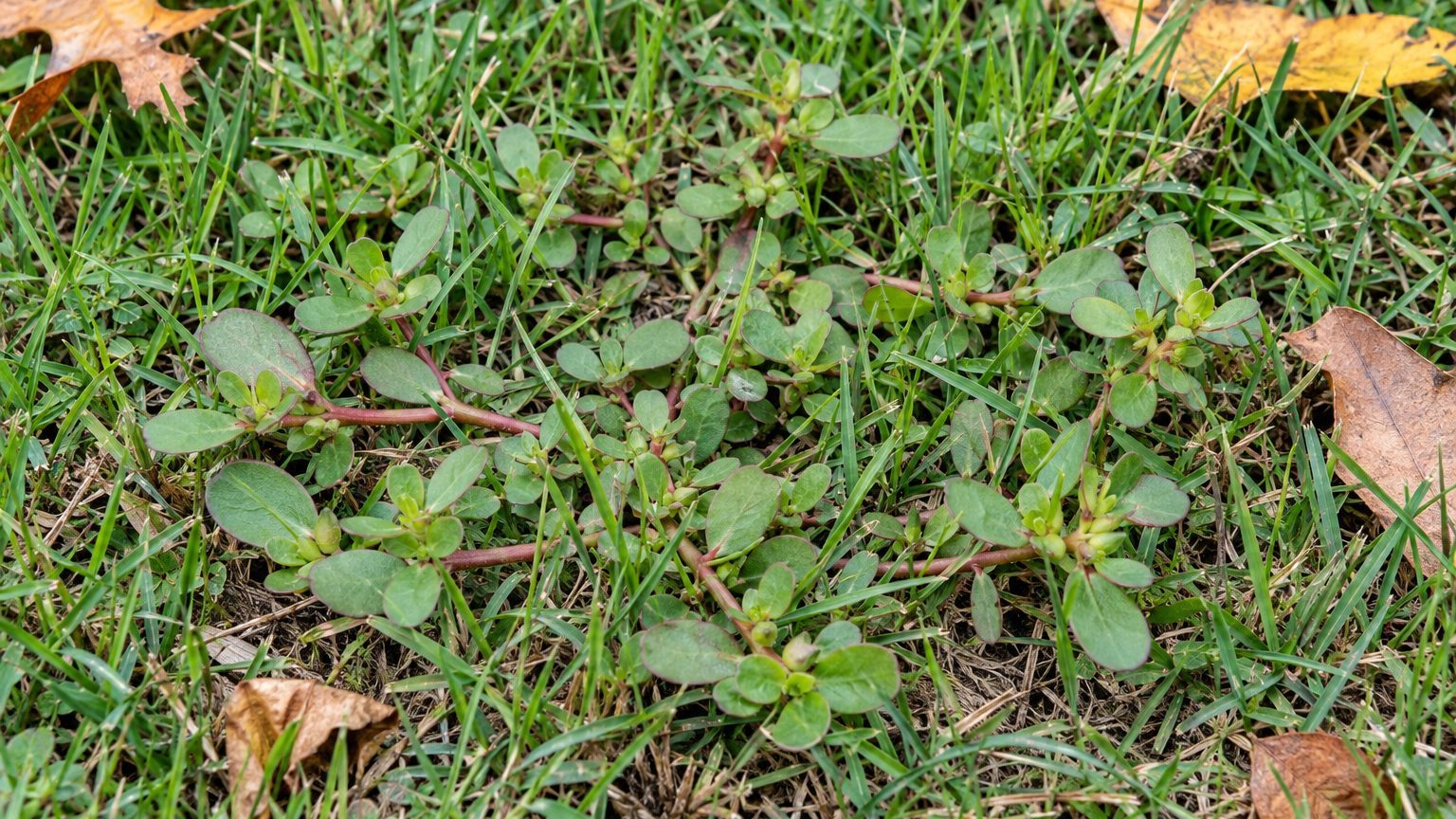
A flat, reddish mat of fleshy leaves creeping across a bare patch of lawn in midsummer is usually common purslane, a summer annual that moves in where the turf has thinned. Young plants come out by hand; in California, common purslane is usually not a problem in healthy, well-established turfgrass. Getting it out of a lawn comes down to timing and a denser stand.
How to Identify Common Purslane

Look low, near the ground, where the plant spreads outward from its center like a flat star.
- Thick, smooth, shiny leaves that feel succulent and sit directly on the stem with no leaf stalk, each between 1/2 to 2 inches long.
- Oval leaf shape, often wider toward the tip, which sets it apart from the narrow blades of the grass around it.
- Stems that lie flat and branch outward, forming a mat that smothers the turf beneath it.
- Small yellow flowers with five notched petals, only 1/4 to 1/3 inch across, so they are easy to miss.
- A summer annual life cycle, with emergence timing that varies by region.
A single plant can set 240,000 seeds, so a small patch in July becomes a bigger one next year if it is left alone.
From the almanac
Lawn in your state
The dates on this page depend on where you live. Your state's page carries its frost dates, its USDA zones and the year laid out month by month.
Northeast
Southeast
- Alabama
- Arkansas
- Delaware
- Florida
- Georgia
- Kentucky
- Louisiana
- Maryland
- Mississippi
- North Carolina
- South Carolina
- Tennessee
- Virginia
- West Virginia
Midwest
Southwest
West
Pacific Northwest
Canada
Weeds Mistaken for Common Purslane
Several low, spreading weeds get confused with purslane because they crawl across bare soil in the same warm months. Each has a feature that helps settle the identification quickly.
Check the leaf and the stem together. Texture and flower color tell you more than the overall shape of the mat.
| Looks like | How to tell them apart |
|---|---|
| Horse purslane | Also a flat, fleshy plant, but the leaves have stalks and the flowers are pinkish purple, not yellow. |
| Prostrate pigweed | Lies flat in the same bare, sunny spots, but the leaves are not fleshy when you pinch them. |
| Prostrate knotweed | Mats across compacted soil, but papery sheaths called ocreas wrap the stem just above each leaf. |
Pinch a leaf if you are unsure. Purslane feels thick and juicy, while pigweed feels thin, and the stem sheath on knotweed is easy to spot once you know to look for it.
What Causes Common Purslane in Lawns
Seed is always waiting in the soil. It can germinate even after 5 to 40 years, so the seed bank is rarely the thing you can change. What changes is whether the seedlings find open ground and sun when the soil warms.
In California and Pennsylvania, that is why purslane shows up in weak turf. In California, it is usually not a problem in healthy, well-established turfgrass; in Pennsylvania, it often appears in thinning, poorly maintained lawns and newly established turf seeded in late spring or summer. In Pennsylvania, it grows best in full sun and handles poor soil and moderate drought, so a dry, compacted, sunny strip along a driveway is a classic spot.
Timing depends on where you live. In California, seedlings start in February to March in the southern desert areas and in late spring in cooler areas, once the soil reaches about 60°F. In New York, most seedlings emerge in late spring when the maximum air temperature passes 86 °F and rain is adequate.
How to Get Rid of Common Purslane
Young plants come out easily, so work early and do not let any plant flower and set seed.
- Pull small plants by hand while the soil is moist, taking the whole mat, because broken stem pieces can lie there and keep growing.
- Bag what you pull instead of tossing it on the compost pile or the edge of the lawn, so the stems and seed do not spread.
- Rake and stir bare patches lightly before reseeding. According to Cornell Cooperative Extension, stirring the top 1-2 inches of soil 2-4 times after the soil warms is highly effective at removing most individuals in open ground.
- Solarize larger bare areas that you plan to renovate. In California, covering moist soil with a clear plastic sheet for 4 to 6 weeks in summer can kill purslane and its seed.
- Reseed or patch the cleared spots with grass suited to your area, so bare soil does not stay open for the next flush.
If hand work is not enough, your state extension office can tell you which herbicides are approved where you live and when to apply them.
How to Prevent Common Purslane
Dense turf helps keep common purslane out.
- Fill thin spots and fix compacted ground so no bare soil is waiting when the weather warms.
- As seedlings emerge, check bare edges and thin areas and pull them before they spread.
- Through summer, water deeply when the lawn needs it and mow at the height recommended for your grass, since a taller, thicker canopy shades out seedlings.
- According to UC IPM, keep organic mulch at least 3 inches thick where beds border the lawn so seedlings have a harder time emerging.
- Pull any plants that are still flowering so they do not add more seed.
In Pennsylvania, avoid seeding new turf in late spring or summer when you can, because that is when purslane has the advantage.
Common Questions
Can You Eat Common Purslane from Your Lawn?
The plant is edible, but a lawn is a poor place to harvest it if the grass has been treated or if pets use the area. Pick from spots you know are clean and wash it well.
Does Common Purslane Come Back Every Year?
It comes back from seed, not from the root, because it is a summer annual. Seed already in the soil can sprout for decades, so expect some new seedlings each summer until the turf is thick.
Why Does Purslane Grow in the Cracks of a Driveway but Not in the Middle of the Lawn?
Full sun and poor soil favor purslane, helping explain why driveway cracks can suit it. Healthy grass leaves purslane little room, so edges and thin patches deserve attention.