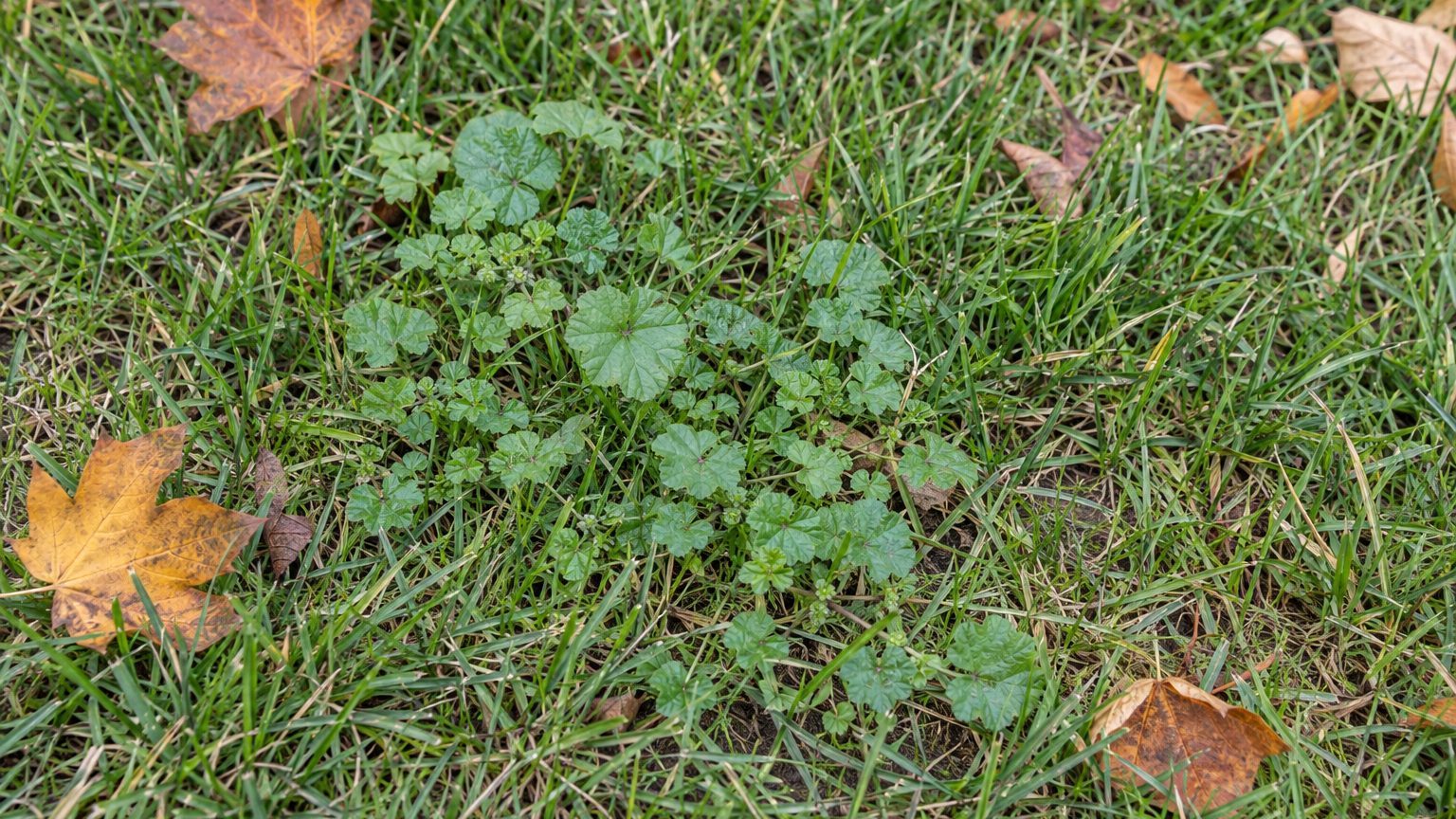
A patch of rounded, scalloped leaves spreading flat between the blades of grass, usually where the turf has gone thin, may be mallow. In Pennsylvania and Maryland, common mallow favors low-maintenance areas. Young plants come out by hand, while thick turf helps you take the patch back.
How to Identify Mallow

Look at the leaves first, since they give mallow away long before anything else does.
- The leaves are rounded, with veins fanning out from the center like fingers on a palm and toothed edges.
- Each leaf sits on a long stalk, and the leaves alternate along the stem instead of pairing up.
- Branching starts right at the ground, so a plant forms a loose, sprawling clump that can climb past 1 ft. high if the mower skips it.
- Five pale lavender to white petals open on the plant, and they are followed by a flat, button-like fruit much like a hollyhock’s.
- Dead stems can stand through winter, so a brown, stiff skeleton in the lawn edge is often last year’s mallow.
Because the plant is found growing all year in many yards, you may spot it in any season, not only in summer.
From the almanac
Lawn in your state
The dates on this page depend on where you live. Your state's page carries its frost dates, its USDA zones and the year laid out month by month.
Northeast
Southeast
- Alabama
- Arkansas
- Delaware
- Florida
- Georgia
- Kentucky
- Louisiana
- Maryland
- Mississippi
- North Carolina
- South Carolina
- Tennessee
- Virginia
- West Virginia
Midwest
Southwest
West
Pacific Northwest
Canada
Weeds Mistaken for Mallow
Common mallow and little mallow can be confused in a lawn. Both have the same round, lobed leaves, so the difference lies in the petals and the fruit.
Check the petals and fruit on the same plant before deciding which species you have.
| Looks like | How to tell them apart |
|---|---|
| Common mallow (M. neglecta) | Petals are longer, and the button-like fruit feels smooth when you roll it between your fingers. |
| Little mallow (M. parviflora) | Petals are shorter, and the fruit looks wrinkled up close. |
Hollyhock fruit looks much like the fruit of common mallow, which is a reminder that the whole mallow family shares that button shape. A hollyhock grows tall in a garden bed, though, while mallow stays low and sprawls in turf.
What Causes Mallow in Lawns
In Pennsylvania and Maryland, lightly maintained turf gives mallow room to establish. In Pennsylvania, common mallow turns up in turfgrass and landscape beds, most often in low-maintenance areas. In Maryland, low-maintenance turf, landscapes and nursery crops are the places it favors.
The weed spreads by seed alone, and the seeds wear a tough coat that lets them wait in the soil. In Pennsylvania, common mallow seeds can germinate throughout the growing season, so a bare spot can fill with seedlings in any warm month. In California, the seedlings begin growing with the first rains of fall.
Speed makes it harder to stay ahead. In Australia, little mallow seeds mature only 15 days after the plant begins to flower, so a patch you ignore for a short while can reseed itself before you act.
How to Get Rid of Mallow
Start with the youngest plants, then change the conditions that let them in.
- Pull seedlings as soon as you see them. According to UC IPM, University of California, home lawns and landscapes are best handled by pulling plants with four or fewer true leaves, when they still come out easily.
- Dig out larger plants by hand, taking as much root as you can, because a broken plant is more likely to regrow.
- Clear last year’s dead stems from the lawn edge, since they can stand through winter and make new growth harder to spot.
- Raise the mowing height. According to University of Maryland Extension, 3-4 inches is the advice, because taller grass shades the soil and gives mallow seedlings a harder start.
- In Maryland, test the soil for pH and fertilize to match the results so the grass thickens and fills the gaps.
- Spread mulch over any bed that borders the turf. According to UC IPM, University of California, at least 3 inches of bark or wood chips makes it physically difficult for seedlings to emerge.
For a big infestation, your state extension office can tell you whether a herbicide is approved where you live and how to apply it safely.
How to Prevent Mallow
Prevention should follow the weed’s own calendar, since seed can germinate across the growing season.
- In Maryland, test the soil for pH and fertilize according to the results so the turf can fill its gaps.
- According to University of Maryland Extension, mow at 3-4 inches once the grass is growing steadily.
- According to UC IPM, University of California, walk the lawn regularly and pull any seedling that has four or fewer true leaves.
- Before fall rains begin, top up mulch in nearby beds to a depth of at least 3 inches, which is the advice in California, where seedlings start growing with the first rains.
- Clear standing dead stems so new seedlings are easier to spot.
In California, mulched beds leave seedlings less room to emerge.
Common Questions
Is Mallow an Annual or a Perennial?
It is usually called an annual, a winter annual or a biennial, because plants can be found growing all year. That mix of habits is why a patch may look different from one season to the next.
Why Does Mallow Keep Coming Back After You Pull It?
The plant spreads only by seed, and the seed has a tough coat that lets it sit in the soil until conditions suit it. Pulling plants before they set seed, and thickening the turf, cuts down the supply.
Does Mallow Only Grow in Lawns?
No. In Pennsylvania, it also grows in landscape beds; in Maryland, it favors low-maintenance landscapes and nursery crops. A bed beside your lawn can be the source of the seedlings you keep finding in the grass.