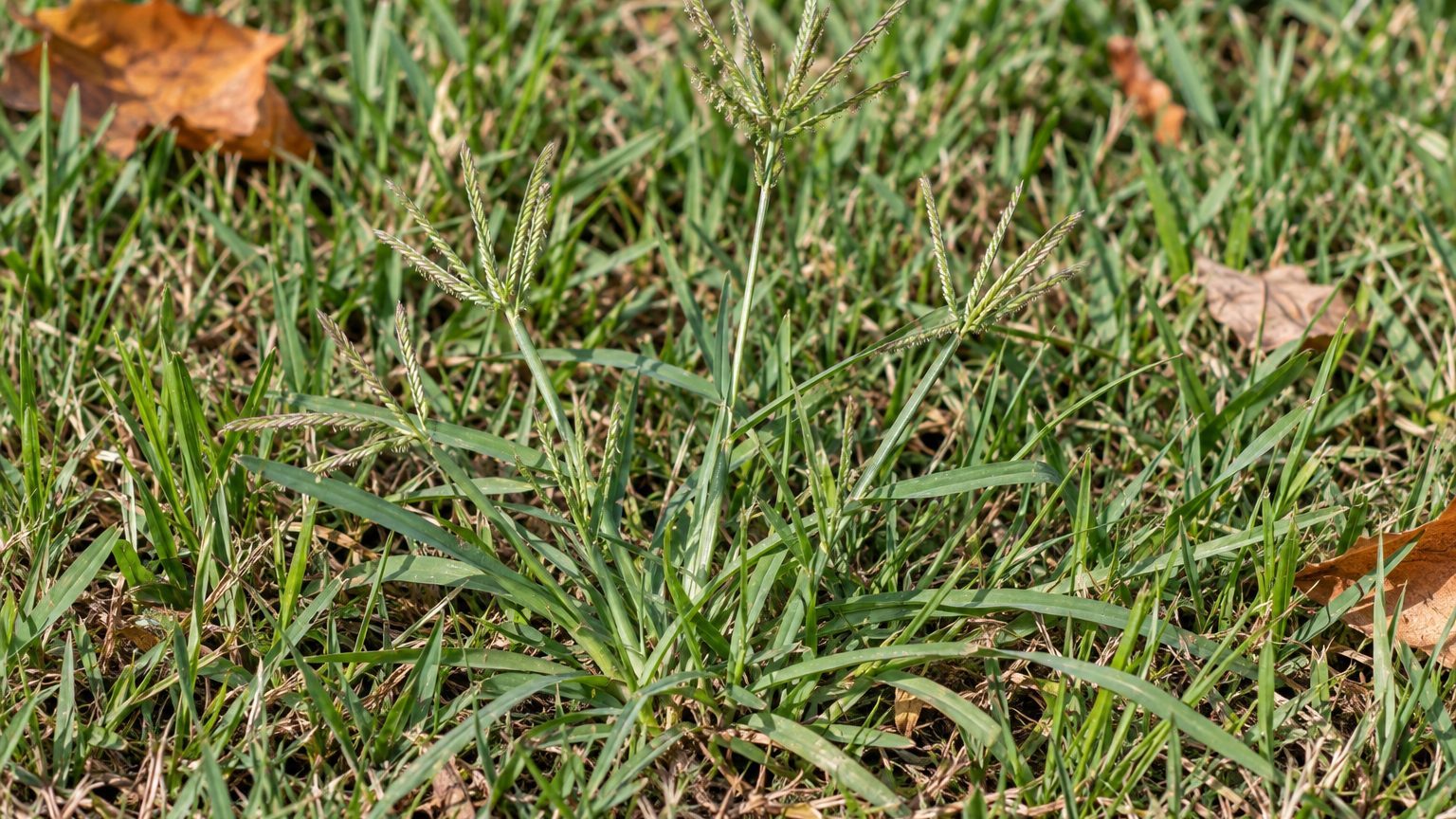
In summer, a flat, pale-centered rosette often shows up in hard, trampled lawn areas, along the driveway or where the kids cut the corner. That is goosegrass, a weed that thrives where turf struggles and stays low beneath the mower. Knowing it on sight, and what lets it settle in, decides how you get rid of it.
How to Identify Goosegrass

Look low, at the center of the plant, because that is where it gives itself away.
- The center of each plant is pale, almost silvery white, and the flattened stems fan out from it like the spokes of a wheel.
- Leaves are folded along the middle with blunt tips, and they are usually up to 6 inches long.
- Blades are 0.2–0.4 inch wide, coarser and darker green than most lawn grasses around them.
- Seedheads form on upright stalks, with 4–8 fingerlike branches radiating from the top.
- Where the leaf meets the stem, a short membrane (1 to 1.5 mm) sits there with a jagged top and a split down the middle.
- It appears as the soil warms and keeps growing through summer, becoming more noticeable in warm weather.
Pull a plant up and look at the base, because the flattened, whitish center is a useful confirmation.
From the almanac
Lawn in your state
The dates on this page depend on where you live. Your state's page carries its frost dates, its USDA zones and the year laid out month by month.
Northeast
Southeast
- Alabama
- Arkansas
- Delaware
- Florida
- Georgia
- Kentucky
- Louisiana
- Maryland
- Mississippi
- North Carolina
- South Carolina
- Tennessee
- Virginia
- West Virginia
Midwest
Southwest
West
Pacific Northwest
Canada
Weeds Mistaken for Goosegrass
Several warm-season grasses sprawl and send up fingered seedheads, so goosegrass gets confused with them all the time. Their differences make it important to check the plant’s growth habit together with the season before identifying it.
Check the habit of the plant and the season it shows up, and the right name usually becomes clear.
| Looks like | How to tell them apart |
|---|---|
| Crabgrass | Leaves are hairy and lighter green, and the plant comes up earlier, once soil stays above 55° to 60°F for 7 to10 days in Maryland. Goosegrass has smooth blades and a whitish center. |
| Bermudagrass | A perennial that spreads by runners and returns in the same patch. Goosegrass is generally a summer annual that returns from seed, though in Florida’s tropical climate it can persist as a short-lived perennial. |
Other low, spreading summer grasses can pass for goosegrass at a glance, but the flat, silvery rosette remains a strong clue when you part the leaves and look at the crown.
What Causes Goosegrass in Lawns
Goosegrass takes over where turf is weak and the ground is hard. Goosegrass is common in compacted soils, high-traffic areas, sites with full sun and light shade, and stands of thinning turf. It prefers full sun but can persist in partial shade.
Low mowing hands it an extra advantage. Because it grows so close to the ground, it tolerates mowing heights of ½ inch or less in Pennsylvania, while taller lawn grass is stressed by the same cut. A scalped, compacted lawn gives goosegrass favorable conditions.
Seed does the rest. It rides in on maintenance equipment and shoes, and with soil moved from infested sites, so a weedy patch at one edge can seed a whole yard. It germinates once the soil warms, with some reports from Florida putting that at 60°F–65°F. Goosegrass is a summer annual, though in Florida’s tropical climate it often lives on as a short-lived perennial.
How to Get Rid of Goosegrass
Young plants come out by hand, and the steps after that deal with the conditions that let it in.
- Pull small plants by hand when the soil is damp, taking the whole crown before the plant produces seed.
- Rake out seedheads and bag them, because loose seed will carry the problem to the next patch.
- Brush off the mower deck and your shoes after working the weedy area, since seed travels on both.
- Core aerate compacted spots, which in Pennsylvania helps turf cover and competition against goosegrass.
- Repair the bare spots at the recommended time for your grass type so the gaps do not simply refill with seedlings.
- Ask your state extension office which preemergence and postemergence herbicides are approved for your lawn grass, and follow the label closely.
Mature plants are hard to kill with herbicides, so removal by hand and a thicker lawn do most of the work. Treat this season’s cleanup as groundwork for next spring, when stopping seedlings is far easier.
How to Prevent Goosegrass
Prevention follows the season, and most of the work happens before you ever see a plant.
- According to Penn State Extension, apply an approved preemergence product before maximum daily soil temperatures at the 2-inch depth reach between 62 and 65°F.
- Once the lawn starts growing, raise the mower and keep it at 3-4 inches, the height suggested in Maryland to keep turf dense and shade the soil.
- In late spring, hold off on extra watering where grass is cut tall, since in New Jersey grass mowed above 2 inches rarely needs supplemental irrigation in spring.
- In Pennsylvania, steer foot and vehicle traffic off worn areas, and clean equipment before moving from a weedy area to a clean one.
- Seed thin or bare spots at the recommended time for your grass type so goosegrass has less open soil to claim.
Adding organic matter to clay soil can improve turf cover and help it compete with goosegrass.
Common Questions
Does Goosegrass Come Back Every Year?
It does, from seed. Cold ends the plants in most places, but the seed they dropped stays in the soil and sprouts when the ground warms again. In Florida, a plant may survive as a short-lived perennial instead.
Is Goosegrass a Grass or a Broadleaf Weed?
It is a grass, in the same family as your lawn. That is why it blends in with turf, and why products meant for broadleaf weeds do little against it.
Is It Too Late to Stop Goosegrass Once It Is Up?
A preemergence treatment is intended to stop seeds before they sprout, so established plants need a different approach. Pull what you can, keep seedheads from forming, and plan the preventive work for the next warm season.