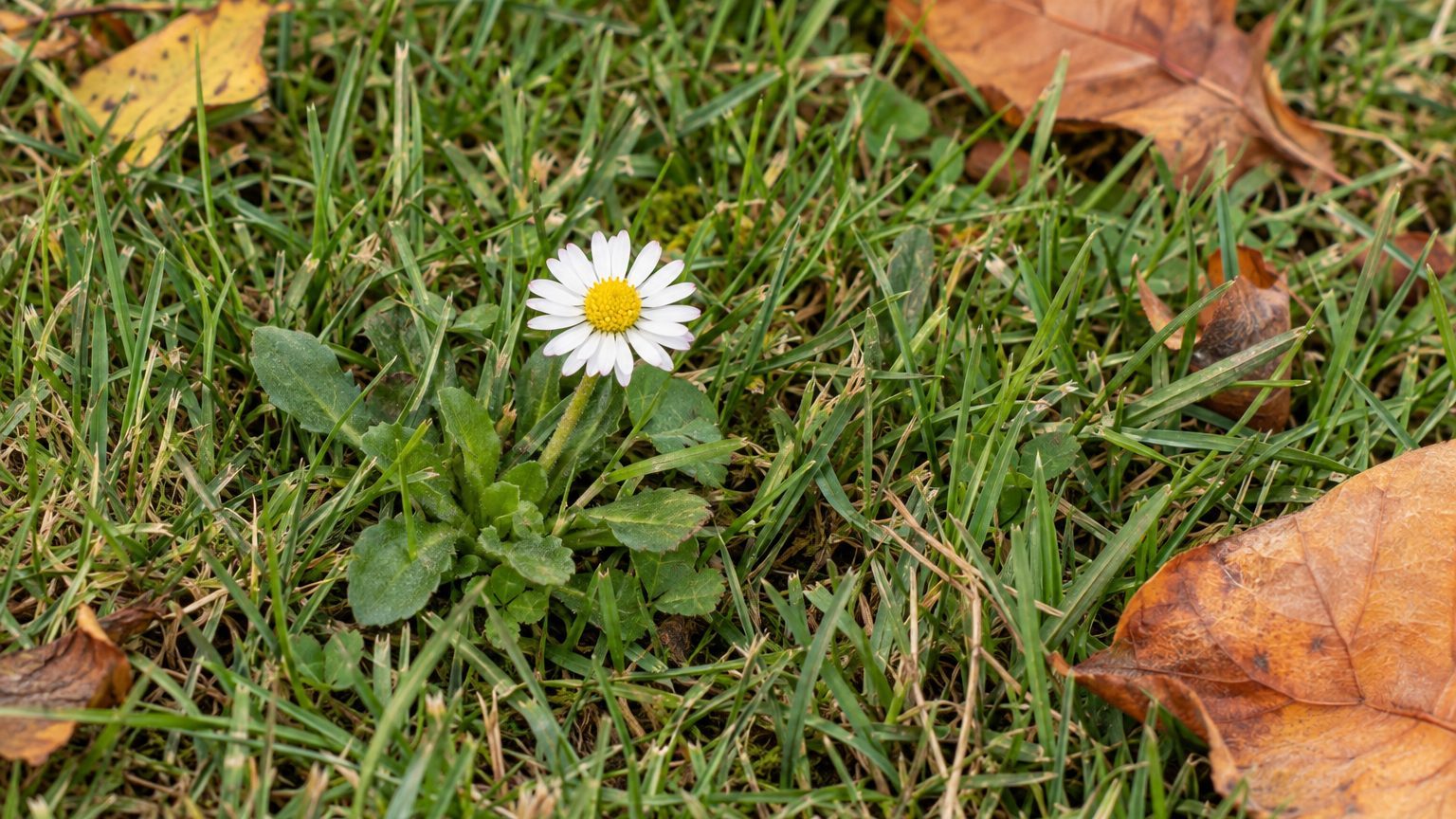
A low mat of leaf rosettes dotted with small white-and-yellow heads can be English daisy. It is a perennial that spreads by seed and underground stems, so control means removing the whole plant and repairing the turf around it.
How to Identify English Daisy

Look low, at the level of the mower deck, because this weed hugs the ground and the clues are all in the rosette.
- Spatula-shaped leaves form short rosettes, each leaf 1 to 2.5 inches long and widest toward the tip.
- The plants grow prostrate, spreading flat across the turf to as much as 8 inches in length.
- Each flower head has many white petals around a yellow center and measures 1 to 1.5 inches across.
- Patches thicken in spring and early summer, with scattered flowering continuing until frost in North Carolina.
- Pull a rosette and you will find creeping horizontal stems underground, which is why a patch widens each year.
A plant that matches the leaf shape and the flat habit is English daisy, even before it flowers.
From the almanac
Lawn in your state
The dates on this page depend on where you live. Your state's page carries its frost dates, its USDA zones and the year laid out month by month.
Northeast
Southeast
- Alabama
- Arkansas
- Delaware
- Florida
- Georgia
- Kentucky
- Louisiana
- Maryland
- Mississippi
- North Carolina
- South Carolina
- Tennessee
- Virginia
- West Virginia
Midwest
Southwest
West
Pacific Northwest
Canada
Weeds Mistaken for English Daisy
Any white daisy in a lawn gets called by this name, but the plant you are looking at may be something else. The mistake matters because a different weed may need a different approach.
A common mix-up is oxeye daisy, a taller meadow plant that turns up along lawn edges and in unmowed corners.
| Looks like | How to tell them apart |
|---|---|
| Oxeye daisy (Leucanthemum vulgare), with white petals around a yellow center | It stands upright on stems instead of lying flat. English daisy keeps its spatula-shaped leaves in a rosette close to the soil, with flower heads of 1 to 1.5 inches. |
Other small white-flowered weeds can pass at a glance, so check the leaves and the growth habit together. Spatula-shaped leaves in a flat rosette, plus creeping stems underground, point to English daisy. If the plant stays tall after mowing, it is a different weed.
What Causes English Daisy in Lawns
English daisy began as a garden ornamental and has escaped into turf. In North Carolina it often moves from flower beds into the lawn next to them, and in California it is described as primarily a weed of turf, sometimes found in moist grassy areas. It spreads by seed and by its creeping stems, so plants can grow into a mat.
Conditions decide how fast it takes hold. In North Carolina, it prefers cool temperatures and cool, moist, fertile soil, with sun and afternoon shade. Those conditions can occur in lawns that are watered often or kept in damp low spots.
Fertility is part of the story too. In North Carolina, English daisy likes heavy fertility, so generous feeding can encourage it. A thin lawn with bare patches gives seed a place to start, and a thick, healthy one leaves much less room.
How to Get Rid of English Daisy
Because the plant spreads underground as well as by seed, remove the whole plant and then fill the space with grass.
- In Washington, hoe or rototill infested ground to eliminate the plants.
- Dig scattered rosettes carefully, and lift the creeping stems with them so they do not regrow.
- Rake the disturbed soil level and remove the pulled plants, since digging can bring weed seed to the surface and encourage more of it to sprout.
- Reseed bare spots when conditions favor your turfgrass, so grass can fill the space before daisy seedlings do.
- In North Carolina, avoid heavy feeding in infested areas because English daisy likes heavy fertility.
- Check the area regularly and dig out any new rosettes while they are still small.
If the patch is too large to dig, your state extension office can tell you which herbicides are registered in your state and when to apply them.
How to Prevent English Daisy
Prevention follows the weed’s season. In North Carolina, it grows in cool weather, so watch for it as the lawn wakes up and wherever turf thins.
- In North Carolina, walk the lawn and edges for flat rosettes during the plant’s spring-to-early-summer active season, and dig them out before they spread.
- Base fertilizer on the needs of your turfgrass rather than feeding the lawn heavily, especially in North Carolina, where English daisy likes heavy fertility.
- Remove flower heads before they set seed, and dig out the rosettes and creeping stems.
- Avoid needless watering in damp areas; in North Carolina, English daisy prefers cool, moist soil.
- Overseed thin or bare patches when conditions favor your turfgrass, so grass fills gaps before daisy can move in.
- In North Carolina, watch lawn edges beside flower beds, because English daisy often escapes from ornamental plantings into turf.
A thick lawn leaves less room for English daisy and makes any dig-out job easier.
Common Questions
Does English Daisy Come Back Every Year?
Yes, because it is a low-growing perennial. Leftover roots or creeping stems can regrow, and seed already in the soil can sprout, so a cleared patch needs watching.
Can English Daisy Spread from a Flower Bed into the Lawn?
It can. In North Carolina, it often escapes from the flower garden into lawns, where it is treated as a weed. Check bed edges and keep the lawn dense beside them.
How Long Does It Take for English Daisy to Reach Full Size?
A plant reaches its mature height in a maximum of 5 years, and in as little as 2 years. A patch you ignore will keep getting bigger and harder to clear.