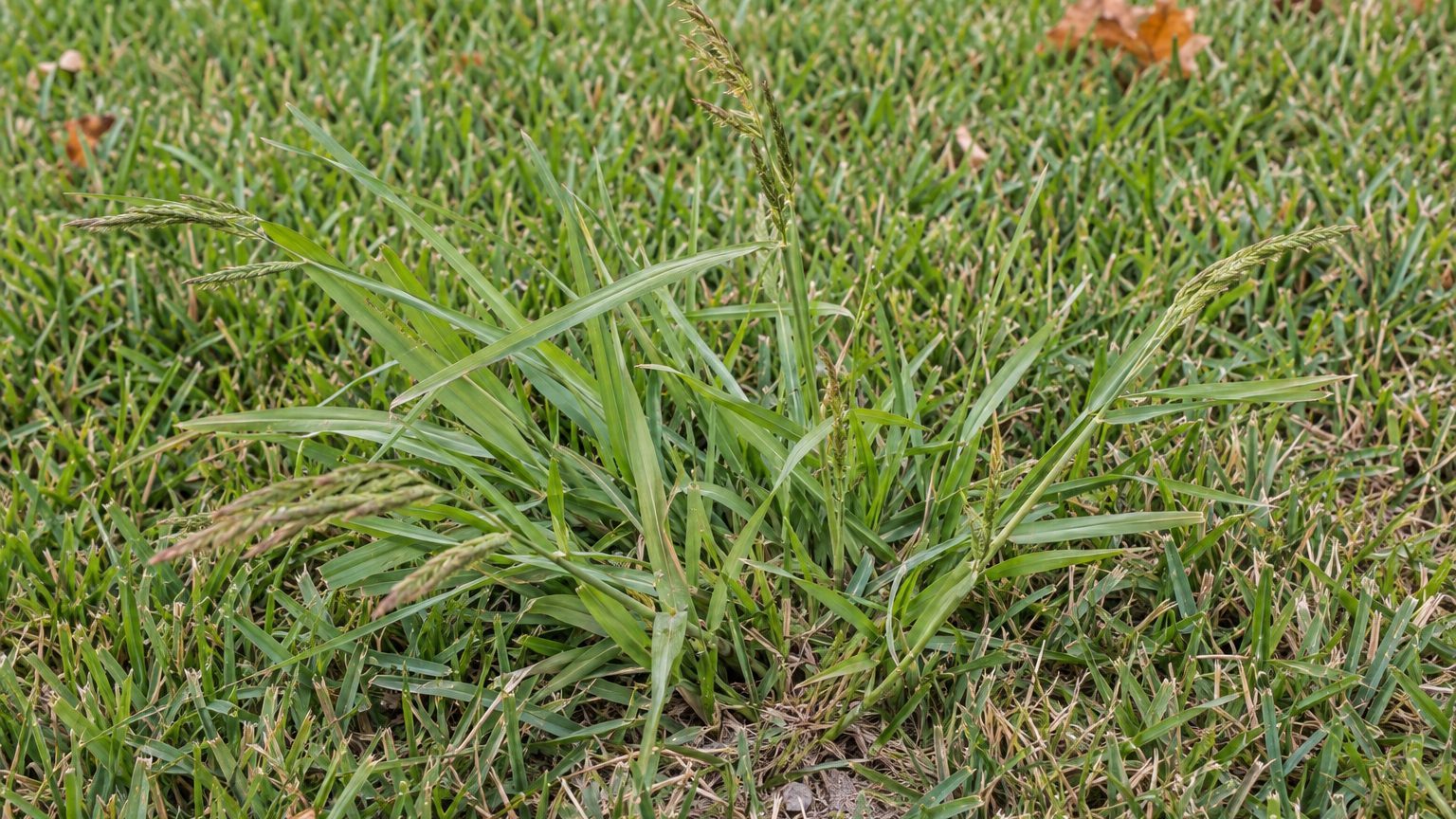
Dallisgrass shows up in a lawn as coarse, clumpy patches that stay green and keep growing after the rest of the turf slows down, and tall seed stalks that rise above the mower deck. It is a perennial bunchgrass with deep roots, so pulling and mowing rarely settle it. Getting rid of it comes down to catching it early and cutting off its seed.
How to Identify Dallisgrass

The seedhead is a useful clue, and the leaves and base help confirm it.
- Look for seedheads with 3 to 7 finger-like branches (racemes) on one stem, each under 2 inches long, with hairy spikelets lined up in 4 rows.
- Check the stalks, which can climb up to 5 feet tall where the grass goes unmowed.
- Watch for seedheads from late May through October in Texas, which means the weed keeps reseeding through most of the growing season there.
- Look at the base of a leaf, where a thin, see-through ligule up to 0.2 inches long sits, sharp pointed to blunt.
- Notice the growth habit, a tight, coarse clump spreading from a short rhizome rather than a creeping mat.
Dig up a clump and you will find thick, deep fibrous roots, which explains why it holds on so stubbornly.
From the almanac
Lawn in your state
The dates on this page depend on where you live. Your state's page carries its frost dates, its USDA zones and the year laid out month by month.
Northeast
Southeast
- Alabama
- Arkansas
- Delaware
- Florida
- Georgia
- Kentucky
- Louisiana
- Maryland
- Mississippi
- North Carolina
- South Carolina
- Tennessee
- Virginia
- West Virginia
Midwest
Southwest
West
Pacific Northwest
Canada
Weeds Mistaken for Dallisgrass
Several grasses get called dallisgrass in yards, and the mix-up matters because the right treatment depends on a correct identification. Check the seedhead and the leaf base before deciding.
Crabgrass is the usual confusion, since both grow as bunches. Field paspalum and thin paspalum are other common look-alikes.
| Looks like | How to tell them apart |
|---|---|
| Crabgrass | Also a bunch-type weed, but dallisgrass has a membranous ligule and a prominent midrib on the leaf. |
| Thin paspalum | Young leaves look glossier and shinier than dallisgrass, and the seedhead structure is different when you compare them side by side. |
| Field paspalum | Often called dallisgrass by mistake, so check the seedhead branches and the ligule rather than going by overall clump shape. |
What Causes Dallisgrass in Lawns
Seed is the cause. Dallisgrass produces abundant seed, its primary means of spreading.
Bare or thin turf gives that seed a place to land. Dallisgrass turns up often in lawns and disturbed areas, and its fast growth and heavy seeding let it invade managed urban sites quickly.
Mowing low does not hold it back. Dallisgrass adapts to low mowing heights and spreads through managed turfgrass, so a closely shaved lawn can end up favoring the weed over the grass you want. Once a clump is established, its deep roots let it outcompete the turf around it.
How to Get Rid of Dallisgrass
Small infestations can be handled by hand, especially before plants form rhizomes or set seed.
- Dig out young plants before they form rhizomes or set seed, because in home landscapes this is the strategy that works for control.
- Remove the whole clump with a spade, including the short rhizome and thick, deep roots.
- Bag the plants and any seedheads instead of composting them, so the seed does not get spread around the yard.
- Fill the hole with good soil and reseed or patch with sod, so bare ground does not invite fresh seedlings.
- Check the spot regularly and dig out any regrowth soon after it appears.
Large or mature stands are harder to remove by hand. For those, your state’s extension service can tell you which herbicides are registered locally and when to apply them for your turf type.
How to Prevent Dallisgrass
Dense, healthy turf leaves the seed little room to establish, and seasonal maintenance helps keep it that way.
- In spring, walk the lawn and dig out any young clumps before they form rhizomes or set seed.
- Water deeply when rain falls short. According to Clemson Cooperative Extension, 1 inch of water a week moistens the soil down to 6 inches and encourages deep turf roots.
- Through summer, mow at the recommended height for your grass type rather than scalping it, since thin turf lets seed take hold.
- From late May through October in Texas, watch for seedheads and cut or remove them before they ripen.
- In fall, clean mower decks and shoes after working in any infested area so seed does not travel to clean turf.
When dallisgrass is kept as a pasture grass, maintain it at 2 to 3 inches because a lower height can cause it to decline.
Common Questions
Can You Mow Dallisgrass Out of a Lawn?
No. It adapts to low mowing and keeps growing, and cutting only trims the seedheads for a while. Digging out the young plants works better.
Is Dallisgrass an Annual or a Perennial?
It is a perennial bunchgrass, so remove the whole clump, including its short rhizome and roots, to keep it from returning.
How Do You Tell Dallisgrass from Crabgrass?
Look at the leaf base and the midrib together. Dallisgrass has a membranous ligule and a prominent midrib, and it grows as a perennial clump rather than a spreading annual.