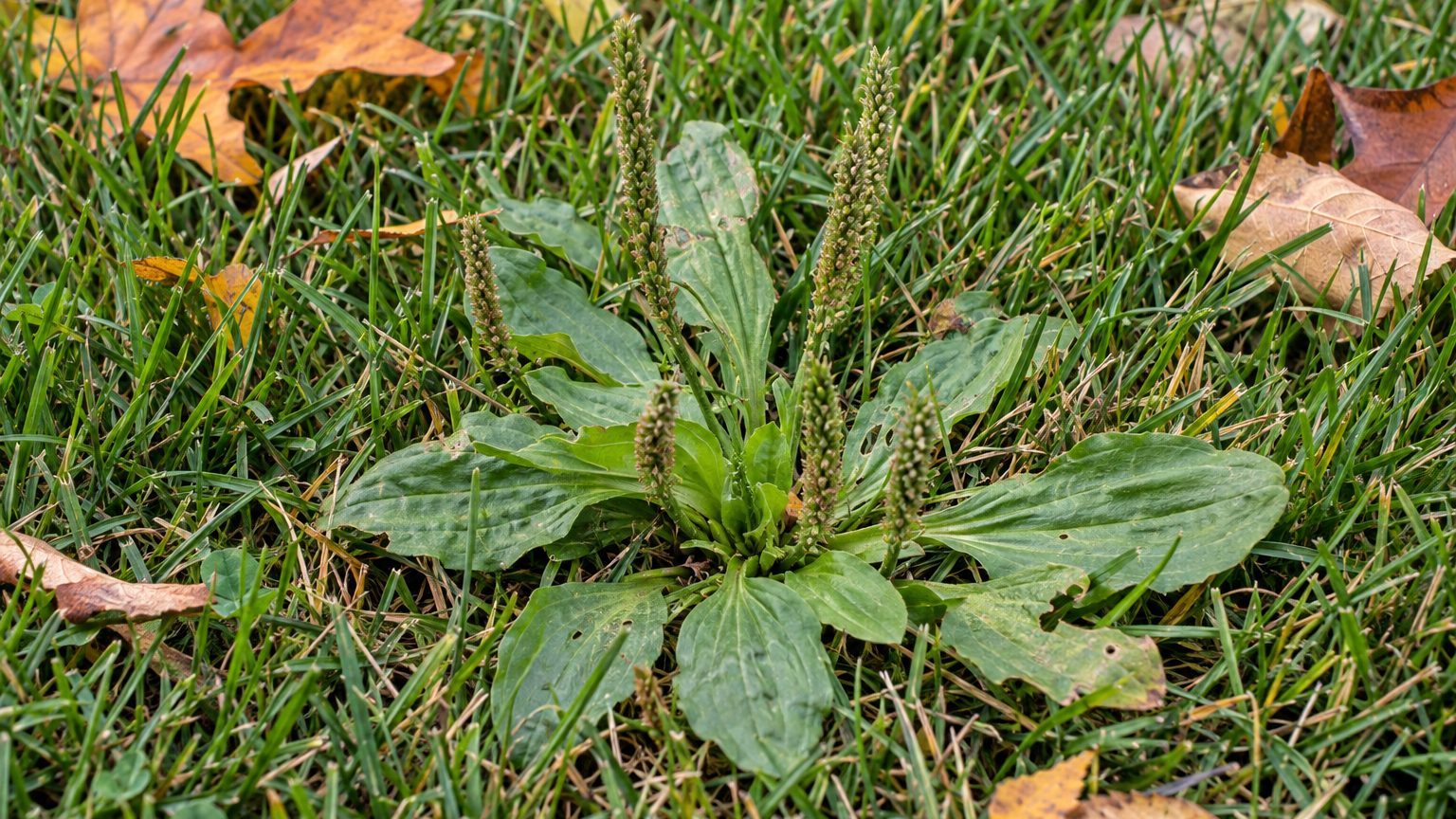
A rosette of narrow, ribbed leaves hugging the ground, with a slim stalk topped by a small brown spike, is the signature of buckhorn plantain in a lawn. It settles into thin, dry, worn turf and persists as a perennial. Getting it out means working on the roots and on the conditions that let it in.
How to Identify Buckhorn Plantain

Look low, at the crown where the leaves meet the soil.
- The leaves are long and narrow, 3 to 12 inches long, with veins running parallel from base to tip.
- Each leaf blade merges smoothly into a short stalk, so the plant looks like a flat starburst pressed against the turf.
- Pull the plant and you will find a taproot heading straight down rather than a mat of fine roots.
- Slim flower stalks rise 6 to 30 inches tall, and flowers occur from May to October.
- The seeds are black, shiny, and about 1/16 inch across, small enough to ride in on a mower deck or a shoe.
Because the leaves lie so close to the ground, a plant can look harmless until the stalks stand above the grass.
From the almanac
Lawn in your state
The dates on this page depend on where you live. Your state's page carries its frost dates, its USDA zones and the year laid out month by month.
Northeast
Southeast
- Alabama
- Arkansas
- Delaware
- Florida
- Georgia
- Kentucky
- Louisiana
- Maryland
- Mississippi
- North Carolina
- South Carolina
- Tennessee
- Virginia
- West Virginia
Midwest
Southwest
West
Pacific Northwest
Canada
Weeds Mistaken for Buckhorn Plantain
Broadleaf plantain and bracted plantain can be confused with buckhorn plantain. Broadleaf plantain shares the rosette habit and perennial lifecycle, making it easy to confuse with buckhorn plantain.
Check leaf shape together with growing conditions before deciding.
| Looks like | How to tell them apart |
|---|---|
| Broadleaf plantain | Wider, oval leaves on a longer stalk, while buckhorn has long narrow leaves that merge into a shorter stalk. Buckhorn also has a taproot and favors disturbed sites. |
| Bracted plantain (Plantago aristata) | Narrow leaves and a similar rosette, but the flower spike carries long, leafy bracts that buckhorn lacks. Check the spike when it forms. |
Broadleaf plantain tends to occur in moist, compacted ground, making site moisture a useful clue.
What Causes Buckhorn Plantain in Lawns
Seeds are the starting point. According to UC IPM, University of California: Plantains, the seeds germinate at or near the soil surface once moisture is adequate and the soil reaches 50°F. In California, germination speeds up as soil warms, so bare soil is vulnerable.
Turf conditions decide whether those seedlings survive. Buckhorn plantain is described as better adapted to areas with less irrigation and mowing, and it is treated as an indicator of dry, low-fertility soil. Thin turf, worn paths and edges, and spots where grass struggles give it room.
It also grows best in disturbed sites, unlike broadleaf plantain. Soil churned up by construction, pet traffic, or a bad patch repair is an open invitation. The weed is a perennial, so once a plant roots in, it returns each year and flowers through summer, from May to August or September.
How to Get Rid of Buckhorn Plantain
Because it is a perennial with a taproot, removal is a matter of getting the whole plant and then filling the gap with grass.
- Moisten the soil before digging so the taproot is less likely to break.
- Dig out each plant with a narrow weeder or knife, cutting well below the crown, since leftover root can sprout again.
- Remove flower stalks before they set seed, because the black seeds are what spread the problem to new patches.
- Fill the hole with fresh soil and seed or sod, so grass claims the space before new seedlings do.
- Cover any bare ground in beds with organic mulch, which in California can control seedlings alone when applied 2 to 4 inches deep.
- Repeat the digging regularly, since removing perennial plantain in California must go on for several years to succeed.
Mowing does not help, because the leaves lie too close to the ground to be cut. For herbicide choices registered in your state, ask your state extension office.
How to Prevent Buckhorn Plantain
Dense, well-fed turf helps prevent buckhorn plantain when care is matched to local growing conditions.
- According to UC IPM, University of California: Plantains, check for thin or bare patches when the soil reaches 50°F and repair them at the locally appropriate time.
- Keep irrigation and fertility appropriate for the turf because buckhorn plantain is adapted to dry, low-fertility soil.
- Maintain irrigation and mowing appropriate for the turf, because buckhorn plantain is better adapted to areas with less irrigation and mowing.
- Remove flower stalks before seeds ripen; flowering begins in May and continues to August or September.
- Repair ground disturbed by projects with seed or sod at the locally appropriate time so bare soil is not left for seedlings.
Seedlings can take 8 to 15 weeks to reach the next stage, which gives you a real window to spot and pull young plants easily.
Common Questions
Can Buckhorn Plantain Be Killed by Mowing?
No. Mowing passes over the flat rosette, and the plant keeps growing from its taproot. Mowing at a steady height still helps the turf stay thick enough to crowd out seedlings.
Does Buckhorn Plantain Come Back After Digging?
It can, if a piece of the taproot stays in the soil or if seeds are already in the ground. Regular digging for several years is what finally exhausts the population.
Why Does Buckhorn Plantain Grow in the Driest Part of the Yard?
Buckhorn plantain indicates dry, low-fertility soil and grows best in disturbed sites. Where grass thins, bare soil gives plantain room to establish.