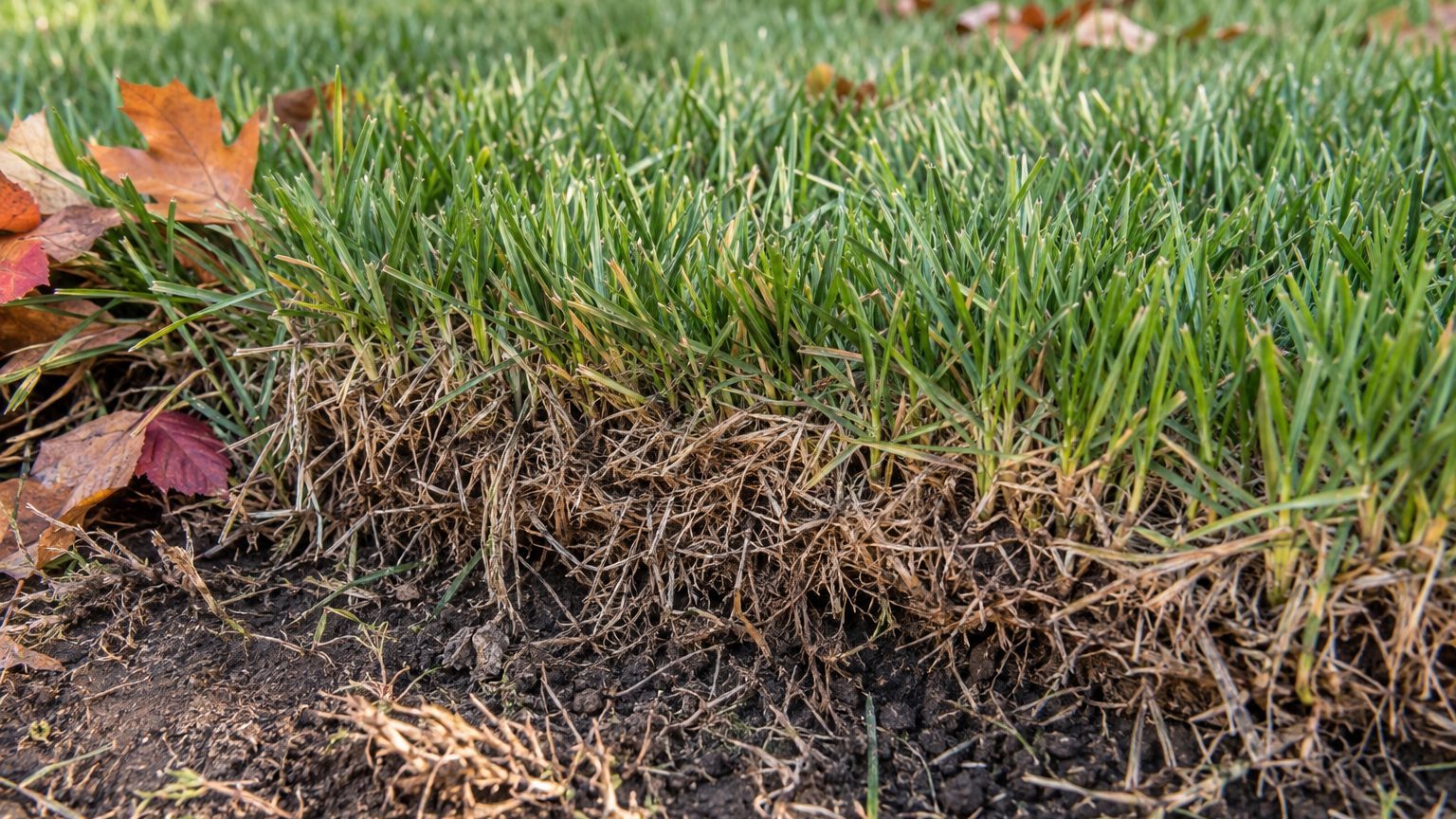
A spongy, springy feel underfoot, with a brownish mat showing when you part the grass blades, can be a sign of thatch. It is a layer of dead stems and old plant material packed just above the soil. A thin layer does the lawn good, but a thick one needs attention, and the fix depends on your grass type.
How to Recognize Thatch

Start by parting the grass with your fingers and looking at the base of the plants, where the layer sits between green blades and soil.
- A tan to brown, fibrous mat sits between the green blades and the soil, made of dead stems rather than roots.
- The lawn feels bouncy or spongy when you walk across it, as if a thin cushion lay under the grass.
- A wedge cut 2 inches into the soil shows a mat thicker than 1/2 inch, which is the point where thatch stops helping the lawn.
- Grass crowns and roots sit up in the mat instead of down in the soil, so the turf pulls up easily in patches.
- Mowing scalps high spots, because the mower wheels ride on the cushion and the blades cut too low.
A layer up to 1/2 inch thick is healthy, since it holds moisture and steadies soil temperature.
From the almanac
Lawn in your state
The dates on this page depend on where you live. Your state's page carries its frost dates, its USDA zones and the year laid out month by month.
Northeast
Southeast
- Alabama
- Arkansas
- Delaware
- Florida
- Georgia
- Kentucky
- Louisiana
- Maryland
- Mississippi
- North Carolina
- South Carolina
- Tennessee
- Virginia
- West Virginia
Midwest
Southwest
West
Pacific Northwest
Canada
Problems Mistaken for Thatch
Brown, spongy turf has other causes, and treating the wrong one wastes time and effort. Match what you see with a simple wedge test instead of guessing.
Dig up a small wedge before you rent any equipment. The wedge can quickly separate thatch from its look-alikes.
| Looks like | How to tell them apart |
|---|---|
| Drought stress, with tan, dry turf | Soil under the grass is dry and hard, and the wedge shows a mat under 1/2 inch; the grass greens up after a deep soaking |
| Compacted soil, with thin, weak turf | A screwdriver or spade resists going in, especially along paths and play areas, and the wedge shows little mat above the soil |
| Soft, wet ground, with a squishy feel | Water pools or the soil stays soggy after rain, and the squish comes from the soil rather than a fibrous layer above it |
Compaction can also work alongside thatch, since compacted soil is one of the conditions that favors it. A thick mat with hard soil underneath means thatch and compaction may be present together.
What Causes Thatch
Thatch builds when grass produces dead material faster than the soil can break it down. The layer is made of dead stems along with clippings and older plant material that naturally falls off the grass. Some lawns are more prone to thatch than others.
Grass type matters a great deal. Hybrid bermudagrass and Kentucky bluegrass build heavy thatch, and zoysiagrass builds it because its fibrous tissue breaks down slowly. Lawns with these grasses deserve regular checks for thatch.
Lawn care habits add to the problem. Excessive nitrogen fertilizer or overwatering often contributes, because both push the grass to grow excessively fast. Soil conditions play a part too:
- heavy, wet soils
- alkaline, or high pH, soils
- compacted soil
Clippings from regular mowing are not usually the culprit. According to University of Illinois Extension, clippings are very high in water content and break down rapidly when returned to the lawn, as long as the lawn is mowed on a regular basis and no more than one-third of the leaf blade is removed.
How to Fix Thatch
Work in this order, and match the timing to your grass type so the lawn can recover quickly.
- Measure the mat first by cutting a wedge 2 inches into the soil, so you know whether it is over 1/2 inch and needs treatment at all.
- Dethatch at the right time for your grass: cool-season lawns in late summer or early fall, and warm-season lawns in spring after green-up or in early summer, when the turf is growing hard enough to fill in.
- Pull the mat out with a dethatcher or vertical mower, then rake up the debris so it does not settle back onto the turf.
- Aerate afterward to open the soil, since in Illinois an average of 15 to 20 aeration holes per square foot is suggested.
- Topdress with a thin layer of compatible topsoil or compost, which in Illinois is advised at 1/8 to 1/4 inch, to feed the microbes that break down what remains.
Severe cases call for patience. According to Oklahoma State University Extension, moderate treatments over two or three years are favored rather than trying to remove everything in a single operation, which can leave the lawn thin and stressed. Your state extension office can confirm timing for your area.
How to Prevent Thatch
Prevention follows the mowing and growing season, and the habits are simple enough to build into a regular routine.
- Avoid heavy nitrogen, since overfertilizing makes the grass grow faster than the soil can digest it.
- Mow on a regular basis and take no more than one-third of the leaf blade, leaving the clippings to break down on the lawn.
- Water only when the lawn needs it, because overwatering is a known contributor.
- For a thatch-prone cool-season lawn such as Kentucky bluegrass, match aeration or topdressing to local conditions.
- On warm-season lawns such as bermudagrass or zoysia, check the mat with a wedge in spring after green-up, then decide whether to dethatch.
In Illinois, thatch torn out with a dethatcher will most likely return unless the cause is corrected, so the habits matter more than the machine.
Common Questions
Is a Little Thatch Bad for a Lawn?
No. A layer up to 1/2 inch thick holds moisture and steadies soil temperature, so a thin mat is part of a healthy lawn. Trouble starts when it thickens beyond that.
Which Grasses Are Most Likely to Build Thatch?
Hybrid bermudagrass and Kentucky bluegrass build heavy thatch. Zoysiagrass builds it too, because its fibrous tissue breaks down slowly, so those lawns deserve a check with a wedge more often.
Can You Remove All the Thatch in One Go?
You can, but a severe layer may be easier on the lawn if you take it in stages. According to Oklahoma State University Extension, moderate treatments over two or three years are suggested over complete removal in a single operation.