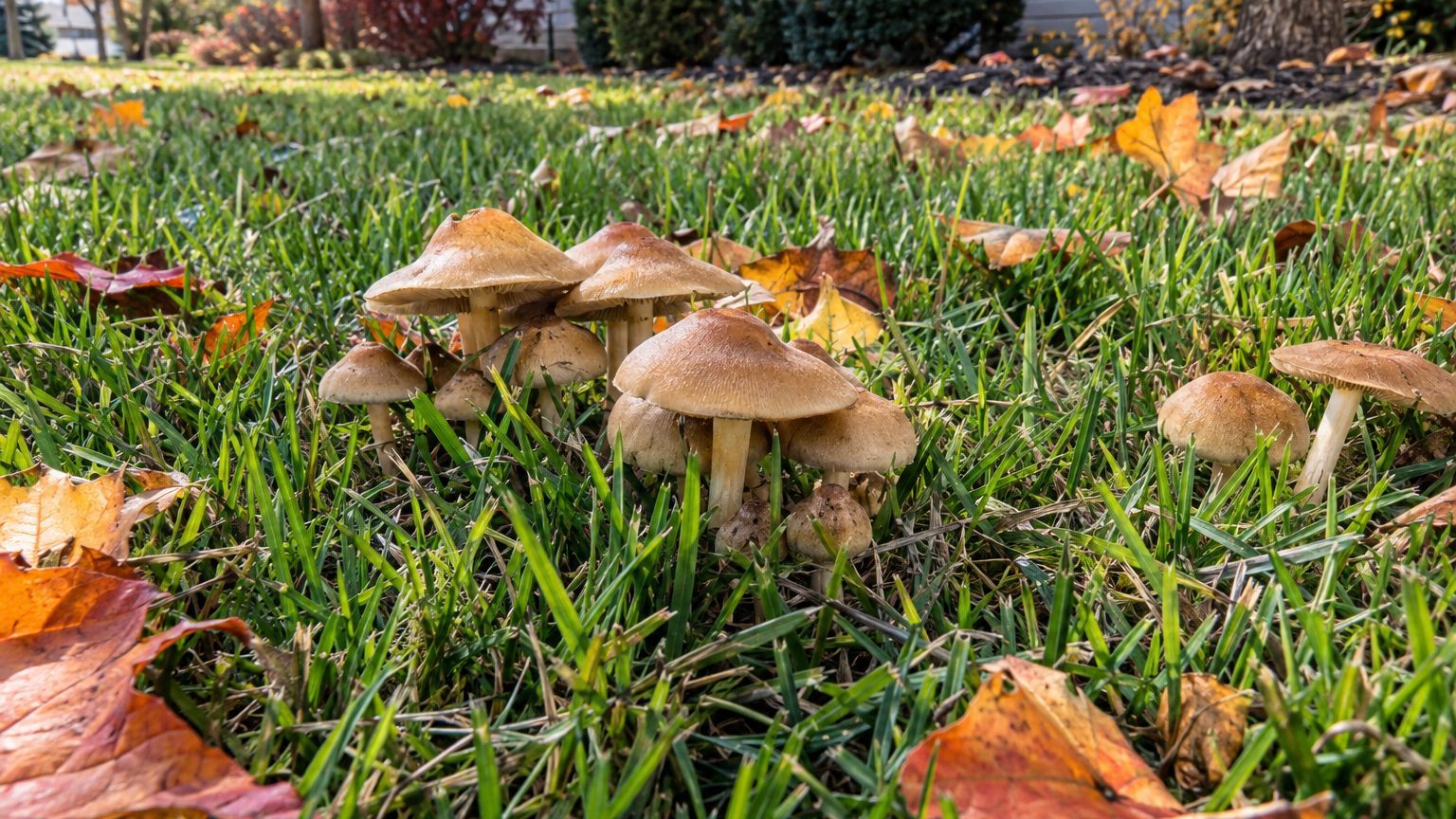
Pale caps pushing up through the grass after a stretch of wet weather are one of the more surprising sights in a lawn. Mushrooms are the fruiting part of a fungus living in the soil, and they rarely hurt the grass itself. The real question is what the fungus is feeding on, and whether anything needs to change.
How to Recognize Lawn Mushrooms

Look for the feature that sets them apart: a cap on a stalk, or a round puffball, appearing on bare-looking turf rather than growing from a grass blade.
- The fruiting body is short-lived, so it may stand firm in the morning and be collapsed or gone a little later.
- Shape, size and color vary from one fungus to another, from tiny tan caps to large white balls.
- Mushrooms often cluster over a buried spot, such as old wood or a dead root, rather than spreading evenly across the yard.
- They tend to show up after wet weather, when the soil stays damp.
- Some grow in a circle or arc, and fairy rings can be 1 to 12 or more feet in diameter, with or without mushrooms present.
Puffballs and mushrooms both count as nuisance fungi in turf, and neither means the grass is dying.
From the almanac
Lawn in your state
The dates on this page depend on where you live. Your state's page carries its frost dates, its USDA zones and the year laid out month by month.
Northeast
Southeast
- Alabama
- Arkansas
- Delaware
- Florida
- Georgia
- Kentucky
- Louisiana
- Maryland
- Mississippi
- North Carolina
- South Carolina
- Tennessee
- Virginia
- West Virginia
Midwest
Southwest
West
Pacific Northwest
Canada
Problems Mistaken for Lawn Mushrooms
Not every odd growth on the lawn is a mushroom. A few other things look similar from across the yard, but each gives itself away when you check where it sits and how it behaves.
Fairy rings can include mushrooms, so look at the surrounding grass before deciding what you are seeing.
| Looks like | How to tell them apart |
|---|---|
| Slime mold | A crust or smear on blades, not a cap on a stalk, that fades when left alone and can leave shaded, smothered grass underneath. |
| Fairy ring | A ring or arc of dark or dead grass that widens slowly, whether or not caps appear; the diameter tends to run 1 to 20 feet. |
| Puffball | A round, stalkless ball sitting on the turf that turns powdery inside as it ages, not a flat cap on a stem. |
Fairy rings are sorted into type 1, 2 or 3 by how much the fungus affects the grass, and a ring can expand about 3 to 19 inches per year. A mushroom-free ring is still a ring, so look at the grass pattern too.
What Causes Lawn Mushrooms
The cause is food in the soil. Mushrooms in lawns often grow from buried wood or dead plant roots, and the fungus lives quietly underground until moisture pushes up the fruiting bodies.
Typical hidden sources include scraps of construction lumber left under the sod, old tree roots from a removed tree, and other organic matter. New housing lots and yards where a stump was ground out are common spots.
Wet conditions finish the job. Mushrooms in lawns are commonly tied to overirrigation or poor drainage, so a low corner that stays soggy or a sprinkler zone that runs long will often produce a crop. In Maryland, mushrooms tend to appear after wet weather.
How to Fix Lawn Mushrooms
You can’t pull a fungus out of the ground, but you can clear the fruiting bodies and make the soil less inviting.
- Pick and bag mushrooms where children or pets might reach them; mowing removes the caps but leaves the fungus in the soil.
- Cut back on watering, because in California the mushrooms don’t harm the lawn and will disappear when irrigation is reduced.
- In California, core-aerate the area, removing plugs at least 1/4 to 1 inch in diameter and slightly deeper than the fungal mat, so water and air move in more freely.
- Apply nitrogen fertilizer where the mushrooms grow from organic matter, since in California 1 pound of actual nitrogen per 1,000 square feet can hasten decomposition of the buried material.
- Dig out the source if you find it, such as buried lumber or a dead root, and fill the hole with clean soil and fresh sod.
For a fairy ring where you want it gone completely, California guidance is to remove soil and sod to at least a depth of 1 foot and 18 inches beyond the outside edge of the ring. Begin 2 feet outside the margin and work inward so no fungus is left behind. Your state’s extension office can tell you what treatments are approved locally.
How to Prevent Lawn Mushrooms
Prevention follows the wet and dry seasons, because moisture is the trigger. Good habits through the year keep the buried food source from turning into a flush of caps.
- In California, dethatch if the layer is thick and aerate compacted areas; removing excess thatch and improving water penetration can help in some cases.
- Once the grass is growing actively, water deeply and less often, and check that sprinklers are not soaking one low corner.
- In Maryland, avoid over-fertilizing and unnecessary pesticide use, which may harm beneficial mycorrhizal fungi.
- Fix any spot that holds water after rain by regrading or aerating it.
- After removing a tree or building anything in the yard, pick buried wood and roots out of the soil before laying sod.
Even with all of this, a wet stretch can still bring mushrooms, and in Maryland they tend to appear after wet weather and disappear on their own in time.
Common Questions
Are Lawn Mushrooms Poisonous to Dogs and Children?
Some wild mushrooms are toxic and you can’t tell safe from unsafe by looking. Remove them promptly, keep pets and children away, and call a vet or poison control if something was eaten.
Will Mowing Over Mushrooms Get Rid of Them?
Mowing knocks the caps down for now, but the fungus stays in the soil. Bag the pieces when you mow, then deal with moisture and buried organic matter to stop a repeat.
Do Mushrooms Mean the Lawn Is Unhealthy?
Not by themselves. They usually point to decaying material below the surface or soil that stays damp, and the turf around them can look perfectly fine.