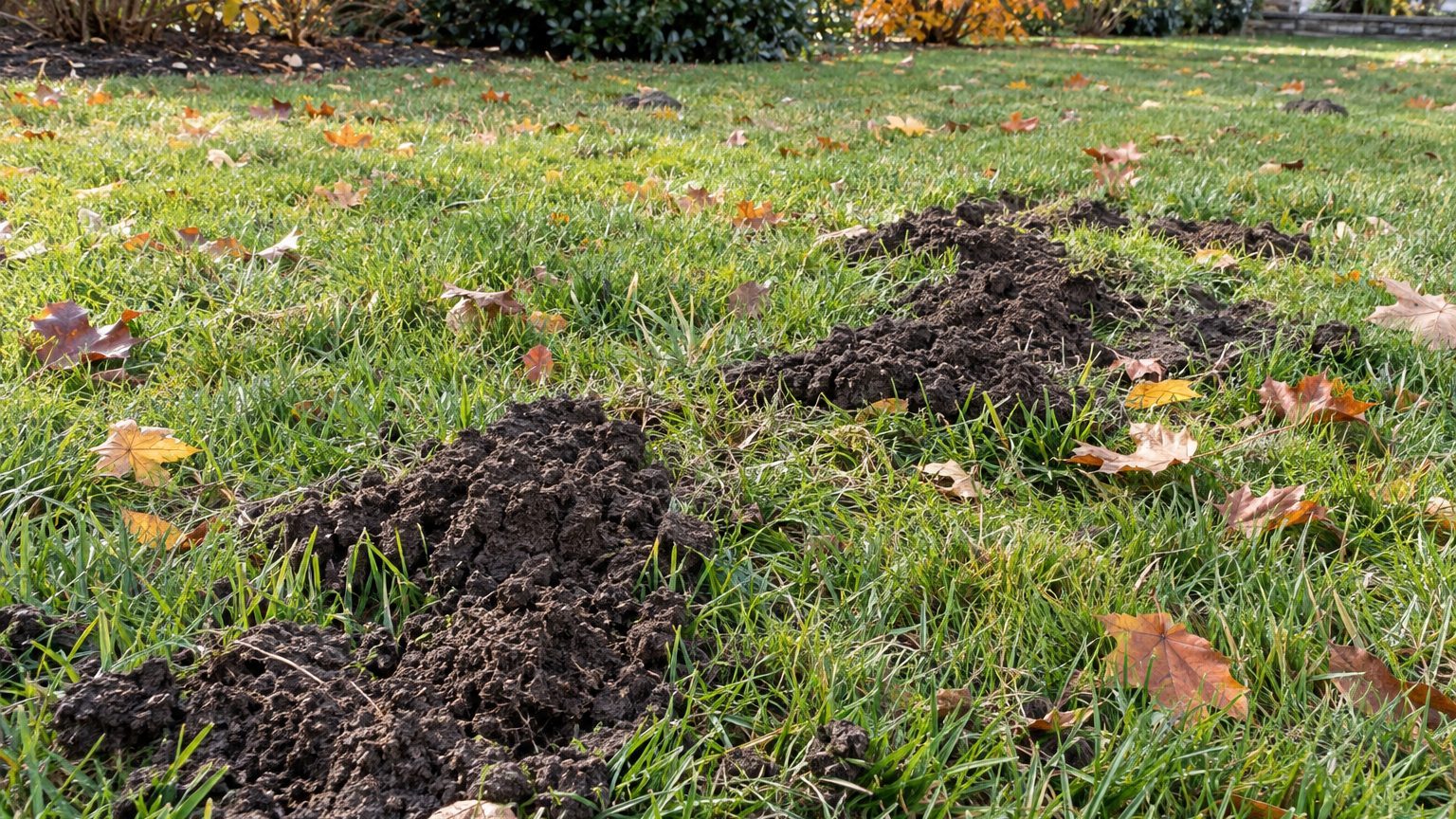
Raised, winding ridges across the grass and the occasional cone of loose soil mean a mole is working underneath. The lawn looks rough, but the animal is after food in the soil, not your grass. Knowing what the tunnels are, and what they are not, tells you how much to worry and what to do first.
How to Recognize Mole Tunnels

Mole activity leaves a few signs that are easy to read once you know what to look for.
- Raised ridges push up the sod and seem to wander aimlessly across the lawn, which is the surface feeding tunnel and the sign that sets a mole apart.
- Volcano-shaped mounds of loose soil sit on top of the grass, pushed up from deep tunnels below.
- The sod feels spongy or hollow underfoot where a run lies just beneath it.
- New ridges can appear fast, since a mole can dig surface runs at 1 to 3 ft. per minute.
- Tunnels also show up in shrub beds, not only in turf.
Ridges and mounds often turn up together, and the pattern tends to follow wherever the soil is easiest to dig.
From the almanac
Lawn in your state
The dates on this page depend on where you live. Your state's page carries its frost dates, its USDA zones and the year laid out month by month.
Northeast
Southeast
- Alabama
- Arkansas
- Delaware
- Florida
- Georgia
- Kentucky
- Louisiana
- Maryland
- Mississippi
- North Carolina
- South Carolina
- Tennessee
- Virginia
- West Virginia
Midwest
Southwest
West
Pacific Northwest
Canada
Problems Mistaken for Mole Tunnels
Voles also leave trails in a lawn, and so do other burrowing animals. Each leaves a different mark, so look at the shape of the damage and then check the opening or the soil.
To check whether a ridge is active, press it down and see whether it gets pushed back up.
| Looks like | How to tell them apart |
|---|---|
| Mole ridges | Raised, wandering ridges of lifted sod with no open hole, often with volcano-shaped mounds nearby. Pressed-down ridges get rebuilt. |
| Vole runways | Open surface trails and small holes in the grass, with no soil mounds. In South Carolina, a wire fence with a mesh of ¼ inch or smaller helps keep voles out. |
| Mounded soil from other burrowers | An open burrow with soil fanned to one side, rather than a cone of soil with no visible hole. |
If you see open holes and bare trails but no raised ridges, voles are the likelier cause, and the fix differs from what works on moles.
What Causes Mole Tunnels
Moles dig tunnels through the soil for burrows and for feeding. The shallow runs that lift your sod are feeding tunnels, made while the animal hunts for food, and the soil from deeper tunnels gets pushed up to the surface as mounds.
The eastern mole, Scalopus aquaticus, is the mole you will most often meet in Iowa lawns. It is 4 to 7 inches long, with paddle-shaped feet and prominent digging claws that make quick work of loose ground.
Away from the surface, moles spend the rest of the year in deep tunnels 6 to 24 inches under the lawn. That is why damage can seem to stop and then start again: the animal moves between deep and shallow runs.
How to Fix Mole Tunnels
Trapping is the usual way to stop an active mole, and repairing the turf comes after the animal is gone.
- Walk the lawn and find the main runways, since a trap only works where a mole travels regularly.
- Set several traps unless activity is very light, because in New Jersey, 3 to 5 traps per acre (7 to 12 per hectare) give better and faster control.
- Check each trap daily so a catch is found quickly.
- Move a trap to a different part of the main runway system if it has not caught a mole in 3 to 4 days, since the animal may be using another stretch of tunnel.
- Press the raised ridges back down once the activity stops, so the roots touch the soil again.
- Reseed or patch any bare spots left behind, so weeds do not move in.
Repellents are sold for moles, and in South Carolina a castor oil treatment on the lawn repels moles and voles for about two weeks. Your state extension office can tell you which products and methods are allowed where you live.
How to Prevent Mole Tunnels
Prevention comes down to barriers and steady watching, and the timing follows the seasons.
- Walk the lawn regularly and look for fresh ridges and mounds so you catch activity before the runs spread.
- Before planting a bed you want to protect, build a barrier from 3′ (91.5 cm) width of galvanized hardware cloth or aluminum sheathing, as advised in New Jersey.
- When you set that barrier in New Jersey, bury it 2′ (61 cm) deep, or 1.5′ in hard ground, with 6″ (15 cm) left above the ground.
- Bend the bottom 3″ (7.5 cm) outward, which in New Jersey is advised to discourage moles from digging underneath.
- Keep watching for new ridges.
Mole damage is usually temporary in Florida, so a lawn that gets caught early generally recovers once the animal is gone.
Common Questions
Do Moles Eat Grass Roots?
No. Moles dig through the soil in search of food, and the ridges and mounds are the unsightly result. Roots can still dry out where a tunnel leaves a gap beneath them, which is why pressing ridges back down helps.
Can You Just Flatten Mole Ridges?
You can, and it helps the grass reconnect with the soil, but the mole will rebuild if it is still active. When activity has stopped, flatten the ridges and repair any bare turf.
Will a Lawn Recover from Mole Damage?
Mole damage is generally temporary, and a lawn typically fills back in once the tunneling stops and any bare patches are reseeded.