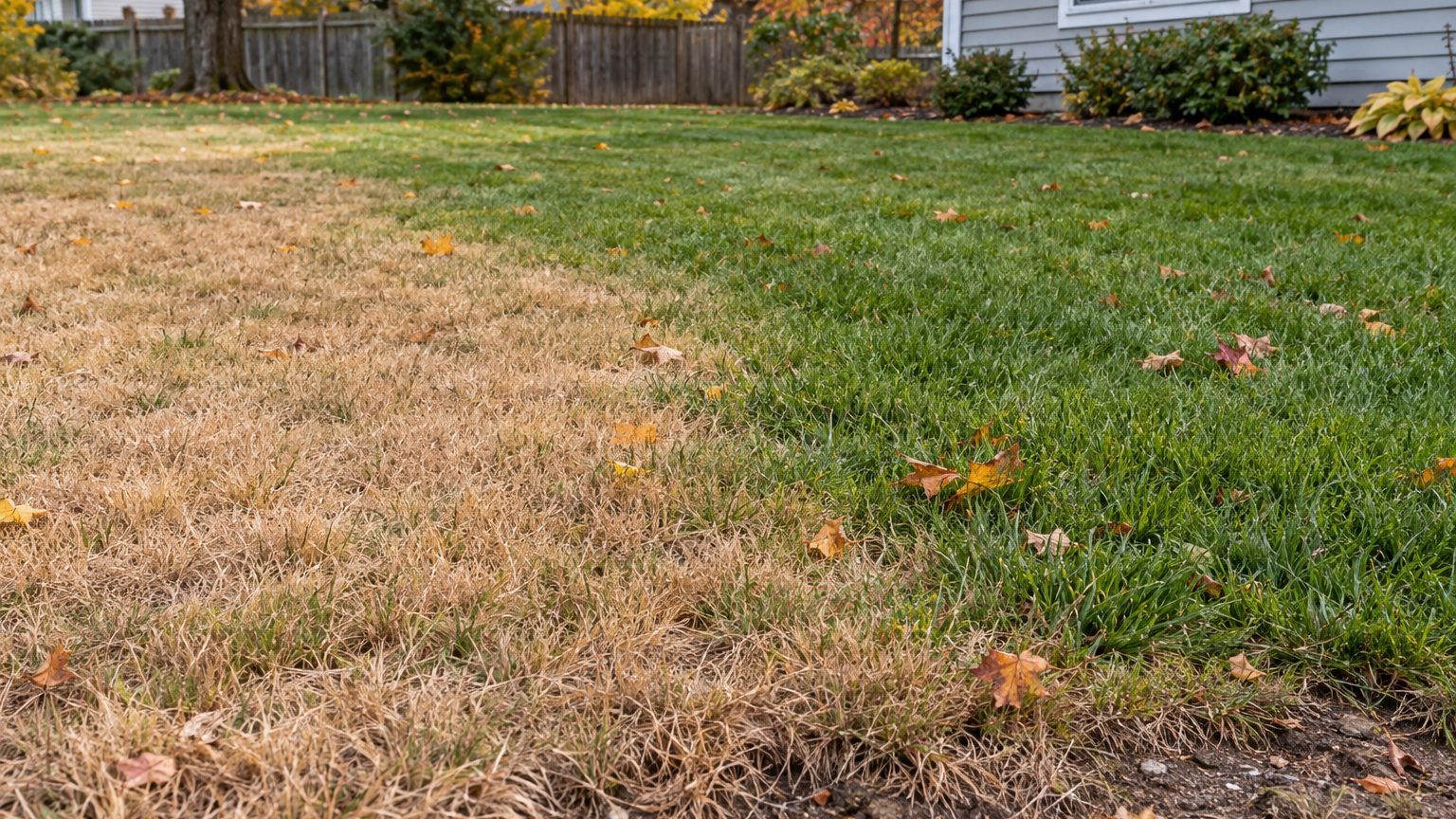
Straw-colored grass after a long dry stretch can signal dormancy rather than a lost lawn. Turf shuts down above ground to protect the crown, the growing point at the base of the plant, and wakes when water returns. What matters is how you treat it while it rests and how it comes back.
What Happens to a Lawn in a Drought?
A lawn in drought stops growing, fades to tan, and goes dormant to protect its crown and roots. In a typical Illinois summer, lawns go dormant and resume active growth when conditions improve. How hard the drought hits depends on the grass type, the season and your region.
Survival can be long. In one North Carolina experiment, all the tall fescue cultivars tested recovered after 40 days without any water. Good soil structure helps a lawn return to active growth quickly, which is one reason loose, healthy soil pays off before a dry spell.
The state selector below takes you to the page for your state, where you can find local timing.
From the almanac
Lawn in your state
The dates on this page depend on where you live. Your state's page carries its frost dates, its USDA zones and the year laid out month by month.
Northeast
Southeast
- Alabama
- Arkansas
- Delaware
- Florida
- Georgia
- Kentucky
- Louisiana
- Maryland
- Mississippi
- North Carolina
- South Carolina
- Tennessee
- Virginia
- West Virginia
Midwest
Southwest
West
Pacific Northwest
Canada
How to Care for a Lawn During a Drought

Drought care is mostly restraint, and the gestures below go in the order you meet them as a dry season deepens and then breaks.
- Accept dormancy instead of forcing green growth, because a resting lawn spends nothing on new leaves and keeps its energy in the crown.
- Water dormant turf lightly, because a small drink keeps the crown and roots moist without waking the grass into growth it cannot sustain. In Illinois and South Dakota, apply one-quarter to one-half of an inch of water every two to four weeks.
- Follow the local pattern if your state differs, because in North Carolina the suggestion is a minimum of 0.5 inches every three to four weeks to keep the crowns hydrated.
- Mow less often as stress deepens, since severely stressed turf grows slowly and each cut is another injury. When you do mow, never remove more than one-third of the leaf blade at once.
- Return to regular watering once conditions improve, because the grass grows back from the crown when water resumes, and a steady supply lets it rebuild.
Watch the weather rather than the lawn’s color. Brown grass tells you little about whether the crowns are alive, while the moisture reaching them tells you a great deal.
Drought Tolerance by Grass Type
Grasses do not share the same toughness. Cool-season types such as tall fescue grow mostly in spring and fall and slow down in summer heat. Warm-season types such as zoysiagrass and bermudagrass thrive in heat and enter dormancy in cool weather.
North Carolina observations ranked three common lawn grasses as a dry spell dragged on.
| Grass | Season | How it does in a long drought |
|---|---|---|
| Tall fescue | Cool | Suffered the most of the three, yet cultivars recovered after 40 days without water |
| Zoysiagrass | Warm | Suffered less than tall fescue but more than bermudagrass |
| Bermudagrass | Warm | Suffered least of the three |
For you, this means a tall fescue lawn is not doomed by its ranking. In the same North Carolina work, most tall fescue cultivars survived 48 days without water. Warm-season grasses showed more drought tolerance in the North Carolina observations, but their crowns still need enough moisture to survive. Either way, survival depends on keeping the crown moist.
Drought Lawn Care Mistakes to Avoid
Fertilizing in Summer Heat
Feeding a stressed lawn pushes leaf growth the roots cannot support, and the grass burns through its reserves. In Illinois, the advice is to wait for the early September period to fertilize most lawns rather than feeding in summer. According to NC State Extension, light nitrogen rates of no more than 0.5 pounds N per 1000 square feet are suggested.
Heavy Foot Traffic
Dormant blades snap and crush easily, and worn paths are slow to fill in afterward. In Illinois, limit traffic of any type on a drought-stressed lawn whenever possible. Route kids, pets and mowers along other paths, and put play equipment on a patio or driveway for a while.
Letting Crowns Dry Out
Dormancy is not permission to ignore the lawn entirely. A long dry stretch with no water at all eventually reaches the crown, and then the grass cannot regrow from it. The fix is the small, spaced watering described above, which costs far less than reseeding bare patches.
Drought Lawn Care in Your State
The cue to act is the lawn itself: growth slowing, soil heating and drying, and your grass type entering its resting season. Cool-season lawns usually stall in summer heat, while warm-season lawns stall in cooler weather.
- Your state’s page gives the months for lawn care where you live, so check it when the grass starts to fade.
- Watering restrictions vary by town, so confirm local rules before you set a light dormant watering.
Common Questions
How Can You Tell Dormant Grass from Dead Grass?
Dormant grass browns evenly across a wide area, and the crowns at the soil line stay firm and slightly green when you scrape the surface. Dead grass often shows in irregular patches, with crowns that are dry, mushy, or easy to pull away from the soil.
Do You Have to Reseed After a Drought?
Often not. Dormant grass can regrow from the crown when watering resumes, so reseeding may be unnecessary. Patches that stay bare after the lawn greens up are the ones to reseed, once the season suits your grass type.
Does Watering a Dormant Lawn Wake It Up?
A light watering is meant to keep the crowns alive, not to bring the lawn back to full growth. The small amounts that suit dormant turf are too modest to trigger lush growth, so the lawn stays tan until real conditions improve and regular watering resumes.