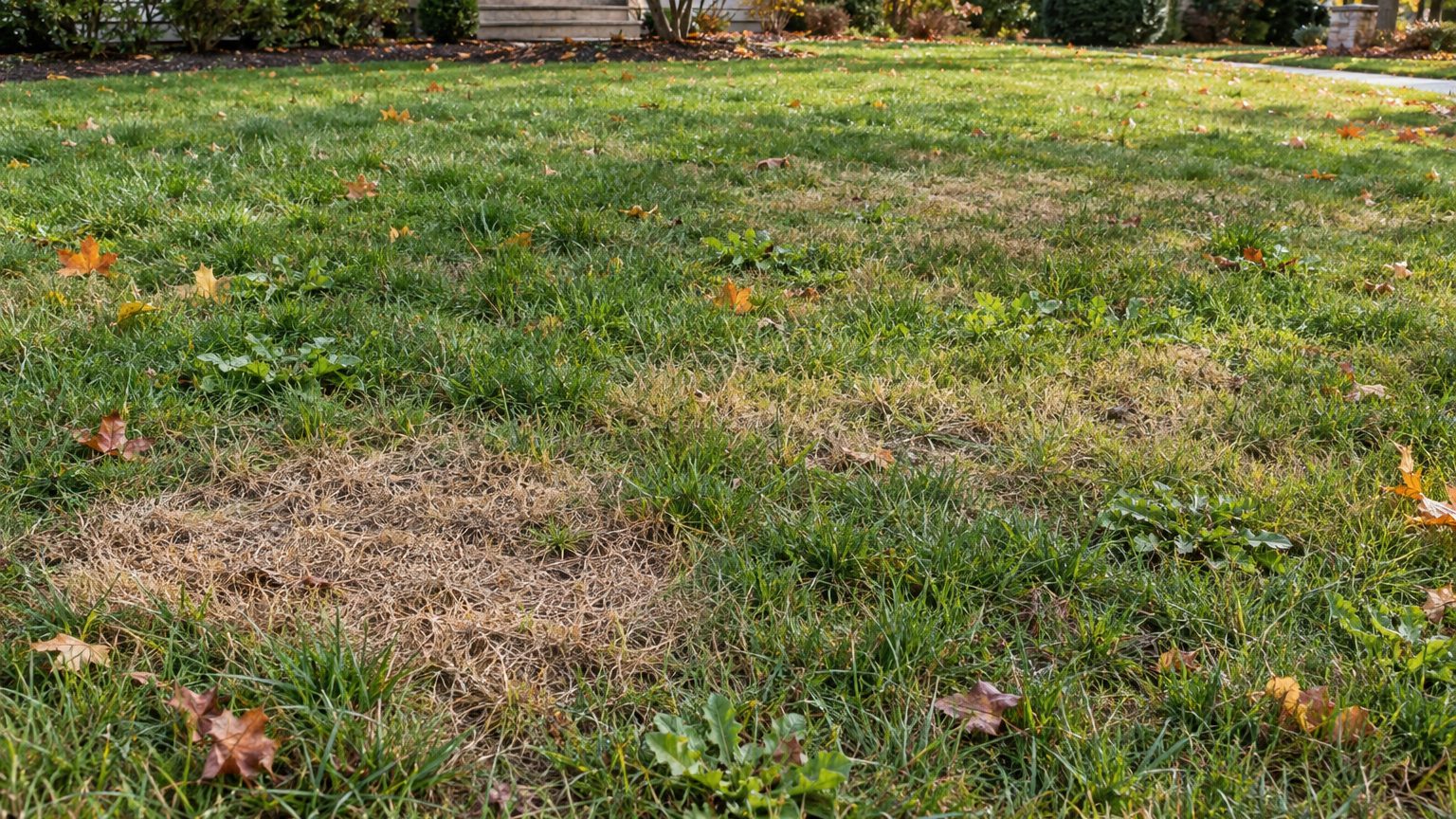
A round tan patch after a muggy stretch of summer, or a lawn that turns pale and sparse in spots, usually leaves clues you can read from the yard itself. Brown patches, yellowing and thin grass each point to a short list of causes, and the shape, the timing and the grass type narrow that list quickly.
What Causes Brown Patches and Thin Grass?
Most lawn problems come from stress meeting a weak spot: heat, too much or too little water, disease, insects, packed soil, or mowing at the wrong height. Which one wins depends on the grass type, the season and the region, so the same tan circle can mean different things in Georgia and in Michigan.
Warm, wet weather is the classic setup for fungal trouble. According to Penn State Extension, brown patch is a midsummer disease, often showing up when night temperatures stay above 68°F.
Yellowing tends to come from a different set of causes, including poor drainage, low soil fertility and compacted roots. The state selector just under this section leads to the page for your state.
From the almanac
Lawn in your state
The dates on this page depend on where you live. Your state's page carries its frost dates, its USDA zones and the year laid out month by month.
Northeast
Southeast
- Alabama
- Arkansas
- Delaware
- Florida
- Georgia
- Kentucky
- Louisiana
- Maryland
- Mississippi
- North Carolina
- South Carolina
- Tennessee
- Virginia
- West Virginia
Midwest
Southwest
West
Pacific Northwest
Canada
How to Diagnose a Lawn Problem

Work from what you see to what you can test, because a quick look at the grass and the soil rules out more causes than guessing does.
- Measure the damaged area and note its shape, since size and outline separate a disease from a spill or a pet spot. According to Clemson Cooperative Extension, damaged areas range from a few inches to several feet and may merge.
- Check the grass early in the morning while it is still wet, because long wet spells let disease spread. According to Clemson Cooperative Extension, free moisture lasting more than 10 hours of continuous leaf wetness lets it move fast.
- Tug a handful of the affected grass, since blades that pull away while the roots hold firm suggest a leaf disease, and turf that lifts like a loose mat suggests root damage from insects or stress.
- Push a screwdriver into the soil and look at the thatch layer, because hard, dry ground and a thick spongy mat both keep water and air from the roots.
- Send in a soil sample, because pH and nutrient levels explain yellowing that no amount of watering fixes. According to Clemson Cooperative Extension, disease may be more severe when soil pH is less than 6.0, except in centipedegrass.
- Write down the weather and the date the problem started, because timing separates heat stress from disease. On high-cut turf in Pennsylvania, brown patch usually appears as light brown circular patches.
No single clue settles it. Diagnosing lawn problems can be challenging because symptoms from environmental stress, pests, diseases or physical damage overlap. Compare clues before you treat anything, such as a circular shape plus a stretch of humid nights.
Lawn Problems by Grass Type
Cool-season grasses such as tall fescue can struggle in the heat of midsummer, when disease and drought stress arrive together. Warm-season grasses face their own problems, but they often show them at other times of year.
Cool-season lawns can develop brown patches, yellowing and thin grass, and each of these problems has its own common causes and fixes.
| Grass | Season | What to watch |
|---|---|---|
| Tall fescue | Cool | In Pennsylvania, watch for brown patch in humid midsummer; in South Carolina, avoid mowing too short |
| Other cool-season grasses | Cool | In South Carolina, heavy nitrogen in late spring and summer invites trouble |
Centipedegrass, a warm-season lawn grass, stands apart in one respect. According to Clemson Cooperative Extension, low soil pH can make disease worse, except in centipedegrass. If your lawn is warm-season, check your state page for its timing rather than borrowing a cool-season schedule.
Lawn Care Mistakes That Cause Problems
Mowing Too Short
Scalped grass has less leaf to feed its roots and leaves bare soil open to heat and weeds. According to Clemson Cooperative Extension, do not mow fescue lawns shorter than 2½ inches high.
Cutting too tall is no better, since a shaggy lawn holds moisture around the blades. According to Clemson Cooperative Extension, the upper limit is 3½ inches.
Watering Shallow and Often
Frequent light sprinkling keeps the surface wet, which favors disease, while the roots stay shallow and weak. In South Carolina, the advice is to water only when needed and to a depth of 4 to 6 inches.
That generally works out to 1 inch of irrigation water per week there. Check how your soil drains before setting a schedule.
Ignoring Compaction and Thatch
Packed soil and a thick thatch mat keep water sitting on top and roots starved of air, which shows up as thin, yellowing grass. Core aeration corrects soil compaction, and good surface and subsurface drainage keeps water moving.
In South Carolina, prevent excessive thatch buildup before it becomes a spongy layer you have to remove.
Lawn Problems in Your State
The signal that starts the work is what the lawn is doing: new growth, warming soil, or a stretch of hot, humid nights. Grass type decides which of those matters most, and each state’s months are on that state’s page.
- Open your state’s page to see when your grass is growing and when it is stressed.
- Go there in the season your symptoms appear, so you can match what you see to the right gesture.
Common Questions
Does Rainy Weather Make Brown Patch Worse?
Yes. According to Penn State Extension, rainy weather and a saturated atmosphere at 100% relative humidity greatly speed disease development. Water the lawn in the morning so the blades dry during the day.
Will a Brown Patch Grow Back on Its Own?
It depends on whether the crowns and roots are still alive. Tug the grass and look at the base of the blades. Green, firm tissue at the base often recovers once the stress passes, while a mat that lifts away easily needs reseeding or patching.
Should You Test the Soil Before Fertilizing a Thin Lawn?
Yes, because fertilizer and lime should follow soil test recommendations, not guesswork. According to Clemson Cooperative Extension, keep soil potassium and calcium at the upper end of the sufficient ratings. Your state’s extension office can explain how to collect a sample.