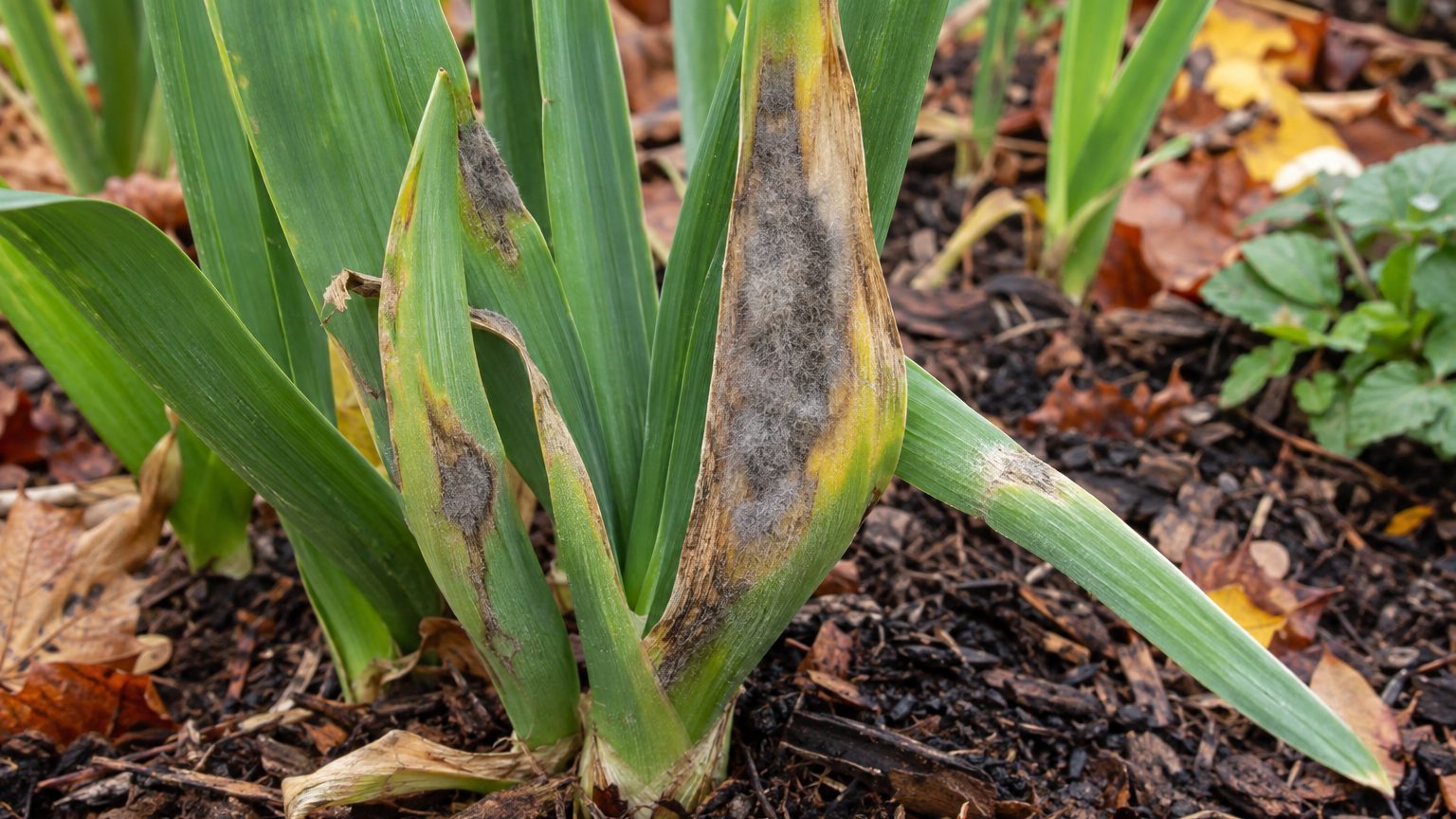
Bulbs that pull out of the soil with no resistance, their roots gone and their base wrapped in fuzzy white growth, are the classic picture of white rot in a spring bed. The disease lives in the soil, not the air, and once it settles in, it stays. Catching it early and keeping it from moving around the yard decides how much of the bed you save.
White Rot: What You See
Start at the base of the bulb, because that is where the disease announces itself, and work up to the leaves.
- Bulbs are covered in black sclerotia (tiny fungal resting bodies) about the size of poppy seeds.
- Early on, fluffy white growth wraps around the base of the bulb, and large dark brown spots can mark the bulb itself.
- Roots rot away, so the plant lifts out of the ground with almost no effort.
- The bulb scales turn semi-watery and soft, and white or pink fungal growth can show on them.
- Leaves yellow and wilt, and the decay begins at the base, with the oldest leaves collapsing first.
Any of these on a bulb you dig up means it should not go back into the ground.
From the almanac
Bulbs in your state
The dates on this page depend on where you live. Your state's page carries its frost dates, its USDA zones and the year laid out month by month.
Northeast
Southeast
- Alabama
- Arkansas
- Delaware
- Florida
- Georgia
- Kentucky
- Louisiana
- Maryland
- Mississippi
- North Carolina
- South Carolina
- Tennessee
- Virginia
- West Virginia
Midwest
Southwest
West
Pacific Northwest
Canada
White Rot or Something Else?
Bulbs have plenty of ways to rot, and several of them look alike from the garden path. Yellow leaves and a soft bulb fit more than one problem, so look at where the damage sits and what the surface looks like.
| Looks like | How to tell them apart |
|---|---|
| A gray mold disease on leaves and petals | Brown decay spreads over leaves and petals, and a brownish-gray powdery mold covers the surface. White rot starts at the base and roots instead, with fluffy white growth. |
| Nematode or bacterial rot | Discolored patches and a soft, spongy bulb decay, but no black poppy-seed sclerotia and no fluffy white collar at the base. |
Tulip and daffodil bulbs also suffer from basal rot, black slime, blue mold and crown rot (southern wilt). If the bulb shows none of the black sclerotia and no white growth at the base, one of these is the more likely cause, and your state extension office can help sort them out.
What Causes White Rot, and Where It Is Worst
A fungus called Sclerotium cepivorum causes it, a relative of the white mold fungi. It does not drift on the wind as airborne spores. It moves as threads of mycelium and as sclerotia, in soil carried on tools, boots and bulbs.
Those sclerotia can sit dormant in the soil until an allium grows nearby. The roots give off sulfur compounds, the fungus detects them, and it wakes up. That is why a bed can look healthy for seasons before trouble starts.
Moisture that suits good bulb growth suits the fungus too, so there is no dry or wet extreme to dodge. Excess nitrogen, phosphorous or organic matter in the bed also works against you. Wherever the fungus has been introduced, it is a problem.
How to Treat White Rot
Treatment is about removing what is infected and stopping the soil from traveling, because chemical controls have not been shown to work.
- Lift any plant that yellows early or wilts at the base, so that you can check the roots and bulb for black sclerotia and white growth.
- Remove and destroy infected plants, bulbs and the soil clinging to them, so that the fungus does not return to the bed or the compost pile.
- Handle remaining bulbs gently, because bruises give rot an easy way in.
- Wash tools, boots and wheelbarrow wheels after working in the affected spot, so that sclerotia are not carried to clean beds.
- Leave healthy neighbors in the ground, and let their leaves stay until they turn yellow, so that the bulbs can still feed themselves for next year.
- Ask your state extension office what, if anything, is approved locally before buying any treatment, because products and rules vary by state.
Be realistic about the timeline. The pathogen can persist in the soil for up to 40 years, so the aim is to keep it from spreading and to plant clean bulbs elsewhere or in rotated beds.
How to Prevent White Rot Coming Back
Prevention follows the gardening year, from the day you buy bulbs to the day the leaves fade.
- In early fall, buy clean, disease-free bulbs and look each one over, because planting clean stock is a key step against this disease.
- At planting time in fall, reject any bulb with white or pink fungus on it, and handle the rest carefully to avoid bruising.
- When you prepare a bed in fall, go easy on nitrogen, phosphorous and organic matter, since heavy amounts favor the fungus.
- Each year when you choose a spot, rotate the flower beds so that soil pathogens do not build up to high levels.
- In late spring, leave the foliage until it turns yellow, and watch for early yellowing or wilting at the base while you do.
Keep a note of where affected plants stood, since that is the bed to rest from bulbs the following fall.
Where This Comes From
The details here come from university extension and government plant disease pages. Before you act on a rule or a product, confirm it with your state’s cooperative extension service, since soils and approvals differ from one place to the next.
Common Questions
When Do White Rot Symptoms Usually Show Up?
Plants can be infected at any stage of growth. In California, symptoms usually appear from mid-season to harvest, so the damage often shows after the bulbs have been growing for a while.
Why Did My Tulips Not Come Up, or Come Up Yellow or Reddish?
In Texas, tulips may fail to come up, or their leaves may turn yellow or reddish, stunt and die because the bulb has rotted. Dig one up and check the base and roots, since the same symptoms can come from other bulb rots.
How Much Infested Soil Does It Take to Cause a Problem?
Very little. Only 1 sclerotium per 10 liters of soil is enough to cause disease, and 10 to 20 sclerotia will cause upwards of 90% infestation. Flowers from infected bulbs also come up deformed, and the foliage dies early.