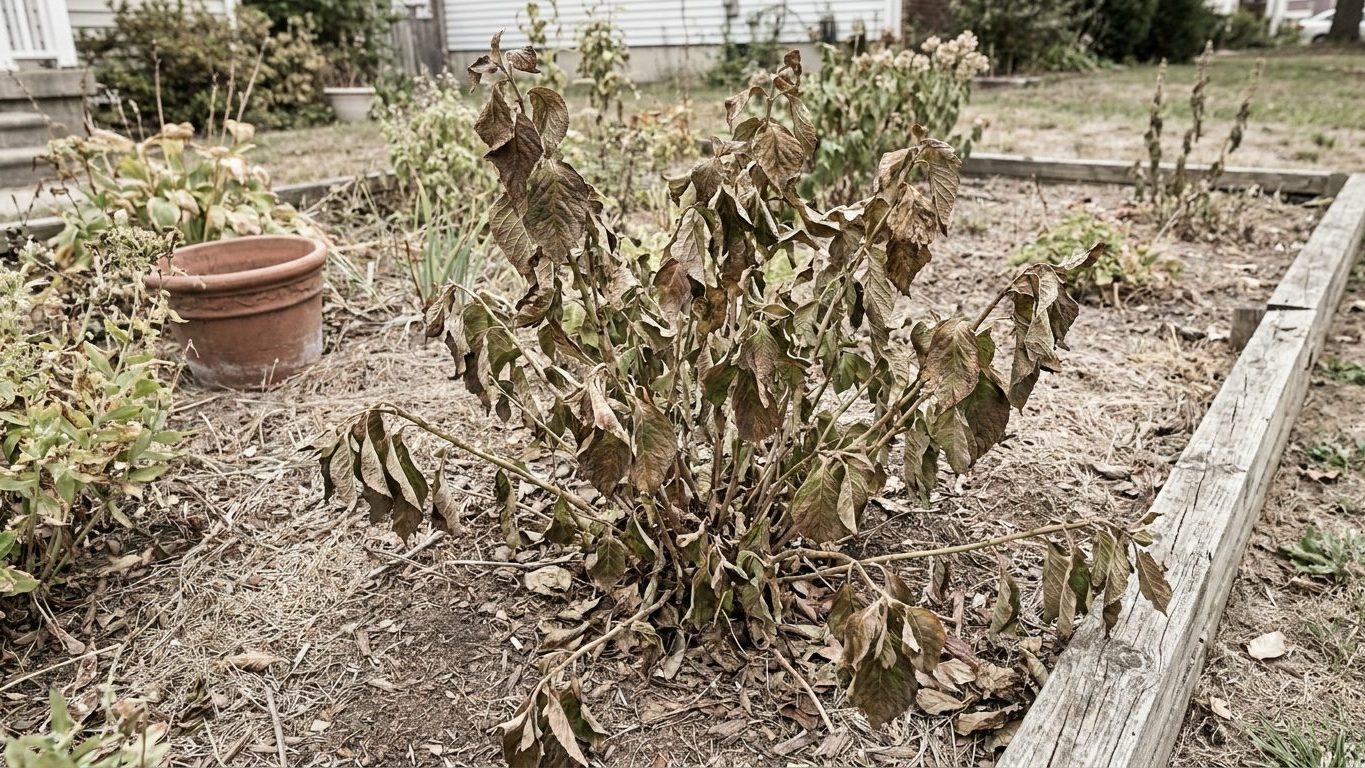
Most hydrangea complaints trace back to the same three culprits: a prune at the wrong time for that particular type, too much direct sun for a shade-loving variety, or a soil chemistry issue that shows up as a color problem instead of a feeding problem. The right fix depends entirely on which of the six hydrangea types you’re growing, not on the genus as a whole.
Hydrangea problems: The Short Answer
NC State Extension Gardener Plant Toolbox places the hydrangea genus across USDA zones 3a through 9b, but that range covers six very different plants. What decides your outcome is the type in your yard, not the genus number on the tag.
Bigleaf hydrangeas set their flower buds the previous summer, so a late frost or a spring cut removes them before they open. Panicle hydrangeas bloom on wood grown this same year, so a hard cut in late winter still leaves a full show.
Flower color follows soil chemistry only on bigleaf and mountain hydrangeas, running blue below about pH 5.5 and pink above about pH 6.5. Panicle, smooth, oakleaf and climbing hydrangeas stay white, cream or green no matter what the soil pH is.
The state selector just below this section opens the page built for your zone, your frost dates and your pruning window. Check it before you cut anything back on a bigleaf, oakleaf or mountain hydrangea.
From the almanac
Hydrangeas in your state
The dates on this page depend on where you live. Your state's page carries its frost dates, its USDA zones and the year laid out month by month.
Northeast
Southeast
- Alabama
- Arkansas
- Delaware
- Florida
- Georgia
- Kentucky
- Louisiana
- Maryland
- Mississippi
- North Carolina
- South Carolina
- Tennessee
- Virginia
- West Virginia
Midwest
Southwest
West
Pacific Northwest
Canada
Hydrangea problems, Step by Step

Work through a struggling hydrangea in the order a real diagnosis happens, starting at the stem and ending at the flower.
- Check the wood before you blame anything else: scratch a stem near the base, and if a bigleaf or oakleaf hydrangea that never bloomed still shows green underneath, the buds were most likely pruned off, since NC State Extension Gardener Plant Toolbox notes both types flower on wood formed the previous summer.
- Read where the scorch shows up: leaf browning only on the side facing afternoon sun points to too much light, since the source lists dappled sun through deep shade as the range for bigleaf and warns against afternoon exposure.
- Test the soil before treating color: on bigleaf or mountain hydrangeas, blue runs below about pH 5.5 and pink above about pH 6.5, so a soil test tells you which direction to push before adding anything.
- Rule out a phosphorus feed: a high-phosphorus fertilizer locks aluminum in the soil, and that shift alone can push a blue hydrangea toward pink even when the pH itself hasn’t changed.
- Look for the named pests before assuming disease: aphids, scales, nematodes and mites appear on the source’s list but are rarely a problem, while deer are a documented damage agent on this plant.
- Match any pruning to the type: cutting a panicle hydrangea back hard in late winter is fine because it flowers on current-season growth, but the same cut on a bigleaf removes the whole season’s flowers.
None of this replaces a soil test or your own state’s frost dates, but it separates a pruning mistake from a light problem from a feeding problem, which covers most of what goes wrong with this genus.
Hydrangea problems by Hydrangea Type
Two of the six hydrangea types carry both a hardiness range and a sun requirement, which is why they generate most of the questions about bloom failure.
NC State Extension Gardener Plant Toolbox puts bigleaf hydrangea at USDA zones 6a to 11b and panicle hydrangea at 3a to 8b, and panicle is the only one of the two that takes full sun well.
| Kind | Flowers on | USDA zones | Sun |
|---|---|---|---|
| Bigleaf | Last year’s wood | 6a-11b | Dappled to deep shade, avoid afternoon sun |
| Panicle | Current season’s growth | 3a-8b | Full sun |
Smooth hydrangea, the Annabelle type, flowers on new wood and is described as the hardiest of the genus. Oakleaf, mountain and climbing hydrangeas all flower on old wood, but the other kinds are on their own pages.
Hydrangea problems: Mistakes That Cost a Season
No blooms after a hard prune

Cutting a bigleaf, oakleaf, mountain or climbing hydrangea back in fall or early spring removes buds already formed on last year’s wood, so the plant grows all season with nothing to show. Prune only right after the flowers fade, and confirm the exact window on your state page before the shears come out.
Leaves scorched on the sunny side

Afternoon sun on a bigleaf hydrangea, which does best in dappled sun to deep shade, dries and browns the leaf edges facing that light by midsummer. Move the plant to a shadier spot or add afternoon shade rather than watering more, since scorch is a light problem, not a drought problem.
Blue flowers drifting toward pink
A high-phosphorus fertilizer locks aluminum in the soil, and that alone can push a blue bigleaf or mountain hydrangea toward pink even when nothing else in the yard has changed. Switch to a lower-phosphorus feed and test the soil before adding aluminum sulfate, since color follows available aluminum, not the fertilizer bag’s claims.
Hydrangea problems in Your State
The ranges above don’t set a pruning date or a mounding depth for your yard, since both depend on your zone and your frost dates.
- Your state page: the frost dates and the pruning window for your zone, sorted by type.
- Which types hold up here: whether bigleaf survives your winter outdoors or needs mounding for protection.
- Your local extension office: a soil test and a second opinion on a pest or disease you can’t identify.
Common questions
Why didn’t my hydrangea bloom this year?
Most likely a spring or fall prune removed buds already set on last year’s wood, if it’s a bigleaf, oakleaf, mountain or climbing type. Panicle and smooth hydrangeas flower on the current season’s growth, so a badly timed cut affects them far less.
How do I turn my hydrangea blue?
Color change only works on bigleaf and mountain hydrangeas, and it runs on soil acidity, not on coffee grounds or citrus peel, whose effect on pH is very small. Flowers run blue below about pH 5.5 and pink above about pH 6.5, and aluminum sulfate is what actually moves the needle.
Are hydrangeas toxic to pets?
Only H. macrophylla, the bigleaf hydrangea, is documented as toxic, and only if eaten in large quantities. Symptoms include nausea, stomach pain, vomiting and sweating in people, and the same risk applies to cats, dogs and horses, since the toxic compounds sit in the bark, flowers, leaves and stems.